

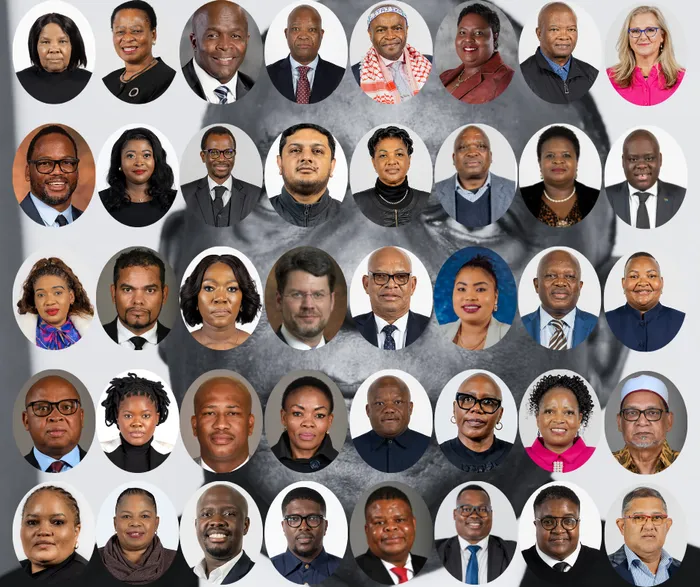
President Cyril Ramaphosa is under fire for defending his bloated Cabinet, including 42 deputy ministers despite it costing taxpayers more than R95m a year.
Image: GCIS / IOL Graphics
What can R93 million a year achieve for this country? This question arose this week following an oral question session in the National Assembly. President Cyril Ramaphosa stated that deputy ministers play a critical role in assisting ministers with their responsibilities and suggested that they should be entrusted with additional duties.
It's reported that the deputy ministers are costing taxpayers R93.2m a year in salaries.
For example, R93 million could build about 364 RDP houses in South Africa, as the government's 2023 subsidy increased to R255,364 per house, according to economic estimates.
This cost per house includes the subsidy quantum and other infrastructure expenses, like servicing the land with roads, water, and sewer systems.
Analyst, Gideon Hlamalani Chitanga, who is also a researcher at the University of Johannesburg, agrees that trimming the Cabinet size would make a lot of sense.
" Under the circumstances, with unemployment and pressure for social spending ( education, health and other social services), SA could prudently trim the government to redeploy finances in a manner that stimulates growth.
''In fact, it is the financially and economically cheapest option than borrowing,'' he said.
''Strategic trimming of the government expenditure will save a lot of money, which the government desperately needs.
''The position of the president may make political sense, rewarding allies and members of his party, and indeed opposition figures and parties in the GNU also benefit.
''I would argue that in an economy where everyone is tightening their belts, and much of the population cannot afford electricity, food, or shelter, while they pay growing taxes, the President and the government must lead by example.''
Chitanga added that there is much sense in cutting the size of both the central and provincial government, redeploying ministers more strategically and effectively, which maximises their professional and political skills.
Another political commentator, Kenneth Moeng Mokgatlhe, was equally appalled: ''It is ridiculous that we still have the largest cabinet in the world. It was enlarged by the ANC to appease the comrades who were from exile and prison.
''It became even bigger during Cyril Ramaphosa to appease all factions within the ANC to cement his stay as the leader of the party. It became worse under GNU, where smaller parties had to be given ministerial positions to ensure that the ANC remained in power by any means possible. We don't need provinces and district governments; it is a way of appeasing comrades, it is a waste of money that we don't have. We don't need deputy ministers. What is their use? ''
Corruption watchdog Organisation Undoing Tax Abuse (OUTA) and political analysts have also slammed Ramaphosa for defending his bloated Cabinet, including 42 deputy ministers, saying it’s more about political favours than good governance and comes at a high cost to taxpayers.
Despite mounting criticism over the size and cost of the Cabinet, Ramaphosa defended his appointments, saying the Constitution allows for the inclusion of deputy ministers, and that those appointed in June 2024 were adding value to the government.
The current Cabinet size has raised eyebrows, particularly after the 2024 elections, which saw the formation of a Government of National Unity (GNU) and the expansion of the executive.
The total budget allocation for new ministries and deputy ministries amounts to R239 million for the 2025 and 2026 financial year, with carry-through costs over the medium-term expenditure framework.
Including perks such as support staff, vehicles, security, and office costs, the overall expenditure is significantly higher.
Deputy ministers earn R2.22 million annually, with the total salary bill for all 42 amounting to R93.2 million per year.
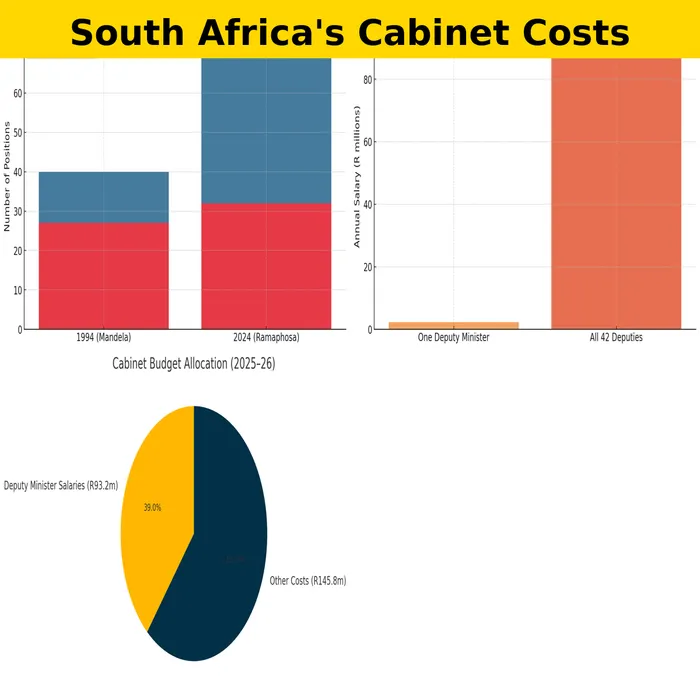
Deputy ministers earn R2.22 million annually, with the total salary bill for all 42 amounting to R93.2 million per year.
Image: IOL Graphics
Ramaphosa argued that the GNU necessitated the current Cabinet structure. The ANC is leading the GNU after it failed to get more votes during the May 2024 general elections.
“It was not possible to reduce the number of ministries when I announced the Cabinet, as we needed to ensure inclusivity among GNU partners,” he said.
“You may recall that from the start, I expressed a desire for a smaller executive. That remains my wish, but we had to accommodate various parties in the GNU who requested a broader executive.”
Despite his defence, critics say the justification falls flat.
Another political analyst, Anda Mbikwana, sharply criticised the size of the Cabinet: ''President Cyril Ramaphosa's defence of his expanded deputy minister appointments has exposed the yawning chasm between political rhetoric and South African realities.
''While the president wraps himself in constitutional legitimacy to justify the R93.2 million annual cost of these positions, this expenditure reveals a government more invested in internal horse-trading than addressing the crises devastating ordinary citizens. ''
Mbikwana added that the money should be channelled for better use elsewhere. ''The numbers tell a damning story: this amount could fund 3,100 teaching positions, provide skills training for 23,000 young people, or establish 930 nursing posts. Instead, it underwrites what critics rightly identify as political sinecures — positions created not to enhance governance but to reward loyalty and maintain coalition stability in a fractured ruling party.''
CEO of OUTA, Wayne Duvenage, told IOL News Ramaphosa’s justification for a bloated executive was disingenuous and motivated by political convenience rather than public interest.
He criticised the government for using ministries and deputy minister roles as rewards for political loyalty, saying many are ineffective and redundant.
He told IOL News: “Some departments, such as Police and Water and Sanitation, have more than one deputy minister, which makes no sense from a governance perspective.”
Duvenage added that scrapping the positions could offer both symbolic and fiscal relief.
Political analyst Solly Rashilo echoed OUTA’s concerns, supported ActionSA’s private members’ bill, which aims to scrap deputy minister roles entirely.
He estimated the total savings from eliminating deputy ministers, including perks, could range between R200 million and R300 million annually.
ActionSA’s parliamentary leader and MP, Athol Trollip, questioned whether the president and ANC would support his bill to remove deputy minister positions and redirect the funds to essential services.
Ramaphosa responded by saying he would review the bill before offering support.
OUTA confirmed it had formally submitted support for the bill.
“We believe it’s a credible and necessary step. South Africa’s executive is now one of the largest in the world - not just because of the 42 deputy ministers, but also due to the 32 ministries currently in place,” Duvenage said.
He drew comparisons to former President Nelson Mandela’s first democratic Cabinet in 1994, which had only 27 ministries and 13 deputy ministers.
Duvenage said the recent cabinet reshuffles illustrate the problem.
“The splitting of Higher Education, Science and Innovation into two separate ministries appears to have been done to keep Blade Nzimande in Cabinet, even though the split was unnecessary.
He said new ministries are being created not out of necessity but to protect underperforming ministers.
Additional Reporting by Simon Majadibodu
IOL Politics