

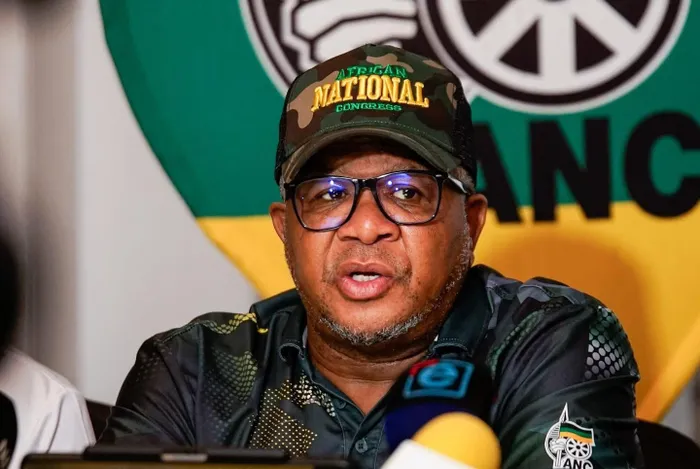
ANC secretary-general Fikile Mbalula addresses recent political developments within the party.
Image: Facebook/MyANC
The recent political developments in South Africa reveal a sobering truth: the Government of National Unity (GNU), once hailed as a beacon of collaboration and renewal, has been reduced to a game of thrones—a scramble for power, prestige, and political survival. What was meant to be a platform to represent the will of the people has instead become a backroom arrangement that prioritizes political convenience over principle.
Let’s be clear: the concept of a GNU is not inherently flawed. In fractured political landscapes, coalitions can offer a path to stability and inclusivity. But what we have seen unfold in South Africa is not a genuine unity of vision or purpose. It is a desperate marriage of political actors more interested in preserving their relevance than delivering meaningful change. The electorate spoke clearly in the 2024 general election. No single party emerged with an outright majority. This was not a mandate for behind-the-scenes deals—it was a plea for accountability, transparency, and realignment. It was the people's rejection of the status quo. The voters demanded change. Instead, they got compromise—at the top, and at their expense.
The ANC, long the dominant force in South African politics, has emerged from the election bruised and bloodied. Its loss of majority was more than a numerical shift — it was symbolic of deep public discontent. Corruption, mismanagement, unemployment, and deteriorating public services have eroded its credibility. Yet, rather than stepping back to reflect, the ANC has treated the GNU as a lifeline—a way to cling to power under the illusion of cooperation. But they are not alone in this opportunism. Other parties, too, have jumped at the chance to gain seats at the table. The DA, which has spent years positioning itself as an alternative to ANC rule, now finds itself entangled in alliances that blur ideological lines. Smaller parties, previously vocal critics of the government, are now part of the very machinery they condemned. The question must be asked: if everyone is in government, who is left to hold it accountable?
South Africa does not suffer from a lack of ideas or policy documents. What it suffers from is a lack of political will and moral leadership. The GNU, as it currently stands, is not a vehicle for transformative governance but a coalition of convenience—a power-sharing pact designed to keep established players in control while keeping true reformers at bay. Worse still, the language of the GNU has become a smokescreen. Words like "unity," "cooperation," and "nation-building" are thrown around as though simply saying them will make them true. But unity without purpose is meaningless. Cooperation without accountability is dangerous. And nation-building cannot happen while ignoring the voices and suffering of the people. There are deep contradictions within the GNU setup. Parties with fundamentally different visions for the country are now expected to co-govern harmoniously. How can a coalition that includes both economic liberals and radical redistributors function without paralysis? How will decisions be made, and more importantly, who will take responsibility when things go wrong? The public deserves clarity, not choreography. Already, we see signs of dysfunction. Policy standoffs, turf wars, and disagreements over key appointments are beginning to surface. Instead of charting a bold new course, the GNU is caught in the old trap of patronage and political jockeying. It is less about service delivery and more about seat allocation. Ministries have become bargaining chips; leadership positions, prizes in a political lottery. This is not what democracy looks like.
Democracy is not just about voting every five years—it is about meaningful representation, responsiveness, and trust between leaders and the people they represent. The GNU, in its current form, undermines that trust. It sends a message to citizens that their votes are negotiable, their demands expendable, and their futures a secondary concern. South Africans are not apathetic. They are angry, disillusioned, and tired. Tired of promises. Tired of recycled ministers and recycled failures. Tired of watching politics turn into theatre while communities crumble. The GNU was an opportunity to reset—to do politics differently. Instead, it has become more of the same, just under a new banner. There is still time to course-correct. But that would require courage—real courage. It would mean putting egos aside, rejecting the culture of entitlement, and genuinely placing the people's interests at the centre of governance. It would require transparency in how decisions are made, who benefits, and what the long-term plan is. It would mean building a coalition not just of parties, but of values. Until then, let us not be fooled by the optics. The GNU, for now, is not a reflection of unity—it is a reflection of desperation. And unless it begins to serve the people, rather than the parties, it risks becoming yet another failed experiment in South Africa’s long struggle for a just and accountable democracy.
* Mayalo is an independent writer and the views expressed here are not necessarily those of IOL and Independent Media