

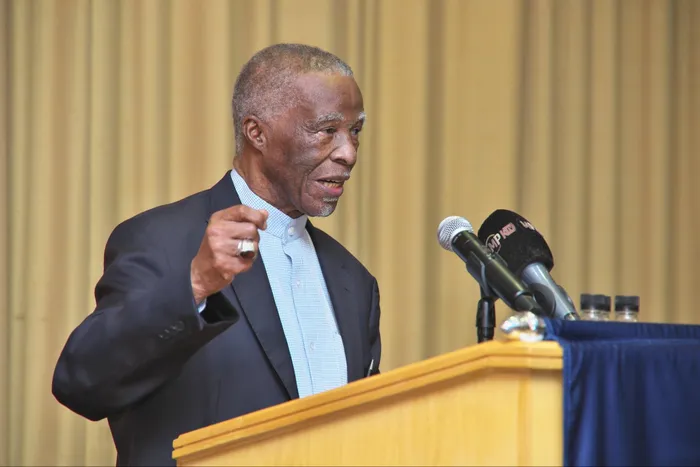
Former President Thabo Mbeki, Chancellor of the University of South Africa.
Image: X
By Nkazimulo Qaaim Moyeni
The Unisa Chancellor’s Calabash Awards occupy a distinctive position within South Africa’s higher education and public governance landscape. They integrate cultural symbolism, intellectual recognition, and civic responsibility into a single institutional practice. To describe them merely as awards is insufficient; they function as an academic and societal mechanism for acknowledging individuals whose contributions have advanced national discourse, democratic development, and collective well being.
Established in 2007 to “recognise excellence and exemplary achievements,” the Awards have evolved into one of Unisa’s most significant institutional instruments. The profiles of their recipients, spanning public service, scholarship, activism, and cultural production, demonstrate the Awards’ capacity to capture a broad spectrum of intellectual and societal achievement. Understanding why the Calabash Awards constitute an “incredible deal” requires examining their symbolic framework, institutional utility, and the calibre of their honourees.
The Calabash as an Epistemic and Cultural Symbol
The calabash carries deep historical and cultural resonance across African societies. As Chancellor Dr Thabo Mbeki frequently observes, it symbolises generativity, sustenance, and communal continuity. Within the Awards, the calabash is not a superficial emblem but an interpretive device through which the university articulates the relational and community oriented nature of intellectual and civic achievement.
In a period when higher education is often evaluated through utilitarian metrics such as labour market outcomes, tuition costs, and credentialing, the Calabash Awards reintroduce an epistemic orientation rooted in humanistic and civic values. They foreground ideals of ethical leadership, public scholarship, and social accountability, thereby reinforcing the broader mission of the university.
Recipients as Exemplars of Intellectual and Civic Contribution
The distinguished individuals recognised through the Calabash Awards illustrate the Awards’ alignment with national priorities and academic values. Among them:
Gill Marcus, former Governor of the South African Reserve Bank, honoured as an Outstanding Alumnus for her principled stewardship during complex macroeconomic conditions.
Dr Frene Ginwala, foundational Speaker of South Africa’s democratic Parliament, recognised for her contributions to constitutionalism, democratic institutionalisation, and the advancement of gender equity.
Sally Motlana, prominent anti apartheid leader and community organiser, awarded the Robben Island Award for her lifelong contribution to social justice and community mobilisation.
Naledi Pandor, acknowledged through the Outstanding Educator Award for her sustained leadership in education policy, scientific advancement, and international cooperation.
Justice Albie Sachs, Constitutional Court jurist and veteran of the liberation struggle, recipient of the 2024 Liberation Struggle Hero Award, symbolising the convergence of legal thought, ethical commitment, and historical sacrifice.
Ruth First, journalist, scholar, and anti apartheid intellectual, honoured posthumously for her analytical contributions and political courage, with her daughter Shawn Slovo accepting the award.
Professor Salim Abdool Karim, globally recognised epidemiologist, recipient of the Public Servant Award for his evidence based leadership in public health and scientific governance.
Deshnee Achary, recognised as Outstanding Alumna for her work in global vaccine access and pharmaceutical equity.
Yvonne “Chaka Chaka” Mhinga, artist, activist, and humanitarian, honoured for her role in global health advocacy and transnational development partnerships.
Peter Paul Ngwenya, former political prisoner and later business leader, awarded the Robben Island Alumnus Award for embodying resilience, leadership, and post apartheid economic engagement.
Sam Nujoma, founding President of Namibia and key figure in regional liberation movements, honoured posthumously with the Liberation Struggle Hero Award.
Collectively, these individuals represent a synthesis of intellectual rigour, public responsibility, and historical agency.
How Recipients Enhance the Awards’ Intellectual and Institutional Value
By honouring individuals whose work has shaped South Africa’s political, cultural, scientific, and intellectual landscape, the Calabash Awards function as a moral and epistemic compass. They reinforce the principle that meaningful achievement is defined not by status acquisition but by sustained contribution to democratic governance, knowledge production, equity, and social transformation. The Awards thus operate as a pedagogical archive: a curated record of exemplary individuals whose lives and work provide a framework for understanding responsible engagement in public life.
A Strategic Institutional Instrument
From an institutional standpoint, the Calabash Awards operate as a strategic mechanism through which Unisa strengthens alumni relations, enhances public credibility, cultivates philanthropic partnerships, expands cross sectoral engagement, and demonstrates its long term contributions to national development. Their integration with initiatives such as student support and community programmes amplifies their systemic value. The Awards generate substantial intellectual and reputational impact relative to their material cost, making them an efficient and high yield institutional practice.
The Awards as Instruments of Narrative Construction
Beyond their ceremonial and institutional functions, the Calabash Awards play a critical role in shaping Unisa’s narrative identity. In contemporary higher education, universities are increasingly required to articulate coherent stories about their historical origins, social commitments, and intellectual trajectories. The Calabash Awards contribute to this narrative construction by foregrounding individuals whose achievements reflect the university’s stated values. Through the public recognition of figures associated with democratic resilience, scientific advancement, and cultural production, Unisa positions itself as an institution aligned with societal transformation rather than merely academic certification. In this sense, the Awards function as discursive tools that embed the university within national and global conversations about equity, knowledge production, and the civic purposes of higher education.
The Politics of Recognition
The Calabash Awards also invite analysis through the politics of recognition, a framework advanced by theorists such as Charles Taylor and Axel Honneth. This perspective argues that justice encompasses not only material conditions but also the affirmation of identity, dignity, and contribution. By recognising individuals whose work has shaped South Africa’s democratic and intellectual landscape, Unisa participates in broader debates over whose knowledge, labour, and histories receive public validation. Such recognition has both symbolic and structural implications: it corrects historical patterns of exclusion, legitimises diverse forms of intellectual and civic labour, and contributes to the reconstruction of collective memory in a post apartheid society. Consequently, the Awards function as interventions in the ongoing project of defining whose achievements constitute the moral and intellectual foundation of the nation.
An Intellectual and Civic Asset of Exceptional Value
When one considers the symbolic depth of the calabash, the calibre of honourees, the strategic institutional roles of the Awards, and their alignment with global academic traditions, it becomes clear that the Unisa Chancellor’s Calabash Awards exceed the boundaries of symbolic ritual. They constitute an intellectual and civic institution in their own right. For recipients, they provide distinguished acknowledgement. For Unisa, they reinforce identity, mission, and scholarly legitimacy. For society, they affirm the foundational values required to sustain democratic life and public scholarship. In every substantive respect, the Calabash Awards represent an exceptional institutional achievement whose cultural, intellectual, and societal significance far surpasses their ceremonial form.
*Nkazimulo Qaaim Moyeni is an attorney. He holds an LLB from Wits and LLM from Unisa. He specialises in Nuclear Law and is editor of the South African Daily.