

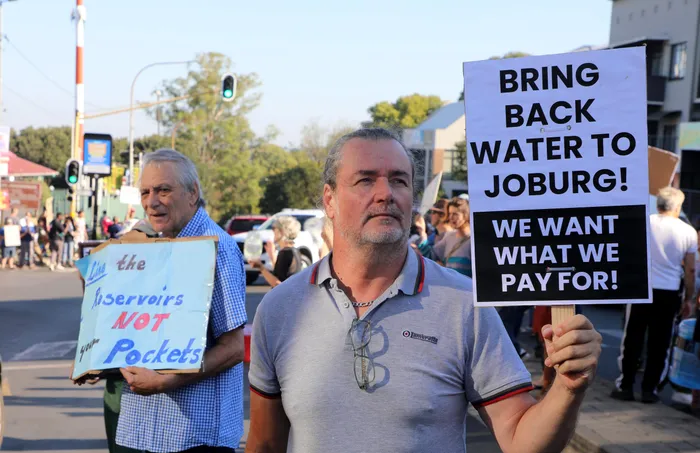
Joburg residents took to the streets last week to protest over continued water challenges.
Image: Timothy Bernard/Independent Newspapers
President Cyril Ramaphosa has been urged to declare the water crisis in Johannesburg a national emergency and form an inquiry commission to look into the systemic breakdown of the water and sanitation infrastructure.
The Johannesburg water crisis should be deemed a national disaster, according to the People's Water Forum, a community-led group of activists, locals, and water specialists. They contend that this action is necessary to allow for immediate funding release and urgent intervention.
The forum includes civil society groups such as WaterCAN, the Ahmed Kathrada Foundation, Joburg Crisis Alliance, Water Crisis Committee, Legal Resources Centre, Organisation Undoing Tax Abuse, the SA Council of Churches in Gauteng, the Foundation for Human Rights, JoburgCAN, Defend Our Democracy, and the SA Federation of Trade Unions, among others.
Its letter to Ramaphosa has been endorsed by nearly 160 community organisations and more than 3,220 individuals.
They want the president to also appoint an independent, technically competent intervention team with clear powers and timelines.
“There are too many role players currently working out of sync to address the crisis,” the organisations complained.
In addition, they propose a commission of inquiry made up of all sectors of society – including civil society – to investigate the systemic collapse of water and sanitation provision in the City of Joburg. They have suggested that such a commission of inquiry should be time-bound, focused on solutions, but must not delay repairs and maintenance.
“As such, this must be a parallel process. Water is a constitutional right. The continued failure to secure reliable access undermines public trust and erodes confidence in government at all levels. Without urgent intervention, the crisis will worsen, with severe consequences for health, safety, and economic recovery,” reads the letter sent last week.
On Wednesday, People’s Water Forum Chairperson Dr Ferrial Adam said civil society has grown its knowledge, built its own kind of information, and that having a national disaster will help some small municipalities in the middle of nowhere to understand that organisations are not just doing this to fight, but that these are also health issues.
“If people drink bad water, there are health issues, young girls cannot attend school as 25% of our schools lack running water or proper toilets,” she said.
Adam said some of the challenges they face are non-responsiveness by municipalities.
“It’s been very difficult. In other parts of the country where we test water and prove that there are bacteria in that drinking water, municipalities will not engage us. So it’s not been an easy ride for the government to listen. They dismiss us, stating that we do not know what we are talking about, and that we don’t have a laboratory. So they dismiss us at every avenue,” she added.
According to Adam, their work is not about attacking a municipality.
“We want to work with them to solve the issues, and that’s the understanding that because they are defensive, they close doors, and if they are just more open, more transparent, and in terms of all the tenders that are lining up because of water issues, be transparent, open those doors, let us see what is going on.
“It’s because of the transparency (that) we can say that, excuse me, this person had a Hammanskraal tender, or this person messed up in the Free State,” she further stated.
The DA is also heading to the High Court to compel Johannesburg Water to fix and maintain its infrastructure.
“This court case relies on first-hand accounts from residents and businesses who are affected.
“These accounts are needed to show the real impact of the ongoing water failures,” the party said, calling on those affected to share their experiences so that they can be formally documented and used to support the case.