

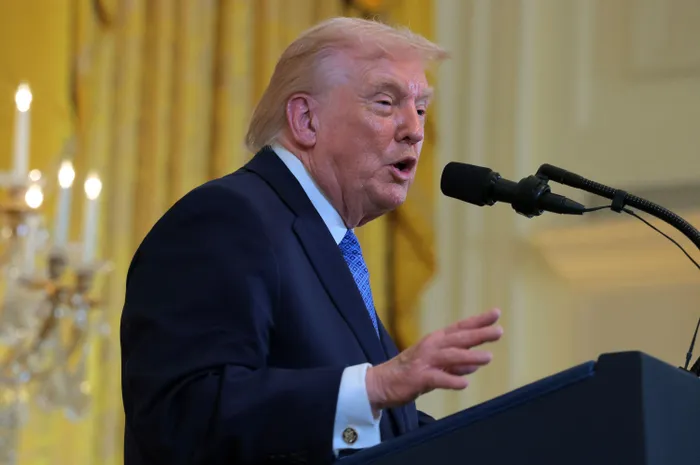
Donald Trump said the updated restrictions follow extensive interagency reviews and continued engagement with foreign governments that, in many cases, failed to address long-standing deficiencies.
Image: Anna Moneymaker / Getty Images via AFP
US President Donald Trump has issued a sweeping new proclamation expanding and tightening restrictions on the entry of foreign nationals from dozens of countries, arguing that persistent failures in screening, vetting and information-sharing pose unacceptable risks to national security and public safety.
The proclamation, signed on Tuesday and set to take effect on January 1, 2026, builds on earlier measures taken during Trump’s first term and reinstated early in his second administration through Executive Order 14161 and Proclamation 10949.
Trump said the updated restrictions follow extensive interagency reviews and continued engagement with foreign governments that, in many cases, failed to address long-standing deficiencies.
“It is the policy of the United States to protect its citizens from terrorist attacks and other national security and public safety threats,” Trump said, adding that the government must exercise “extreme vigilance” in visa issuance and immigration processes.
Under the new proclamation, the United States will continue to fully suspend the entry of immigrants and nonimmigrants from 12 countries previously identified as posing significant risks: Afghanistan, Burma, Chad, the Republic of the Congo, Equatorial Guinea, Eritrea, Haiti, Iran, Libya, Somalia, Sudan and Yemen.
Nationals of four countries, Burundi, Cuba, Togo and Venezuela, will remain subject to partial entry suspensions.
In addition, Trump ordered full entry suspensions for nationals of seven new countries: Burkina Faso, Laos, Mali, Niger, Sierra Leone, South Sudan and Syria.
The proclamation also fully suspends entry for individuals seeking to travel on documents issued or endorsed by the Palestinian Authority, citing the active presence of US-designated terrorist groups and compromised vetting capabilities in the West Bank and Gaza Strip.
The administration also imposed partial suspensions on nationals of 15 additional countries, including Nigeria, Senegal, Tanzania, Zambia and Zimbabwe, as well as several Caribbean and African states with citizenship-by-investment programmes or high visa overstay rates.
In most of these cases, immigrant visas and common non-immigrant categories such as tourist, business, student and exchange visas will be suspended, while other visa types will face reduced validity periods.
According to the proclamation, the determinations were based on a range of factors, including unreliable civil documentation, inaccessible or inaccurate criminal records, widespread corruption, terrorist activity, high visa overstay rates and the refusal by some governments to accept the return of their nationals ordered removed from the United States.
Trump cited examples of countries where births are not reliably recorded, civil documents can be easily purchased fraudulently, or criminal records are handwritten and vulnerable to alteration. In other cases, only portions of national territory are under effective government control, limiting authorities’ ability to monitor or verify the identities of citizens and residents.
The proclamation also highlights concerns around citizenship-by-investment programmes that allow foreign nationals to obtain passports without residency, potentially enabling individuals from restricted countries to evade US travel limits by acquiring a second nationality.
While the restrictions are broad, they include a number of exceptions.
Lawful permanent residents of the United States, dual nationals travelling on passports from non-designated countries, diplomats, NATO personnel, and athletes participating in major international sporting events are exempt. This will be a huge relief particularly as the US is co-hosting the 2026 FIFA World Cup in June.
Special immigrant visas for certain US government employees and immigrant visas for persecuted ethnic and religious minorities from Iran will also continue.
Case-by-case national interest waivers may be granted by the Secretaries of State or Homeland Security, or by the Attorney General, particularly where travel is deemed critical to US interests, including participation in criminal proceedings.
The administration said family-based immigrant visas will no longer receive broad categorical exemptions for affected countries, arguing that family ties have previously been exploited for fraud, criminal activity and, in some cases, terrorist financing.
Trump directed the State Department, in coordination with the Departments of Justice and Homeland Security and the intelligence community, to review the restrictions every 180 days.
Officials are also tasked with continuing diplomatic engagement with affected countries to encourage improvements in identity management, information-sharing and compliance with US immigration laws.
The proclamation states that visas issued before its effective date will not be revoked and that asylum seekers and refugees already admitted to the United States will not be affected.
Trump said the measures are necessary to enforce immigration law, reduce visa overstays and pressure foreign governments to address systemic weaknesses.
“Without the restrictions and limitations imposed in this proclamation, the entry or admission of such foreign nationals is detrimental to the national interest,” he said.
BUSINESS REPORT