

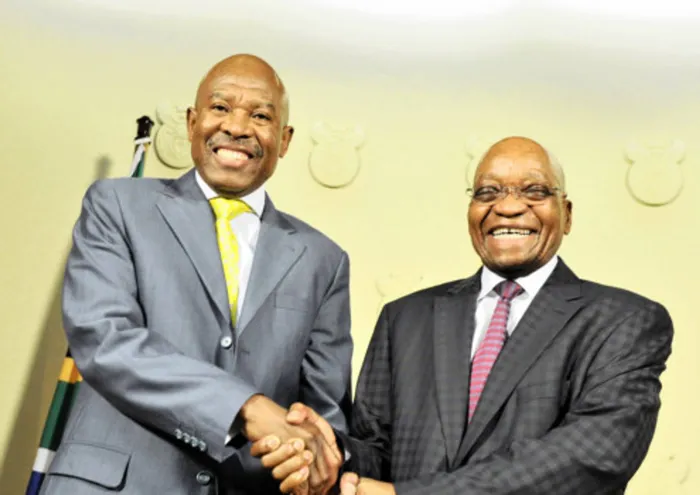
(in the Pic - President Zuma congratulates the new Governor Lesetja Kganyago). President Jacob Zuma appoints Mr Lesetja Kganyago as South African Reserve Bank Governor, Union Buildings, Pretoria, Gauteng Province. 06/10/2014, Elmond Jiyane, GCIS (in the Pic - President Zuma congratulates the new Governor Lesetja Kganyago). President Jacob Zuma appoints Mr Lesetja Kganyago as South African Reserve Bank Governor, Union Buildings, Pretoria, Gauteng Province. 06/10/2014, Elmond Jiyane, GCIS
AMERICA’S founding president, George Washington, in the estimation of many historians, was one of the best because he hated patronage, favouritism and nepotism and knew precisely what his public reputation was and how essential he was to the success of his government. He was worried about appointments that were “honourary and lucrative”.
The “eyes of Argus are upon me”, he wrote, alluding to the mythological Greek giant with 100 eyes. “I alone am responsible for a proper nomination,” he wrote about his dislike of the politics of patronage.
You may ask what a president who lived more than 200 years ago had relevance to modern day politics. President Washington would have been proud of President Jacob Zuma’s appointment of Lesetja Kganyago as governor of the South African Reserve Bank.
You see, President Washington had set up strict guidelines for himself, underscoring his intention to act only with regard to the “public good”, refusing any consideration of “blood or friendship”.
By appointing Kganyago, President Zuma took the public good into consideration. We thank him for that.
According to American historian Susan Dunn, President Washington wanted his appointees to be educated men who were respected in their communities and who were also supporters of the constitution.
Dunn wrote that if his administration was not yet a meritocracy, it was not, in Washington’s mind, filled with political appointees. On the contrary, he often repeated that his aim as president was to “overlook all personal, local and partial considerations”.
How we can all benefit from Washington’s unimpeachable integrity? Imagine if all city managers, let me say all public and civic officials, were of Kganyago’s calibre, quality and credibility. His appointment underscores the importance of succession planning and meritocracy and rejection of “honorary and lucrative” appointments.
The ease and applause of the transition from Gill Marcus to Kganyago confirms the importance of effective succession planning programme and meritocratic appointments across all public and civic portfolios.
Kganyago joined the Treasury in 1996, worked under then Director General Maria Ramos and moved to the bank to become Marcus’s understudy.
This confirms that employees at many levels today need specialised skills and succession planning and meritocraticism should apply to all civil service positions.
Companies, organisations and all government departments need both effective succession planning programmes to succeed in this competitive world and avoid upheavals in the event of the departure of a key member of the team.
Proper succession planning means being ready to handle the eventualities of senior management retiring, getting fired, resigning, being poached, walking under that proverbial bus or simply due to a reshuffle to increase efficiency.
Kganyago’s rise during the past 18 years is confirmed by views from succession planning guru William Rothwell, who says some of the steps to be taken for effective succession planning, include, defining the position, building the skills through skills development programmes and mentoring; managing the impact and identifying the qualities of the candidates who have technical skills, knowledge and experience.
Rothwell says a whole range of leadership skills must be taken into account including personality, temperament, empathy, charisma, decision-making ability and judgement.
Author of Effective Succession Planning, Rockwell says some of the succession planning guidelines include, identifying future leaders and matching skills to organisation needs; staying flexible in identifying potential successors; mentoring direct reports to identify key strengths and areas for improvement; and incorporating succession planning into performance appraisals.
For President Washington, it was an unpleasant, onerous task. Historians such as Dunn record how office seekers were always knocking on his door. His deputy, Thomas Jefferson had to advise people not to importune the president: “To overdo a thing with him is to undo it.”
When his nephew Bushrod Washington asked his uncle for the position of US district attorney for Virginia, Washington tactfully declined, explaining that the young man had neither the experience nor the standing “of some of the oldest and most esteemed general court lawyers in your own state, who are desirous of this appointment”.
Even the opposition praised Washington’s unimpeachable integrity. “The President,” wrote James Madison, fourth president of the US, “was the last man in the world to whom any measure whatever of a deceptive tendency could be credibly attributed.”
The gift that Washington offered to Americans was the gift of character to all of us.
The first US president teaches us today that any appointment of friends of the party, hangers-on and lackeys to civil service positions and government jobs is a disgrace, as it does the country a disservice and maintains bad decision making and inefficiencies.
Our government must prioritise succession planning and introduce and implement an uncompromising meritocracy culture into the bureaucracy which calls for rescreening of appointments based on meritocracy and technocracy rather than based on canine loyalty, political patronage, political debt payback, college fraternities, girl school classmates, provincial mates, and election camp followers.
Having briefly interacted with Kganyago while he was a young activist and while he was Deputy Director General at the Treasury, I know him to be a man of political experience, tireless worker, keen intellect, and sharp job focus.
He must be granted the support and opportunity to pursue his legitimate mandate.
Let us not kid ourselves, under certain complex conditions, political appointments that take into account political affiliation may be necessary. After all, the phenomenon of cronyism has become a familiar part of the political process over decades, with each successive government marking its accession to power – and encouraging future loyalty – by appointing faithful and or generous supporters to positions in governmental departments and, semi-governmental organisations.
We will never see the end of political patronage because political parties, which can put an end to it, are its main practitioners, despite their hypocritical calls for meritocracy. Doing favours is the way a party can hold on to its members and attract new ones.
It is a pity that many of the political appointees owe their positions solely to camaraderie and to secure political turf, at the expense of quality and national interest.
The focus should be on bringing the quality of civil servants up to mark, rather than quick-fix political solutions. A civil servant’s strength lies in the fact that he or she represents the citizenry and not a particular political party or group.
Indeed, how does one justify political patronage when it results in the political doping of the public service and undermines the national interest? How can one believe in political appointments when they cause economic stagnation because they scupper professionalism and meritocracy?
Political patronage leads to exclusion and alienation. No civil service appointments should be used as a reward for party loyalty. Jobs serving the nation instead of the party should be based on meritocracy, open to those with suitable qualifications and appropriate experience such as Kganyago.
It is essential that candidates of appropriate stature both in terms of business acumen and personal integrity are appointed to civil service positions. A well-defined selection process should be an intrinsic element of this process.
If our government wishes to combat growing public alienation and break with old and discredited political practices, it should fill all civil service appointments on the basis of merit reinforced by transparent recruitment criteria.
Let Kganyago’s appointment be an example to all future appointments.
Rich Mkhondo runs The Media and Writers Firm (www.mediaandwritersfirm.com), a content development and reputation management agency.