

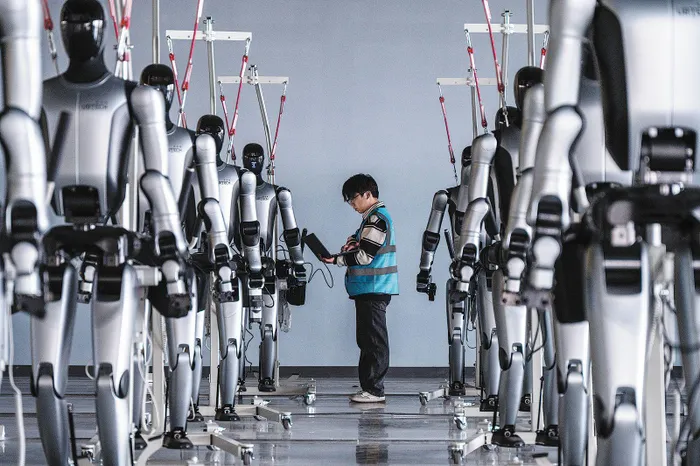
A technician checks humanoid robots at a technology centre in Zigong, Sichuan province.
Image: HE HAIYANG / FOR CHINA DAILY
China’s commitment to high-quality development and its emphasis on dialogue and long-term planning underscore its role as a key contributor to world stability and development, experts said, while highlighting the global relevance of the two sessions, the annual meetings of China’s top legislative and political advisory bodies.
The central focus of this year’s meetings, which concluded on March 12, is the adoption of China’s 15th Five-Year Plan (2026-30), a crucial blueprint that will steer the nation’s modernisation drive in the coming years.
According to the Government Work Report delivered on March 5 during the opening meeting of the fourth session of the 14th National People’s Congress, China’s top legislature, the country will continue its investment momentum in research and development spending and make pursuing high-quality development a major strategic task in the 15th Five-Year Plan period.
Luigi Gambardella, president of ChinaEU, a Brussels-based nonprofit international association that promotes Sino-European business co-operation in the digital sector, said the work report sends a clear signal that China is accelerating its transition towards a new industrial paradigm driven by technology, innovation and advanced manufacturing.
The scale of China’s commitment to R&D is particularly striking, with expenditure in the area expected to grow more than 7 per cent annually, Gambardella said.
“Combined with continued leadership in manufacturing and strong investment in digital industries, this strategy is positioning China at the centre of the next wave of technological transformation,” he added.
Gambardella emphasised that the future of industry will be increasingly shaped by ecosystems that integrate artificial intelligence, advanced manufacturing, connectivity and innovation.
“For Europe and the global economy, this is an important reminder,” he said. “International co-operation will be essential to ensure that such transformation remains open, balanced and beneficial for global development.”
The Government Work Report highlights China’s commitment to expanding high-standard opening-up alongside domestic economic development. This includes measures to keep the volume of foreign trade stable and refine its mix, expand two-way investment co-operation, and promote high-quality Belt and Road co-operation by strengthening strategic alignment with partner countries.
Adhere Cavince, an international relations scholar specialising in China-Africa co-operation, said that the work report offers a critical operational framework that aligns China’s 15th Five-Year Plan with external development goals.
The report outlines a road map for high-quality development and technological innovation that directly influences the scale and focus of China-Africa co-operation, providing a predictable framework for African governments, Cavince said, adding that China’s five-year plans are not merely abstract documents as they guide actual spending and overseas engagement.
It “also emphasises aligning the Belt and Road Initiative with the African Union’s Agenda 2063, ensuring that development strategies are mutually reinforcing”, he noted.
“The key areas that will define China-Africa strategic co-operation include balanced trade and market access,” Cavince said, referring to China’s plan to implement zero-tariff treatment for imports from 53 African countries starting on May 1.
Onyango K’Onyango, a communications consultant based in Nairobi, Kenya, said that as China is one of the world’s largest economies and a major participant in global trade and diplomacy, the significance of the two sessions extends beyond its borders.
China’s policy direction inevitably influences international economic patterns and development trends, he noted.
In a world that is fragmented and uncertain, “China’s emphasis on structured dialogue, long-term planning and steady reform provides an alternative approach to navigating global challenges”, K’Onyango said.
China’s policy orientations will affect not only China’s future but also the broader international landscape, he said.
“At a time when many nations are grappling with instability and competing pressures, the ability to maintain focus on development, innovation and social progress may prove increasingly valuable for global stability,” K’Onyango added.