

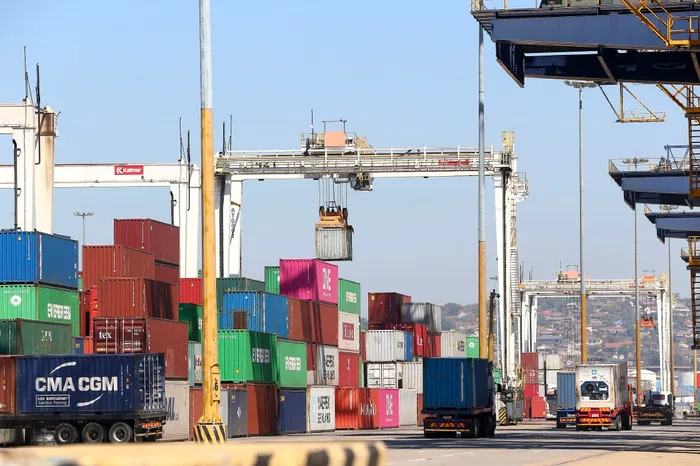
Black Friday shipments to the US came in 46% below the monthly average, and down 66% year-on-year.
Image: Leon Lestrade | African News Agency
Although all eyes are now on a ruling in which the US Supreme Court heard arguments over whether to overturn US President Donald Trump’s sweeping tariffs, SMEs have already felt severe pain.
US media indicate that judges are now debating their decision, having wrapped up arguments last Monday.
This will likely be scant relief for small- and medium-sized enterprises (SMEs) in South Africa, given that they lost two-thirds of Black Friday demand as US tariffs hit hard, a new report shows.
Over the past few weeks, several major companies – including Costco, Revlon, Bumble Bee Foods, and the producer of Ray-Ban – have joined small businesses in petitioning the US Court of International Trade to secure refunds if the Supreme Court overturns Trump’s tariffs.
However, website Politico reported that companies may be hesitant to fully rely on the Trump administration to manage the refund process in good faith without judicial oversight.
In addition, the website Market Realist stated that getting Trump’s tariff refunds will be chaotic for companies, even if the court rules in their favour.
Analysts say that even if the Supreme Court sides with businesses on tariffs, obtaining refunds may still be disorderly, it said.
Craig Lowman, CEO and co-founder of South African international shipping platform TUNL, said that “in a normal year, Black Friday is a clear peak”.
Traditionally, October, November and December are peak months for small exporters as Americans shop for Thanksgiving, Black Friday and the festive season.
However, US shoppers are now cognisant of the knock-on effect of tariffs on goods from South Africa.
When comparing the US-bound gross monthly volume of shipments for Black Friday, which was around 60% above average monthly shipments, to this year, there was a clear loss in exports.
This year, after the new US tariffs and the loss of the $800 de minimis threshold, Black Friday came in 46% below the monthly average, and down 66% year-on-year, data from the SME Index showed.
As of August 29, Trump revoked this threshold concession. As a result, every parcel, no matter how small, now attracts duties and entry fees. This is a heavy blow for SMEs selling items like single handbags, skincare kits and cases of wine directly to consumers.
Lowman described the impact as “catastrophic” because, instead of a strong seasonal peak, local businesses that rely on US sales have lost a key contribution to their annual turnover.
“While most of South Africa’s businesses experienced a knockout domestic Black Friday, the period was not successful for South African brands that ship to the US,” said TUNL COO Aretha Cooper.
Cooper added that “this is directly due to tariffs, which impact small businesses disproportionately. They simply do not have the finances to reduce the tariff impact on their US customers and have to pass the costs along to consumers.”
IOL BUSINESS