

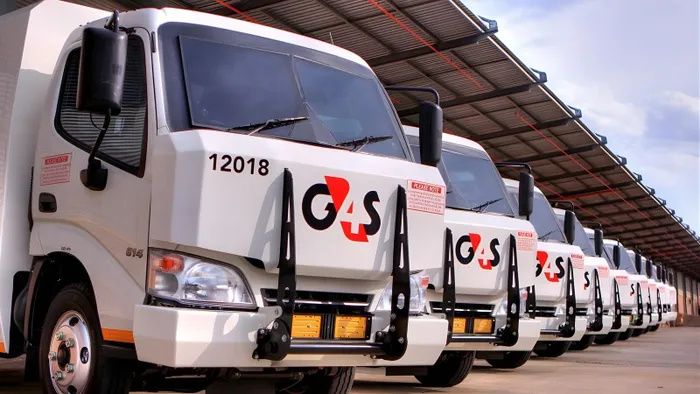
GS4 was held liable for R3 million going missing from Capitec ATMs.
Image: GS4
The Labour Court in Johannesburg has taken aim at the scale of a dismissal case involving global cash-in-transit company G4S after R3.3 million went missing.
The judgment notes that the judge specifically asked why “relatively straightforward” matter required thousands of pages of documentation.
“As a point of departure, I am compelled to say that this matter has been overly complicated by the parties,” said Acting Judge Snyman. “It is a matter spanning thousands of pages, contained in some 30 lever arch files, most of which were simply not necessary to decide the substance of this matter.”
The judge added that it was “entirely undesirable” for the court to be required to work through such extensive records when the dispute itself was straightforward. “Had the parties just applied some focus and effort in putting together a proper review record, [this] could have been avoided.”
The case relates to the dismissal of nine employees by G4S Cash Solutions, part of the global G4S group, which operates in the cash-in-transit industry and transports money on behalf of clients including banks.
“Because of the nature of the product (for the want of a better description) being handled and transported by G4S, it is subject to extremely strict control and security regulatory measures. This is because the product is cash. G4S, on the common cause facts, conducts operations in a paramilitary style,” said the Judge.
Snyman spoke at length about the work procedures, which included various stages of money counting as well as the process being recorded on CCTV cameras. In addition, the Judge noted that bags are scanned and vaults have codes.
“And importantly, any anomaly must be specifically recorded,” said the Judge.
The employees, who worked as custodians responsible for handling and delivering cash to automated teller machines for Capitec, were dismissed for gross negligence after the company recorded cash shortages totalling more than R1.38 million over a six-month period in 2019.
“These shortages led to a number of individual claims made by Capitec for cash shortages, which G4S was then held liable for. A detailed investigation followed,” wrote Snyman, noting that the investigation was “wide ranging and detailed”.
The outcome of the investigation was that the cash shortages involved ATMs that the dismissed staff serviced. “All of the employees were subsequently individually charged with misconduct relating to gross negligence, and were presented charge sheets on different dates as from July 2019,” the ruling read.
Snyman also noted that, when these employees were no longer working that particular routes, shortages dropped by 90%.
The workers, represented by the National Union of Metalworkers of South Africa, challenged their dismissals at the National Bargaining Council for the Road Freight and Logistics Industry, where an arbitrator found that the dismissals were both substantively and procedurally unfair and ordered their reinstatement with back pay.
G4S then took the matter on review to the Labour Court.
In his judgment, Snyman said the core issue was whether the dismissals were fair, noting that arbitration proceedings are meant to determine the fairness of the original reason for dismissal.
Snyman found that the arbitrator had taken the wrong approach by limiting the scope of the charges and failing to properly consider the evidence presented. The court held that the arbitration award was unreasonable and set it aside.
Indicating that there was no need to further extend the matter, the Judge substituted the arbitration decision with a ruling that the dismissals were fair.
IOL BUSINESS