

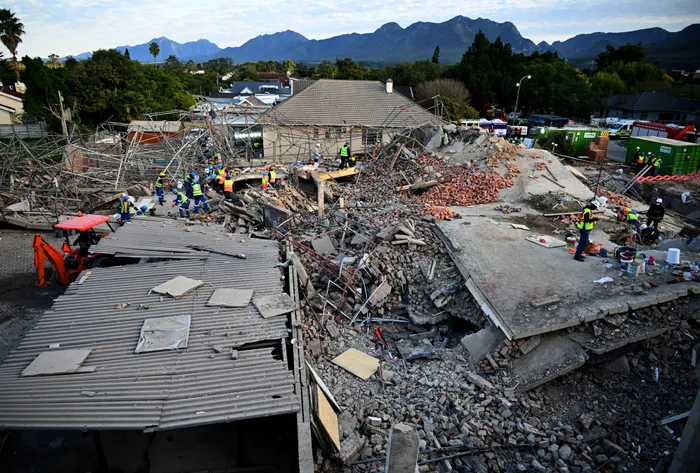
The rubble of the collapsed multi-storey construction site at 75 Victoria Street in George, which claimed the lives of 34 workers and left dozens injured.
Image: Ayanda Ndamane/ Independent Newspapers
The publication of South Africa's Draft Construction Regulations 2025 is more than a routine regulatory update, as it signals a fundamental shift in how the industry approaches safety, accountability and professional responsibility.
For construction professionals, clients and developers, understanding these changes is essential for survival and success in an evolving landscape where the stakes have never been higher.
Moral imperative
With construction accounting for 40% of work-related fatalities in industrialised nations despite employing only 6% to 10% of the workforce, the proposed regulations respond to an urgent need for systemic change, says Craig Laskey, the group SHEQ (safety, health, environment and quality) manager at GVK Siya Zama.
“When construction accounts for four out of every 10 workplace deaths while employing less than one in 10 workers, we have a moral and business imperative to transform our safety culture fundamentally.”
The privately-owned construction company says construction creates jobs, stimulates investment and builds infrastructure that benefits future generations. It says effective regulation ensures public safety, consumer protection and industry sustainability.
“Like the buildings we construct, our industry must rest on a firm foundation of integrity and professionalism.”
Recent events have underscored this need for reform. The tragic George building collapse in 2024 was one of the most devastating structural failures in recent memory and a stark reminder of the consequences when oversight, competency and accountability are compromised.
As investigations and lessons continue to unfold, the message is clear: complacency is not an option, the company says.
A new era of accountability
The draft regulations usher in a new era of accountability. Their most significant departure from the 2014 regulations lies in the expanded web of responsibility. Clients can no longer remain passive project sponsors.
“The new regulations make it clear: if you commission a building, you’re accountable for ensuring safety is embedded from day one. This isn’t about pointing fingers; it’s about creating shared ownership of outcomes,” says Gareth Robb, GVK-Siya Zama’s contracts director in the Western Cape.
Under the proposed framework, clients must prepare documented design risk assessments before construction begins, develop comprehensive health and safety specifications and ensure designers integrate these considerations from inception. Safety is now embedded at the project’s conceptual stage.
The entire construction value chain stands to benefit. For contractors, the introduction of construction health and safety managers as statutory appointments on complex projects elevates safety from a compliance checkbox to a strategic imperative.
“By creating statutory roles for construction health and safety managers, we're professionalising safety management. These individuals will have the authority and professional standing to stop unsafe work before someone gets hurt or killed,” says Laskey.
Principal contractors must actively coordinate cooperation between multiple contractors on site. Accountability cannot be diluted through subcontracting. Dual-signature requirements eliminate ambiguity about professional responsibility when critical decisions are made.
Designers face heightened scrutiny. Where soil stability remains uncertain during excavation work, both the competent person and the engineer or technologist must sign off jointly. These dual-signature requirements eliminate ambiguity about professional responsibility when critical decisions are made.
Contractors must review risk assessments whenever design changes alter the risk profile, when incidents occur, or at a minimum, annually. Risk assessment documents must be accessible to employees, trade union representatives and health and safety committees – not just inspectors and clients.
The shift from paper-based to electronic health and safety files reflects practical modernisation, but the substance matters more than the format. These files must capture the complete project lifecycle, creating an institutional memory that informs future maintenance and prevents disasters during a structure's operational life.
Building more than just structures
Perhaps the most forward-thinking aspect of the 2025 framework is its emphasis on professionalism and skills development, the company says.
The introduction of construction health and safety managers as distinct roles - both requiring registration with statutory bodies approved by the Chief Inspector - establishes clear career pathways in construction safety management.
By mandating professional registration, the new regulations seek to enhance standards, enable mentorship and build a generation of safety leaders who can elevate industry practice.
Significantly, the regulations’ attention to ergonomics-optimising human well-being and system performance-is a recognition that construction workers’ long-term health matters. With 30% of construction workers suffering musculoskeletal disorders, this acknowledges that sustainable construction requires sustainable work practices.
Sustainability beyond compliance
While primarily focused on occupational health and safety, the 2025 regulations intersect with environmental responsibility. The demolition provisions requiring compliance with Asbestos Abatement and Lead Regulations demonstrate integrated thinking.
The removal of approved inspection authorities streamlines oversight but places a greater onus on contractors to self-regulate effectively.
Building for the future
The transition period will test the industry, but any discomfort will become a benefit in the long term.
“Those who embrace this as an opportunity to build better systems and earn client trust will emerge as industry leaders. The question isn’t whether you can afford to comply; it’s whether you can afford not to,” adds Laskey.
Smaller contractors may struggle with the administrative burden of enhanced documentation. Project costs will increase as safety infrastructure and professional appointments become non-negotiable.
However, these short-term challenges will create long-term competitive advantages. Companies embracing the new framework will differentiate themselves as professional, credible partners.
Clients increasingly recognise that the cheapest tender often carries hidden costs: delays, rework, accidents and reputational damage. The 2025 regulations create a level playing field where cutting corners on safety no longer offers a competitive edge.
Bold action required
The Draft Construction Regulations 2025 are by no means final, says GVK Siya Zama. It says the industry must engage constructively in the public comment process.
“But the direction is clear: over the next five years, with collective commitment, we can build a better sector. Companies that treat this transition as a mere compliance exercise will struggle. Those who recognise it as a catalyst for operational excellence, professional development and sustainable growth will lead South Africa’s construction industry into a safer, more credible future.”
Building Confidence Index
Meanwhile, after slipping one index point to 35 in the third quarter of this year, the FNB/BER Building Confidence Index increased to 43 in the last quarter. This is, along with the fourth quarter in 2023, the best reading in a decade and higher than the long-term average for the series of 40.
However, despite the uptick, the current index level still means that the majority (more than 55%) of respondents are dissatisfied with prevailing business conditions. The composite index benefited from a 21-point rise in sentiment among hardware retailers off the back of improved sales.
“The jump in hardware retailer confidence returns the index to more or less the level registered at the start of the year and reaffirms some of the broader trends regarding the resilience of the SA consumer.
"Household income has benefitted from lower inflation, lower interest rates-including the November cut, although it is too soon for that to add to sales, but potentially to sentiment-and continued two-pot withdrawals,” noted Siphamandla Mkhwanazi, senior economist at FNB.
Following a decline to 18 in the third quarter, the business confidence of manufacturers of building materials rose by 14 points to 32. This is its best level since the first quarter of 2022.
Main contractor confidence declined to 39 in the fourth quarter this year, from 46 in the third quarter this year. Sentiment moved lower despite better activity and overall profitability. Even expectations for activity next quarter were noticeably up.
“In all, sentiment merely slipped back to its long-term average following a jump in the third quarter this year. The underlying trends are still promising,” says Mkhwanazi.
Independent Media Property