

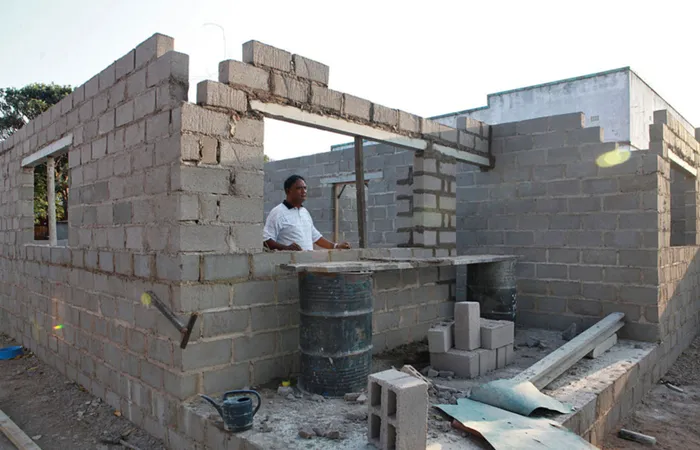
A man at his home in Clairwood, south of Durban, which was still under construction.
Image: Siyanda Mayeza
An estimated 90% of South Africans have cash-built homes one brick at a time without access to formal credit.
This is about R2 to R3-trillion worth of real estate that has transformed the rural and township property landscape. This happens without access to title deeds, pay slips or even formal jobs.
Access to title deeds
The complexity of township home ownership, tribal land ownership and RDP homes means the chance of getting title deeds is extremely slim, says informal sector guru, GG Alcock.
Alcock says, “The reality is that millions of homes will never get title deeds, especially in tribal and Ngonyama trust areas. Township and RDP homes have their own complexities related to historical and cultural issues.
"This is why, in the absence of a title deed, we need to find ways to help owners with no hope of title deeds to realise the value of the asset in which they have invested.”
However, until this treasure chest of potential equity is unlocked, South Africa’s GDP growth could remain stunted at under 1%.
Several factors are driving this renewed demand.
Interest rates impact
According to the December 2025 BetterBond Property Brief, the year ended with the prime lending rate 150 basis points lower than at its peak in 2024, supporting a 16% year-on-year increase in home loan applications.
Application volumes are said to now be 23.5% higher than at the end of 2023.
“Lower deposit requirements have further enhanced affordability, with first-time buyers benefiting from a 20% year-on-year reduction and a 13% quarter-on-quarter drop.
"This is in stark contrast to the period from 2021 to 2024, when deposits rose by 68%.”
BetterBond’s latest bond data is said to also point to a more accommodating lending environment. It said declines in bank impairments relative to assets have made financial institutions more open to new applications, while average house price inflation of 2.8% remains slightly below the Consumer Price Index, keeping conditions favourable for buyers.
Property evaluation system
Lance Milton, an author and entrepreneur, GG Alcock, and Senzo Tsabedze - all co-founders of an evaluation system - have developed a high-tech solution.
AI drive
Driven by Artificial Intelligence (AI) and blockchain, E-DEED provides a 97% accurate evaluation and an associated non–fungible token (NFT), a crypto asset that accurately reflects a property’s value.
The result is that thousands of “unbanked” homeowners with little chance of accessing title deeds for their properties will be catapulted into the formal economy, and families’ legacy investments can at last be recognised.
Putting meaningful property ownership and wealth into the hands of all South Africans has long been on the entrepreneurial radar of Chalwin-Milton, who says, “We want to make the unwealthy, wealthy. When we say ‘unwealthy’, that is a misnomer.
"These assets can be worth R1 to R2-million or more. This is a 100% equity asset. When we did our homework, we encountered an estimated 20 million homes in South Africa. Only 10% - 2 million of them – are classified as ‘shacks’.
"There are about nine million deeded homes, and the remainder are the invisible but significant structures within townships or on tribal trust land in rural areas."
Traditional property wealth processes
Tsabedze believes that traditional property wealth processes have been marred by inefficiencies, paperwork, and a lack of transparency.
He says E-DEED, which requires no more than a smart phone-will also enable the underinsured and uninsured to cover their homes at their true values as the certificate creates insurable interest.
“We are heavily invested in driving innovation and inclusion within the property sector. E-DEED opens up opportunities for homeowners in townships and rural areas, enabling greater financial inclusion and wealth creation.
"This platform provides a secure, efficient, and transparent solution, ensuring that homeowners are no longer excluded from the financial system,” he observes.
Indured homes
Currently, just 11.54% of South Africa’s homes are insured.
Chalwin-Milton notes that insured mansions in Umhlanga were covered during the KZN floods, whilst large family homes in Umlazi were completely lost: “That is absolutely criminal. This is about creating value where there was no perception of value.
"Why should these families be denied the dignity of insurance when their brick and mortar is worth exactly the same as others. By creating the insurable interest, insurance will be available for the first time ever.”
It will certainly be a game changer for the property and insurance industries, Alcock agrees: “I think that this will fundamentally reshape our financial sector when it comes to asset finance and how we look at housing.
"The large portion of our population who have been left out have managed to do amazing things. There is a moral prerogative as well as a business opportunity in changing this.”
Access the untapped market
The overall aim is not only to show institutions how they can use E-DEED to access an untapped market, but to ultimately move beyond South Africa into at least six additional African geographies by the end of next year, they say.
Independent Media Property