

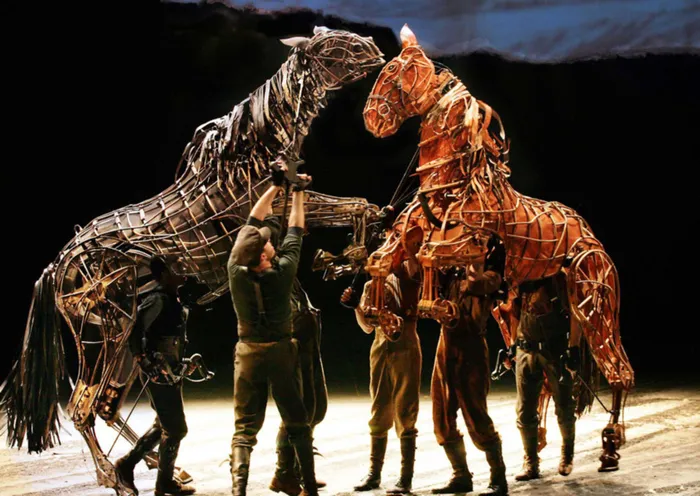
Topthorn and Joey get acquanted on the West End in the London production of War Horse. It takes three puppeteers to manipulate the horses, which are manufactured in a Cape Town-based factory. Topthorn and Joey get acquanted on the West End in the London production of War Horse. It takes three puppeteers to manipulate the horses, which are manufactured in a Cape Town-based factory.
PARIS
, London and New York … at the end of April, Cape Town-based Handspring Puppet Company had a production running in each of those cities.
“And one coming up at the Baxter soon,” says Basil Jones, who started the theatre company 30 years ago with Adrian Kohler and two others.
Today they run a theatre company of 17 full-time employees in their Capricorn Park factory, eight people on tour plus a further 30 puppeteers working in London and New York.
“So that’s 55 people who are engaged in our material right now,” says Kohler.
They also started the non-profit Handspring Trust, which works in Barrydale through a local arts and culture programme called Net Vir Pret and one of the company’s founders, Jill Joubert, is involved in workshops there.
Their involvement with the British National Theatre’s production of War Horse has brought them accolades on both sides of the Atlantic and last year they introduced the Handspring Awards at the Out the Box Puppet Festival in Cape Town.
Not bad for a company that was ignored by local theatre critics for the first few years of its existence.
That changed when they performed their first adult offering, Episodes of an Easter Rising, at a French puppet festival in 1985.
Written by South African novelist David Lytton, it’s about two politically sussed lesbians living in the eastern Transvaal.
“He had all his novels banned and no one knows about him,” said Jones. “He was obliterated from our literature,” Kohler added.
While certain theatre people were being closely watched by the apartheid government, their banned play slipped under the radar and was performed in Cape Town, Grahamstown and Joburg.
“It really did open doors for us, once we put it out there,” said Kohler.
Jones remembers with fondness the play’s Grahamstown success: “It was so completely sold out that there were people happy to sit in the corridor outside, not able to see it at all but just so they could say they had been there.
“It was amazing to have newspapers talking to us seriously. One of the problems we’d had for the first five years of the company was doing children’s theatre; no one took us seriously.”
Since then they’ve worked on plays such as the acclaimed Woyzeck on the Highveld and Ubu and the Truth Commission under the direction of William Kentridge, The Chimp Project, Tall Horse with Marthinus Basson and, of course, War Horse.
The latter was the first time neither performed in the play they were working on and its conceptualisation coincided with the writing of Handspring Puppet Company, the book.
The forced reflection that came with working with Jane Taylor, the editor of the book, and long-time collaborator William Kentridge had them developing their theoretical position with regards to puppets.
“We’re offering on stage the life of animals and human lives as a holistic event that doesn’t normally get offered in the theatre,” said Jones.
“The life of animals as animals rather than as people in disguise,” interjected Kohler.
“Not anthropomorphised animals, “Jones continued. “Globally we’re aware of the integrated nature of our lives with animals. So, we’re offering on stage something that’s never been offered before because puppeteers haven’t been that interested in making that offer, to offer the life of the animal, as an animal.”
Kohler explained further that another dimension to what they offer as puppeteers is the ability to deal with other languages, not in words but with the space between people and the effect of touch.
“Somehow the puppet, because he is not real, when it starts dealing with these other issues, you recognise them much easier than with an actor doing it. For instance an actor can’t die on stage, they can pretend, but a puppet can die.”
Though they love the idea of word-rich plays, they realise that puppets work well when there are no words.
“What starts to emerge are the languages that we use, without knowing that we use them. The minutiae of those movements are what we find very interesting as puppeteers,” said Jones.
“A puppet can pour tea more startlingly and with more life than a normal actor. We re-invent the actor pouring tea or passing a piece of paper.
“We’re poets of the everyday in a sense, more than a live actor.
“It gives you the eyes of a child again. We feel that one of the offers of a puppet is to revisit the ordinary in a very fresh and exciting way.”
As both turn 60 this year, they’re giving some thought to how to step back from constant involvement in the company to a more supervisory capacity.
Already they’re lending their name and expertise to Janni Younge’s Ouroboros production (see Tonight for more) and Jason Potgieter’s forthcoming experimental short-form puppetry theatre project, Iqonga (see www.handspringpuppetcompany.co.za for more information)
Jones said they would like to “plan a situation where a new group of people on a number of levels – as makers, performers and producers – are coming in to be able to take over and find new visions”.