

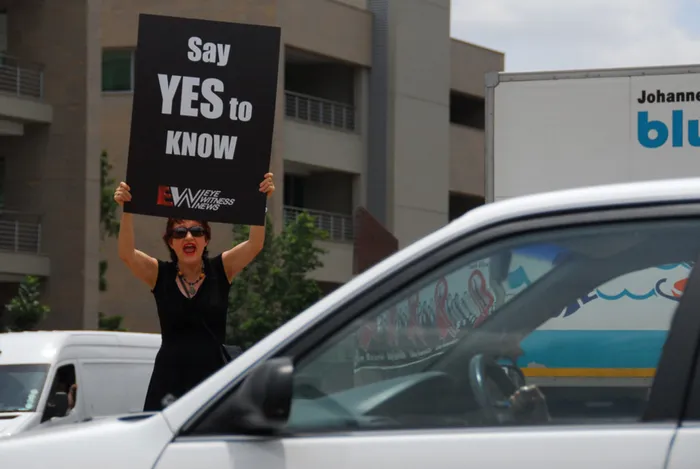
Media freedom campaigners urge motorists to hoot in support of the "Black Tuesday" campaign. Picture: Ihsaan Haffejee Media freedom campaigners urge motorists to hoot in support of the "Black Tuesday" campaign. Picture: Ihsaan Haffejee
Opposition to the Protection of State Information Bill is shifting from the pavements to the digital arena and jumping right into President Jacob Zuma’s e-mail inbox.
Civil rights group AfriForum has set up an online petition which allows citizens opposed to the bill to flood Zuma’s inbox with protests.
The group set up www.thebillstopshere.co.za to encourage South Africans to get involved in “the battle for freedom of information”.
The site states: “Mr President. The bill stops here! I, the undersigned South African citizen, would hereby like to state my concern over the so-called ‘Protection of State Information Bill’. I am of the opinion that the bill in its current form will be detrimental to accountability and effective government in South Africa; that it will have a negative impact on the fight against corruption; and that it will severely curtail the role of the media as watchdogs... I hereby request that you prevent this bill from becoming a law by refraining from signing it.”
AfriForum’s deputy chief executive, Ernst Roets, said yesterday “the major battle is only starting now”. While the battle against the bill had “to a great extent” rested in the hands of opposition parties, this was changing and citizens needed to get involved and make their voices heard.
The bill has also been opposed in a long-running campaign by civil society umbrella organisation the Right2Know campaign, and trade union federation Cosatu, among others.
Within a few hours of the site going live yesterday afternoon more than 1 000 e-mails had been lodged, Roets said. The campaign was also picking up momentum on social networking sites, with the e-mail Zuma facility attracting about 10 hits a minute by yesterday evening.
The e-mails would be sent as a petition to Zuma and his personal assistant’s personal and official e-mail addresses.
Zuma’s spokesman, Mac Maharaj, said he was not aware of the e-mail campaign. He said he hoped they had the right e-mail address. It was a free country, said Maharaj.
“People can do what they want. Whether the president agrees or not, he will be open to it. People are free to express themselves, there’s no impediment in the way.”
Petitioners have to fill in their details on the website to take part in the protest, which AfriForum intends to use as part of legal action in the event the bill is passed.
“Even if this means we have to take this matter to the UN, we will not rest until we have succeeded in putting an end to this legislation,” Roets said.
The ANC ensured the bill passed in the National Assembly last week.
Opposition parties united in their rejection it, with MPs vowing the fight was not over.
The bill has been widely condemned as an infringement on the freedom South Africans fought for.
It still has to make its way through the National Council of Provinces, where it may be amended further by a multiparty ad hoc committee. It would then be referred to Zuma to sign into law.
Those opposing the bill have vowed to challenge it in the Constitutional Court should he do so without changes, particularly the introduction of a public interest defence to protect those who disclose or publish classified information in the belief it is in the interests of society.
Roets said it appeared most of the members of the ANC had “simply ignored the public’s appeals in this regard”.
If the bill became law “it will become the most devastating piece of legislation of the past 20 years.
Should it be called for to flood the president’s e-mail address with complaints by members of the public, we will do so with the greatest of pleasure”.