

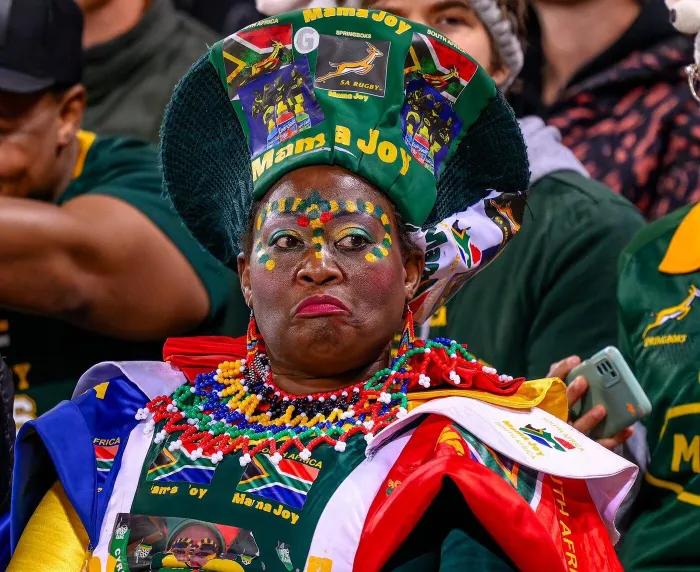
From the stands to the headlines, Mama Joy has become South Africa’s most-talked-about supporter.
Image: File
The X streets are always busy, and this time around, they erupted into a full-scale national argument.
What began as a routine policy statement turned into a public clash that pulled in politics, fandom and questions about how public money should be spent.
At the centre of it all stood one of South Africa’s most recognisable supporters, Mama Joy, and the country’s Minister of Sport, Arts and Culture, Gayton McKenzie.
The debate was sparked when McKenzie confirmed that the Department of Sport, Arts and Culture would no longer fund superfans to attend major international tournaments.
His stance was clear and direct. No policy allows the government to sponsor individual supporters, and it would be unfair to use taxpayer money on a select few while millions of other fans receive nothing.
Joy publicly criticised the decision, raising concerns that ordinary supporters would be excluded from the upcoming World Cup.
Speaking during an interview on Metro FM, she claimed that her previous trips, including the 2019 FIFA Women's World Cup and the 2023 Rugby World Cup, were personally funded by Cyril Ramaphosa rather than by the department.
McKenzie dismissed the claims, stating: “Let me be clear: the President of the country did not pay for Mama Joy's trips, despite what she may think. DSAC did.
"Both trips I could find info on from before my term were covered by the department. Her France trip alone cost R700k. I hope this matter can now be put to rest.”
That figure became the turning point. The revelation that a single trip cost around R700K intensified scrutiny and pushed the issue beyond sport and into public accountability.
McKenzie argued that spending close to a million rand on one person’s travel could not be justified when basic needs across the country remain unmet. For him, it was not personal but a matter of principle.
In one of his posts, McKenzie responded with a sharp but humorous remark, suggesting that her husband should cover her travel costs instead of relying on public funds.
Joy did not stay silent. She took to social media to respond to the Minister.
“I didn’t ask Minister Gayton McKenzie to take me to the World Cup; I asked for 50 fans, and he promised. He wanted to take influencers, but unfortunately, DSAC denied because of the budget. I also didn’t know the money spent for RWC. I felt targeted by his answer with no respect for Papajoy.”
Behind the headlines lies a deeper story of how Joy became a national figure.
Born in Malamulele, Limpopo, she spent the next three decades as a constant presence at stadiums, most notably as a devoted supporter of Orlando Pirates.
Her colourful outfits, loud voice and unwavering energy made her a symbol of South African fandom.
Her profile grew significantly during the 2010 FIFA World Cup, where her presence caught international attention. More than a fan, she became a cultural figure, often described as an unofficial ambassador for South African sport.
In 2022, her global recognition reached new heights when she attended the 2022 FIFA World Cup and won the Best Superfan award.
It was a moment that validated years of dedication and positioned her as one of the most visible supporters in the world.
Her journey has not been without controversy. In 2021, she made headlines by leaving Pirates to support Royal AM, a move she said was driven by a desire to support a woman in football leadership.
When the club later disappeared from the PSL landscape, her shifting allegiances drew criticism from some fans who questioned her loyalty.
More recently, she has been seen supporting different teams, including Mamelodi Sundowns, as well as national sides beyond South Africa. This has led to a narrative that she is now a “wandering fan”, a label that has divided opinion.
At the same time, she has expanded her brand beyond the stands. Through business ventures such as her partnership with Roots Butchery, she has turned her fame into an entrepreneurial platform.
McKenzie has proposed a new approach to fan representation. Instead of government funding, football clubs would nominate their most loyal supporters, who would then be sent to tournaments through sponsorships.
While the idea has been welcomed by some, critics point out that it may exclude figures like Joy, who are no longer tied to a single club.
On social media, the public remains divided. Some argue that Joy represents the spirit of the nation and deserves support. Others believe that the era of state-funded superfans should come to an end.
One user wrote, “R700k for Mama Joy is where we suddenly draw the line? This is nothing. That woman has carried this country’s spirit on her back at every game. Now we are counting coins.”
Another responded, “Mama Joy is so entitled. She thinks she is the biggest fan in the country, and our tax money must finance her trips. She must watch the World Cup like everyone else.”
A third voice called for change, saying, “It is time for new faces. South Africa has many superfans who also deserve to go to the 2026 FIFA World Cup. Please nominate them from different clubs.”