

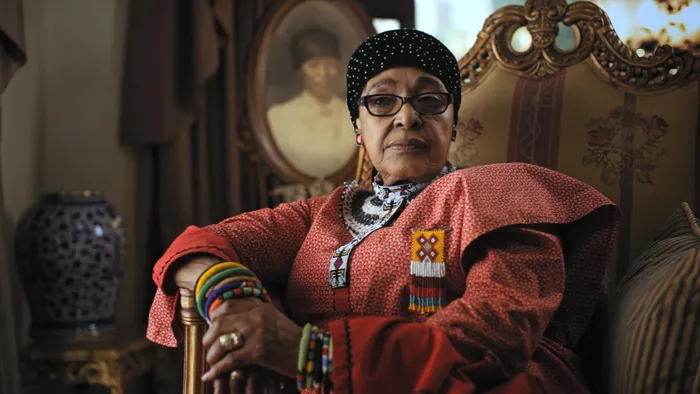
"The Trials of Winnie Mandela" has been released on Netflix
Image: Supplied.
“The Trials of Winnie Mandela”, the revolutionary new Netflix documentary, has opened up debates on social media about South Africa’s storied and painful past.
The seven-episode series, which chronicles the life and times of Winnie Mandela, an activist and the former first lady of the nation when she was married to Nelson Mandela, is directed by Emmy-winning film-maker, Mandy Jacobson.
Released on the global streamer on Thursday, April 23, the timing of its drop coincides with the anniversary month of her passing, imbuing it with added historical and emotional resonance.
Mandela, affectionately referred to as the “Mother of the Nation”, died on April 2, 2018, at Netcare Milpark Hospital in Johannesburg, following a prolonged illness. She was 81, survived by her two daughters, as well as a large extended family of grandchildren and great-grandchildren.
In “The Trials of Winnie Mandela”, her role as a freedom fighter is explored, together with the psychological warfare and persecution she endured under apartheid. It also delves into the controversies and scandals that shaped her public image.
What elevates this production is that it is not a standard biographical documentary and instead, it is told through her granddaughters, Princess Swati Mandela-Dlamini and Zaziwe Manaway.
In it, their intimate conversations on controversial matters such as her alleged links to 14-year-old activist, James "Stompie" Seipei, her separation from Madiba and her thoughts on democratic South Africa feature prominently.
As the series is built around never-before-seen footage and her own voice, some other highlights include Winnie tackling the trauma of the darkest days of apartheid and what it was like to raise two daughters with Madiba in jail and under constant attack from the police force of the time.
In one scene, she admits that she constantly defied the apartheid regime as a way to keep the fight against oppression going, to help secure the former statesman’s release and to get the attention of the international media.
She also delves into the toll this took on her and where she garnered her strength from. It is a fascinating watch, and together with Winnie’s own words, I was also intrigued by how the doccie fuses family perspective and political analysis.
This is as former Public Protector Thuli Madonsela, the ANC’s Kgalema Motlanthe, the former Deputy Chief Justice of South Africa Dikgang Moseneke and Reverend Frank Chikane, a veteran anti-apartheid activist and cleric who lend their voices to “The Trials of Winnie Mandela”.
An interesting insight that Chikane shared was how direct Winnie was and how instrumental she was on the ground during the fight against apartheid.
So while “The Trials of Winnie Mandela” is very personal, it is also layered with historical commentary. Just hours after its release, the documentary has been praised for its unfiltered approach. It is intimate but also confrontational and designed to spark conversations.
And this is exactly what it did on X as users weighed in. Here is what some of them had to say:
@Ndusi27: “I loved every episode of the Trials of Winnie Mandela. What a well-produced series. Of course, there will be some disappointment based on parts of her life that were missing, but I can imagine how difficult it was to fit 81 years of an icon's life in 7 episodes.”
@Vuyo_DwebaG: “THE TRIALS OF WINNIE MANDELA THE PRESIDENT THAT NEVER WAS .”
@mama_d256: “Watching the trials of Winnie Mandela is honestly heartbreaking. You see the strength, the defiance … but also the pain, the isolation, the cost of carrying a whole struggle on your shoulders. It’s not just history - it’s grief, sacrifice and a story that never feels simple. ”