

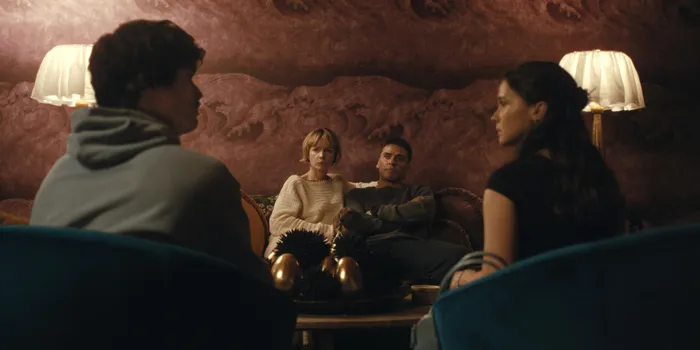
Charles Melton as Austin Davis, Carey Mulligan as Lindsay Crane-Martin, Oscar Isaac as Josh Martin, Cailee Spaeny as Ashley Miller in 'Beef' 2.
Image: Courtesy of Netflix © 2026
Let me just say this right now: season one of "Beef" was definitely a soft launch. Back then, the title made immediate sense.
Two people lose their minds after a road rage incident, and suddenly everyone’s trauma is outside doing cartwheels in broad daylight. It was messy, funny, uncomfortable, and somehow still entertaining enough to make you care about people who desperately needed therapy and maybe a nap.
Season two, though? Yoh. This one walks into the room like it has a trust fund, emotional repression and a prescription for anti-anxiety medication it refuses to take.
Created once again by Lee Sung Jin, the second anthology series comes with an entirely new cast and storyline.
Oscar Isaac and Carey Mulligan lead the season as a wealthy married couple whose relationship is held together by status, passive aggression and the kind of arguments that make nearby staff members quietly update their CVs.
Charles Melton and Cailee Spaeny play a struggling Gen Z couple, who become entangled in their bosses’ unravelling lives after witnessing an explosive fight at an elite country club.
And yes, before anyone asks, there is absolutely no connection to season one besides the emotional damage and the title.
In many ways, this season feels like "The White Lotus" wearing a darker coat. We move through different social classes, hidden resentments, and people desperately trying to maintain appearances while quietly falling apart inside.
Everyone has a secret. Everyone is pretending. Everyone thinks they’re smarter than the next person. Meanwhile, the audience is sitting there watching these people spiral and wondering whether rich people have ever had a normal conversation in their lives.
One thing the season does well is showing how disconnected people have become from reality. Josh and Lindsay genuinely seem to think their elaborate screaming matches are just another Tuesday.
At one point, you almost want to step into the screen and say, “Babes, if somebody is holding a weapon during an argument, that is no longer communication; it is a crime documentary waiting to happen.”
The show leans heavily into themes of envy, image and anti-capitalism. Nobody here is satisfied. The wealthy are miserable. The workers are desperate. The younger characters are chasing validation through aesthetics and proximity to money.
The older characters are trapped in lives they built to impress others. Every interaction feels transactional. Even love starts to look like a business arrangement with emotional perks.
That part actually works.
What didn’t fully work for me was the emotional connection to the characters themselves. Season one gave viewers Danny and Amy, played by Steven Yeun and Ali Wong, who were deeply flawed but strangely magnetic.
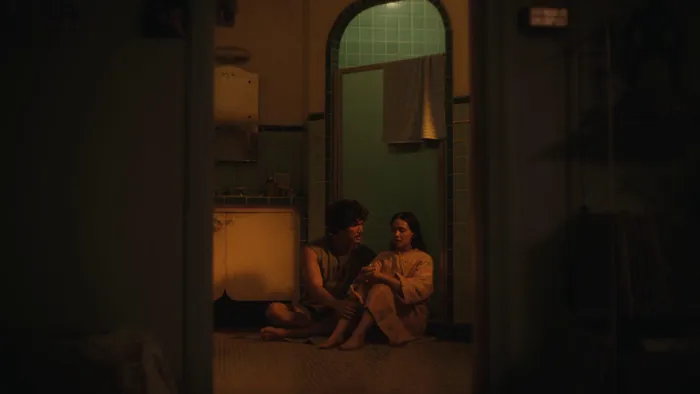
The different couples navigate their own struggles, from strained marriages held together by status to younger relationships tested by ambition, insecurity and the pressure of living up to expectations that never quite match reality.
Image: X/@wickskiller
You rooted for them even when they were making the worst decisions imaginable. There was humour too. Real humour. The kind that made you pause the episode because you were laughing and stressed at the same time.
Season two feels colder.
There are moments where the dialogue lingers in silence for a bit too long, and certain performances feel oddly restrained. Sometimes it works because the tension is simmering underneath the surface.
Other times, it feels like the actors are waiting for a cue that never arrives. It creates this strange viewing experience where you are constantly observing the characters rather than emotionally entering their world.
That becomes a problem because television still needs somebody to hold onto emotionally. We want more than survival mode. We are already surviving in real life. Give us somebody to root for. Give us a little light between all the doom and dread.
Instead, season two often leaves viewers stuck in what feels like an endless emotional waiting room. The atmosphere is heavy, uncomfortable and intentionally suffocating. There’s very little relief. Even the humour feels buried under layers of sadness and ego.
Still, the writing remains sharp when it comes to miscommunication and insecurity. The show understands how human beings constantly project their fears onto each other.
Nobody says what they actually mean. People weaponise silence, money, class and even vulnerability. Every character is trying to maintain control while internally falling apart.
The ending especially pushes the season’s anti-capitalist ideas to the front. Underneath the luxury and expensive interiors are people who are spiritually exhausted and emotionally empty.
The series keeps asking whether success actually heals anything or whether it simply gives people nicer places to collapse.
If we are comparing the two seasons directly, though, season one still wins. Easily.
The original season earned its title through escalating conflict that felt personal, absurd and weirdly hilarious. This new chapter is more interested in internal resentment, social performance and class anxiety.
That is not necessarily bad, but it does make the show feel less immediate and less entertaining.
By the final episode, I wasn’t sitting there shocked or emotionally wrecked. I mostly felt like I had spent eight episodes trapped inside the emotional equivalent of the sunken place.
The cinematography is one of the strongest elements here. The muted colour palette, cool lighting and precise framing reflect the emotional distance between characters. Everything looks polished and controlled, yet the visuals quietly underline how disconnected and uneasy the world of the series really is.
Season two clearly wants viewers to sit with discomfort, emotional emptiness, and the pressure of pretending everything is fine when it really is not. Some people will love that deeper approach. Others will probably miss the humour, tension and emotional payoff that made season one so addictive.
It's still worth watching, though.
Rating: *** solid and enjoyable, though not groundbreaking