

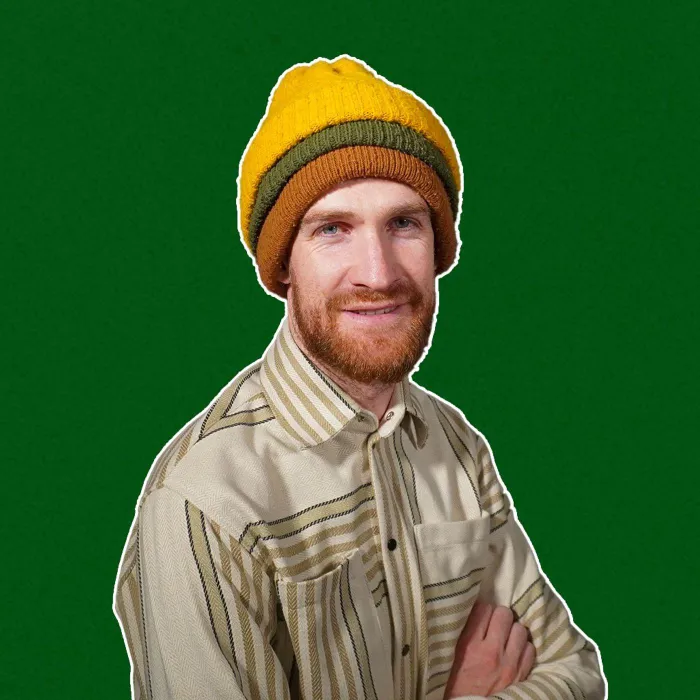
Wouldn't You Want to Know with Dan Corder
Image: Supplied
Dan Corder, broadcaster and host of eNCA’s late-night special, The Dan Corder Show, spends his free time pioneering a unique monthly event called Wouldn't You Want to Know, held to a sold-out crowd at Cape Town’s Gin Bar on November 19.
After hosting his last show of the year, Corder was left with a fatigue he described not as physical, but emotional—a weariness that stems from "speaking in a country that never stops shouting."
Corder reflected on the evening’s success, highlighting a recurring thread. "Guest speaker Rebecca Gore was phenomenal," he noted.
Dr Siya was phenomenal, too. Even without a core theme, there was a through line: fighting against disinformation and fighting for the truth," Corder told IOL.
Here, amidst the humour and hard facts, South Africans are really encouraged to collectively process the chaotic, often absurd narrative Corder stylishly refers to as The South African national 'movie'.
Before the event, IOL had the pleasure of sitting down with Corder. Posing a question often debated in his comment sections: If South Africa were a blockbuster movie, who would be directing it?
"The ANC definitely runs this country," he asserts immediately.
“Not just because they’re the majority party, but because their ground game is astonishing. They’re in every ward, every branch, every community.”
In film terms, he argues, the ruling party (ANC) is the studio, the producer, the head writer, and the distributor. Corder sketches a complex architecture of power—a decades-old network that has not merely survived apartheid but has evolved nearly 30 years into democracy.
“Some of those interests are still tied to the state,” Corder said, explaining how Patrice Motsepe—not as a symbol of conspiracy, but as an example of how threads of power can weave through multiple eras.
With roughly half of the population under the age of 28, according to Statistics South Africa (Stats SA, 2022), the concerns, aspirations, and consumption habits of this youthful demographic are central to the national dialogue.
Corder points to another, less formal yet emerging potential power centre: the South African youth, whom he describes as the “unofficial directors of the ‘movie’ as “young South Africans are a target for redefining media consumption. Traditional media formats are being challenged by online platforms where young people are creating their own narratives.”
The power dynamics are demonstrably shifting. Corder, who jokingly admitted to feeling “old” at 32, underscores how youthful South Africa's social pulse has become.
We discuss the impact of AI on journalism — specifically, the misunderstanding between breathless tech-industry optimism and the lived realities of newsrooms.
Corder cuts through the noise: “AI has no relationship with the truth.”
For him, that is the core problem. Journalists cannot fabricate. Accuracy is non-negotiable.
“I’m not a frontline journalist,” he says, “but I’m in the media ecosystem. I talk about the news with my personality. And it works because South Africa is hilarious. We’re a funny people.”
His online success forced television networks to rethink election coverage. Demand for his voice surged, eventually landing him at eNCA. However, he remains firm about where the industry must go.
“It’s too late for traditional media to deplore creatives. Creatives are winning. The Washington Post hired 10 content creators to work with journalists. That’s where South African media needs to go,” he said.
We drift into geopolitics — South Africa hosting the G20, Trump’s absence, and the youth demographic.
“I genuinely don’t care about Donald Trump,” he says. “Macron is coming. Other world leaders are coming. That’s what matters.”
“Johannesburg is finally being cleaned up for the G20, which is infuriating. It’s going to backfire on the ANC because people will ask, ‘So you could have been doing this the whole time.’”
For Corder, we have reached a critical juncture in terms of national accountability. The country is ageing out of excuses. As South Africa stands on the brink of the 2026 local elections, Corder emphasises the need for "mass participation in the upcoming local elections, specifically from the youth."
In a nation held together by satire, outrage, and resilient hope, Corder does not seek to rewrite the plot but to illuminate that the next scene is still open for contributions. His work reminds South Africans that they possess the power to interpret, interrogate, and even laugh at the surrounding whirlwind.
For Corder, the future of South African media isn't just about fighting algorithms or analysing the "movie" of state capture. It is about creating safe spaces—both online and in bars—where the next generation can speak the truth without burning out.
“Facts over fantasies. You know who loves fantasies? Politicians with bot networks,” Corder expressed to IOL before going to present the evening's plotline.
IOL