

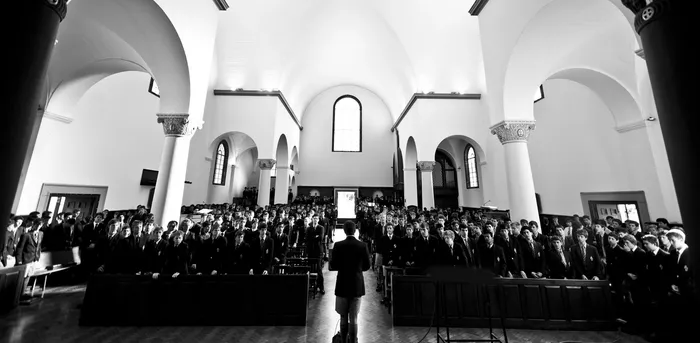
Unbroken Heritage of Community. While the College promotes Chapel as building "resilience" and "belonging," for the individual, it functions as a powerful form of cultural capital, where mannerisms, voice, and self-presentation are polished and performed in the name of heritage.
Image: Bishops Diocesan College
What does Heritage mean to me personally? And is the word 'Heritage' an easy flag to wave? I remember raising the commemorative flags every morning before Chapel Assembly. Perhaps it's become a national myth that we’re told to celebrate with a braai and chant.
But my heritage is not solid. It is a fractured contradiction, one I carry in my bones; a living haunting that shadows my every step. I am born into a Muslim family, and that was my first heritage.
I was six years old when I entered another world. I stepped into Bishops Diocesan College, a school rooted not in the soil of Africa but in the traditions of an empire. For thirteen years, that became my heritage too.
The diocese prides itself on its heritage; the story that tells boys and parents alike is meticulously polished in legacy, excellence, and opportunity.
They say it provides a foundation, or 'special spark' of academic grounding and physical health, an education that recognises and encourages that special spark within each boy to catch fire.
But for me, this "special spark" was my roaring neurodivergence, a mind that refused to be tamed by conventional structures of learning.
This was the first great contradiction. The diocese's school heritage of "New Age Learning" and "Academic Grounding" is based on a historic and system-wide proven record of standardised excellence, notably Matric Exam Results with Bishops' Ranking amongst one of the top 150 schools in the world, along with Michael House.
Saturday mornings saw the beloved Piley Rees on show, a rugby field that has shaped generations of Bishops Boys into stardom.
This tradition elevates the Piley Rees from a simple field to an environmental heritage, a place that shapes the identity of the school and its students. It's a physical space that embodies the school's legacy, where the soil itself holds the history of countless games, victories, and the enduring values of Bishops rugby.
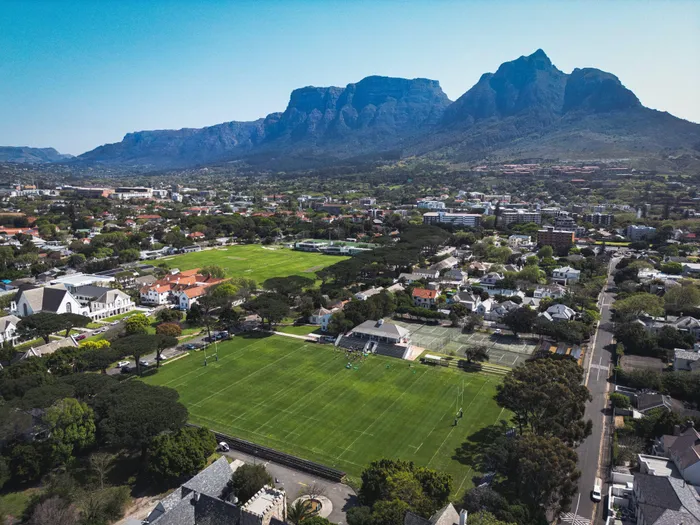
Ariel Shot olf the main rugby field at Bishops, The Piley Rees which the oldest rugby field in South Africa
Image: @Scotlandteam
The most brutal form of assimilation was in my voice and mannerisms, the way I carried and presented my authentic self. Other than being taught to speak with a "white accent" — a product of my education that was the entry point into the world of privilege, I was surrounded by.
A potent form of cultural capital, from embodiment to performance in the hallowed halls of Bishops, how I held myself in the name of heritage was my currency.
But outside, and in the mosque, I was met with suspicion and mockery. The kids from my Muslim school sneered at my "rah rah" accent, an imitation laced with venom. I was too much of a Bishop's boy for the mosque and too Muslim for Bishops; I was caught between two worlds, all the while being rendered an outsider in both.
I learned which parts of me to silence whilst fasting that made me tired during matches, the Arabic I could never bring to the classroom. Even though many Muslim scholars and peers deemed me to be unworthy of Islamic teaching, and therefore, the small rituals fell away because I wasn't allowed to find my meaning in practice.
Assimilation wasn't optional. Splitting myself outwardly Anglican in chapel and inwardly following my spiritual compass; confident on the rugby field, reflective in moments of solitude; engaging in school culture while quietly maintaining the rituals that grounded me.
I let Psalm 150 move through me, not as an outsider mimicking ritual, but as someone who had earned a place in that chorus. In that moment, the words “Let everything that has breath praise the Lord” became mine too. My breath counted. My voice carried.
Heritage is often framed as something pure, unbroken, and singular. But my inheritance is layered. To sing in Chapel was not to lose my Muslim heritage, nor to erase the African soil beneath my feet.
It was to acknowledge that identity is multiplicity — that I could step into the hymn without abandoning the prayer, that my heritage is not either/or, but both/and.
The Chapel gave me resilience, beauty, and a paradox I still live inside. It showed me that heritage can be both wound and gift, fracture and belonging. And in that valedictory moment, Psalm 150 became my own inheritance: not Anglican, not Muslim, not neatly defined, but alive.
Perhaps this is the truth of heritage in South Africa, too.
Our praises will not sound the same. They will clash like cymbals, weave like strings, echo like voices that once could not sing together. But if “everything that has breath” is truly invited, then even fractured inheritances can find their voice.
The Eisteddfod, the annual celebration of music, drama, and public speaking, is a cultural triumph, a heritage of polished performance. For many, it is a joyful inheritance of expression. For me, it was also a stage of assimilation: learning which voices drew applause, which accents were praised, and which silences were necessary. It was heritage, yes, but a heritage that reflected the times, of a celebration that shaped some of us more gently than others.
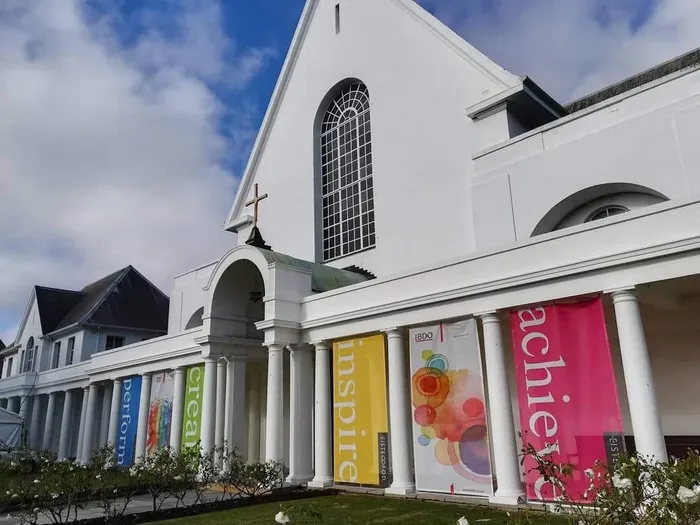
Bishops' Celebrations of Heritage through Eisteddfod
Image: Pasquallie, Trevor. 2001–. Afrikaans, Housemaster of Birt
Bishops shaped me more than I can imagine. It provided me with networks, opportunities, and a resilience I was still learning. It taught me to walk into rooms that weren’t built for me and to hold my own. But it also demanded a profound loss.
The erosion and splitting of myself saw my inheritance of heritage dissipate into fragments, which to this day is a puzzle of contradictions. And this is where my personal story collides with the script of Heritage Day in South Africa.
We are told heritage is a celebration, a braai, a flag. But that version of heritage erases fracture. It pretends our inheritances are whole, when in truth, they are layered with race, class, gender, and sexuality, and are the very forces that shape whose heritage feels celebrated and whose feels conflicted.
And yet, I cannot throw heritage away. I carry it. Be it a mosque I never fully belonged to, in the chapel hymns I half-sang, in the rugby soil that still clings to my shoes, in the quiet prayers I whispered when no one was watching.
My heritage is not a celebration. It is a survival of appreciation. It is the memory of fracture and resilience after years of not knowing my roots, and years later, I am reminding myself how I have shaped something unique to my understanding of heritage out of it.
Perhaps that is the inheritance of my positionality as a journalist: to expose the fractures we are told to ignore, to write what heritage really feels like when it is not neat, not whole, not a flag. To inherit not only the gifts but the ghosts and to turn them into a story.
So, what does heritage mean to me? It is not a myth to perform. It is a question to keep asking. And maybe that is my truest inheritance: to never stop asking.
My heritage is not a fixed, singular narrative to be consumed, but an enduring journey of faith and paradox, a testament to the fact that identity, much like survival, is often about choosing to believe in the story that allows you to breathe. And in that breath, there is a profound, even if fractured, belonging.
IOL