

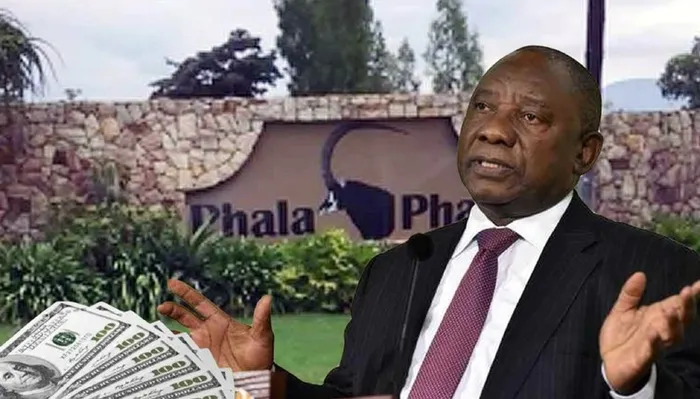
President Cyril Ramaphosa can expect intense questioning in Parliament this week regarding the contentious Phala Phala case, following the Constitutional Court's ruling that the matter must return to Parliament's impeachment committee.
Image: IOL
As President Cyril Ramaphosa prepares to step into Parliament on Thursday to address vital topics such as skills development, employment opportunities, Operation Prosper, and students’ debt, he is also bracing for intense scrutiny regarding the controversial Phala Phala matter. IOL reports the backdrop of this session is underscored by the recent ruling from the Constitutional Court which declared Parliament's handling of the Phala Phala report unconstitutional, reinstating pressing questions regarding transparency and accountability in leadership.
In a landmark judgement delivered last Friday, the Constitutional Court's findings in the case of Economic Freedom Fighters and Another v Speaker of the National Assembly and Others (CCT 35/24) were clear and impactful. The court stated that Rule 129I of the National Assembly is inconsistent with the Constitution and is, therefore, invalid. The subsequent rejection of the Section 89 independent panel report by the National Assembly was deemed irrational and unconstitutional, compelling the matter to be referred back to Parliament’s impeachment committee for a comprehensive investigative process.
Since the ruling, various opposition parties have solidified their stance demanding accountability from the President. Both the African Transformation Movement (ATM) and the Umkhonto weSizwe Party (MKP) have formally invoked Section 102 of the Constitution to initiate a vote of no confidence in Ramaphosa, asserting that the recent developments have severely undermined public trust in his leadership.
Among those leading the charge is the MKP's newly appointed Chief Whip, Mmabatho Mokoena-Zondi. She articulated her party’s determination to address the Phala Phala affairs directly with Ramaphosa during the Q&A session. “We do not think this issue has been fully dealt with, and quite frankly, many South Africans are still sitting with more questions than answers,” she said, highlighting public frustration over perceived discrepancies in accountability standards between ordinary citizens and high-ranking officials.
Mokoena-Zondi continued, “Those are serious concerns because people must have confidence that institutions are acting fairly and independently all the time. You cannot have a situation where an ordinary citizen will be expected to explain every cent, every transaction, every process, but when it involves the highest office in the country, suddenly things become vague or treated as politically sensitive, and that is what really frustrates people.”
The Democratic Alliance’s new parliamentary leader, George Michalakis, echoed a similar call for accountability. He noted that while questions for the President have been structured ahead of time, the party remains committed to capitalising on every available opportunity to hold the President accountable. “The main thing is that the impeachment committee must now be set up, because we can't do the impeachment hearing through questions in Parliament. We should do the impeachment hearing through the impeachment committee,” Michalakis declared, emphasising the need for a rigorous investigative process.
As Parliament convenes, all eyes will be on Ramaphosa, who must navigate these pressing discussions with deftness and transparency amid mounting opposition calls for clarity and accountability concerning the Phala Phala affair. The outcome of Thursday’s session may have significant implications for the President's leadership and the future of governance in South Africa.
IOS