

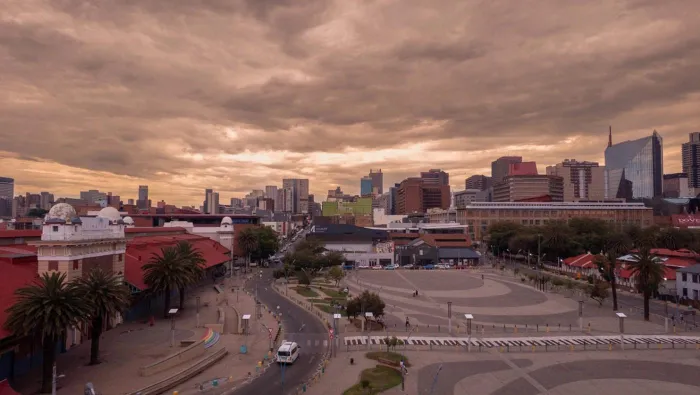
This year’s commemoration coincides with major upgrades at Museum Afrika and the Pink Building in Newtown. These facilities are being brought to international museum standards to accommodate the temporary relocation of the Johannesburg Art Gallery collection.
Image: City of Joburg
As the world commemorates International Museum Day on 18 May, the City of Johannesburg is reflecting on the important role museums play in preserving history, protecting heritage, and connecting communities to their collective identity.
This year’s commemoration comes at a significant moment for Johannesburg, as major upgrades continue at Museum Afrika and the adjacent Pink Building in Newtown to prepare the facilities to international museum standards for the temporary relocation of the Johannesburg Art Gallery (JAG) collection.
Johannesburg is a city shaped by movement — of people, ideas, and histories. At the centre of this dynamism lies the Johannesburg Cultural Arc, a symbolic and physical pathway connecting the city’s major heritage, arts, and human rights institutions.
Stretching from Constitution Hill, across the iconic Nelson Mandela Bridge, and into the vibrant Newtown Cultural Precinct, the Cultural Arc reflects South Africa’s journey from struggle to democracy and its enduring commitment to cultural expression.
The temporary relocation of the JAG collection into Newtown is more than a logistical intervention — it is a strategic cultural repositioning that strengthens the interconnectedness of Johannesburg’s heritage institutions while reinforcing Newtown’s role as a centre of creativity, memory, and urban regeneration.
Museum Afrika, housed in the historic 1913 fruit and vegetable market building on Lilian Ngoyi Street, serves as Johannesburg’s premier history museum and remains one of the city’s most important custodians of social and cultural memory. The museum houses extensive collections of books, artefacts, archives, and historical records chronicling Johannesburg’s evolution.
To support this transition, significant infrastructure interventions implemented by the Johannesburg Development Agency are currently underway at both Museum Afrika and the Pink Building.
Key upgrades include:
The relocation of the JAG collection into this environment creates renewed opportunities for cultural tourism, increased public activity, and deeper collaboration between Johannesburg’s institutions of art, heritage, and memory.
The Newtown precinct is also home to major cultural landmarks including the Market Theatre, the iconic Newtown Heads public art installation, and nearby heritage destinations such as Chancellor House, commemorated by Marco Cianfanelli’s Nelson Mandela: Shadow Boxer sculpture.
By positioning the JAG collection within this broader cultural ecosystem, the City is strengthening the Cultural Arc as a cohesive and accessible spine of arts and heritage while ensuring that Johannesburg’s artistic legacy remains visible and protected.
As Johannesburg commemorates International Museum Day, the City reaffirms its commitment to preserving the stories, artworks, and heritage that define its identity — ensuring that future generations continue to learn from and engage with the city’s rich cultural legacy.
Content by the City of Johannesburg