

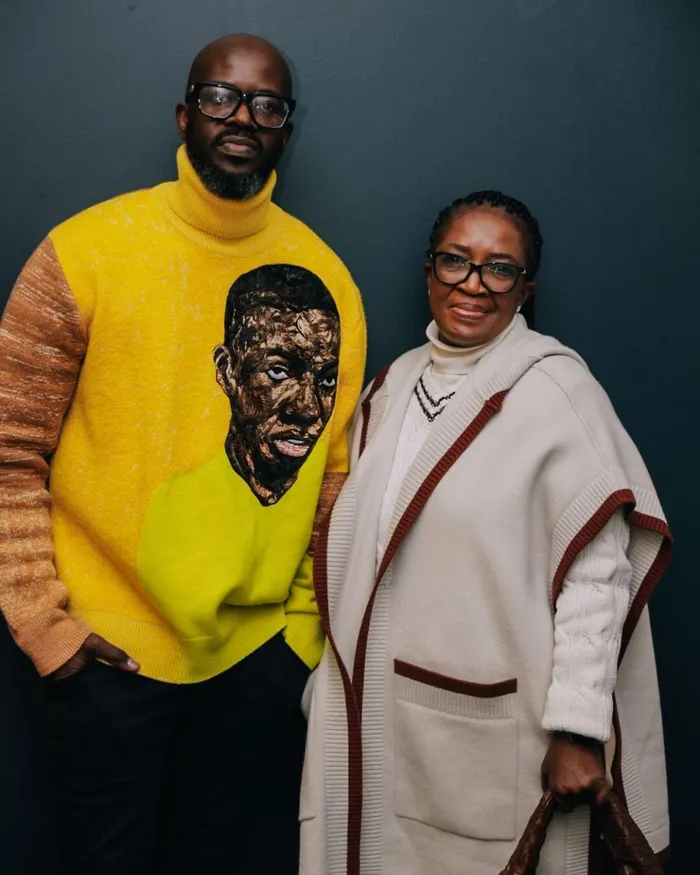
DJ Black Coffee with his mother.
Image: Facebook/Black Coffee
A single, candid image from one of DJ Black Coffee’s children’s birthday parties has sparked a storm of commentary across South African social media.
The photo, originally posted by controversial blogger Musa Khawula, self-proclaimed gossip queen “Wendy Williams Lite”, shows Coffee's mother smiling alongside one of the DJ’s former “partners” and their child.
At first glance, it’s just a grandmother attending her grandchild’s party.
This debate, sparked by an image of Coffee’s mother at a grandchild’s birthday party, goes beyond celebrity drama.
It brings issues of accountability, family dynamics and the cultural phenomenon of "boy mom" behaviour to the forefront, reigniting conversations around the DJ's headline-grabbing divorce from Enhle Mbali Mlotshwa, which was finalised in October 2025.
Mlotshwa and Coffee's split was one of the most publicised divorces in recent South African history.
Mlotshwa cited infidelity as the breaking point, specifically Coffee fathering two children with other women during their marriage.
While she walked away with spousal maintenance and a share of his estate, the public never stopped debating the heartbreak, the humiliation and the social dynamics that made the story so explosive.
So when Coffee’s mother was seen smiling at a party hosted by one of those women whose pregnancy contributed to the alleged collapse of her son’s marriage, a new wave of discourse on X erupted.
An X user, Mafunda, wrote: “Black Coffee’s mom is the perfect example of why the ‘boy mom’ discourse exists.”
Central to this story is a question: Does the image represent blended families putting children first, or does it instead highlight ongoing cultural issues of accountability, especially regarding how some mothers raise their sons?
“Boy mom” culture
At the heart of the debate is the term “boy mom", coined to describe the unique experience of raising sons.
For years, the term was harmless, a lighthearted way for mothers to share parenting anecdotes about roughhousing, muddy sneakers and the chaotic joy of raising boys. But in recent years, “boy mom” has taken on a more critical tone.
Today, it’s often used to describe mothers who are overly fixated on their sons, placing them on pedestals while excusing their bad behaviour.
It’s a loaded cultural archetype.
A “boy mom” is now understood as the mother who:
Research from the American Psychological Association also shows that boys who are over-indulged or shielded from consequences are more likely to struggle with emotional regulation and empathy later in life.
So yes, the photo went viral because it involved celebrities.
However, it resonated because South Africans recognised the dynamic instantly.
It’s not new. It’s just finally being called out.
Others have defended her, saying that a grandmother has every right to be involved in her grandchild’s life, regardless of adult conflicts.
“At the end of the day, children deserve love from all sides of their family,” one user wrote.
Another added, “Healing for blended families requires putting children first, even when the history is messy.”
Some, however, questioned the choice.
“How do you stand by your son’s actions while celebrating with the very people who contributed to destroying a marriage?” one user asked.
Another chimed in, “But where is the line between prioritizing children and enabling harmful behaviour?”
South Africa is a country fighting a very real battle against gender-based violence (GBV). We can’t ignore the role parenting plays in shaping future adults.
That’s why this debate matters. This isn’t about blaming one family. It’s about expanding our awareness.
Parenting experts emphasise, “Mothers play a crucial role in shaping the men their sons will become. It’s not enough to teach them to be strong or successful. We need to teach them empathy, accountability, and respect for others, especially women.”
Others defended her, reminding the public that being present in a grandchild’s life is a universal right, even in complicated families.
And that’s the part we often forget: Blended families require maturity, healing, and sometimes uncomfortable coexistence.
As a mom raising a child in a world where the internet never forgets, this moment made me pause.
It reminded me that every decision we make, the love we give, the accountability we enforce, the silence we allow, shapes the adults our children will become.