South Africa's national happiness dips following a disappointing sports weekend

Springboks captain Siya Kolisi takes a selfie with fans after a Test match in 2024.
Image: File.
On Saturday, South Africa registered one of the lowest happiness levels in recent times due to a number of losses in sport.
According to the Gross Happiness Project, which measures emotional experience in near real-time, South Africans' happiness dipped to 7.17 on the Gross National Happiness (GNH) scale. Significantly lower than the 7.3 average for Saturdays.
This decline has been attributed to a series of disappointing outcomes in major sporting events over the weekend.
This data comes from Professor Talita Greyling, a leading economist and expert in well-being from the University of Johannesburg, who leads the Gross Happiness Project.
The project, which started in 2019, uses advanced data analysis techniques to measure emotional experiences in real-time across selected countries worldwide.
"We measure positive and negative emotions, and we pick them up from people's Google searches in real time. We have 72 emotion words, which we pick, and those are extracted and built into an econometric model where we predict happiness. Ultimately, it becomes numbers and we call it now-casting," shared Greyling.
She added that this past weekend, the specific pattern which has built up over years was disrupted.
"Because we have been doing this for a long time, we have a specific pattern for each day of the week. Mondays in South Africa are constantly low days, Saturdays, on the other hand, are high. According to our research, Saturdays can be anything from 7.3 to 7.4, depending on the year. This past Saturday, it was 7.17, which was lower than usual."
The timing of this significant drop aligns closely with results from the weekend's important sporting events, which left fans feeling disheartened.
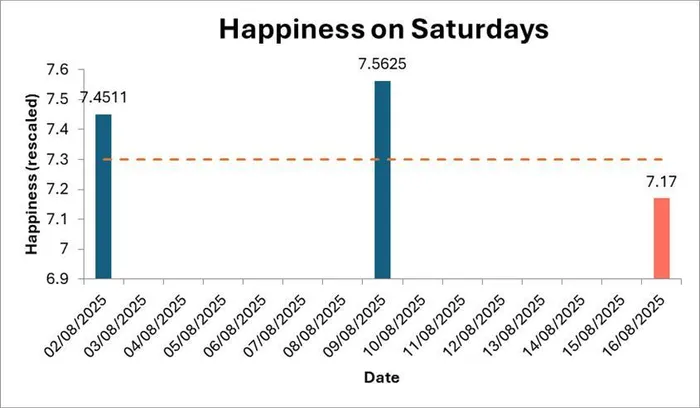
Happiness statistics from the UJ findings.
Image: Supplied.
In soccer, Bafana Bafana faced Nigeria on Friday, August 15, in the African Nations Championship. Despite having most of the ball and creating chances, they ended up in a goalless draw.
The following day, the Springboks took an early lead against Australia at Ellis Park, hoping to secure a victory.
However, after leading 22-0, the team suffered a shocking 38-22 defeat as the Wallabies staged a stunning comeback, marking their first win at Ellis Park since 1963.
Later that same day, the Proteas lost a nail-biting T20 match against Australia in Cairns, Australia.
Despite scoring a total of 172 runs, they fell short as Glenn Maxwell's performance steered Australia to victory by just two wickets.
"Sport plays a central role in South Africa’s happiness and the losses and disappointments across football, rugby and cricket, in a single weekend profoundly affect the mood of the nation," said Greyling.
Delving deeper into South African identity and happiness, she explained: "We find that Monday is a low, then it picks up during the week. By Friday, it is a little bit higher, Saturday is high, and then on Sunday, we start seeing a decrease again. It's the trend every week.
"Sometimes the mood goes above the averages or below, for example, on public holidays it's always above. Sports events can push it above or below. Various things will change that normal weekly pattern."
She said that during the elections and natural disasters, she and her team noticed low moments.
"During elections, those few days, we found really low, then anything like a natural disaster, so fires or floods, has a significant effect in South Africa. So, South Africans are very sympathetic."
She shared that normally economic factors don't affect the mood that much; however, emotional things like deaths can trigger a dip in emotions.
"Like if a movie star passes away, we pick up that dip. I think there is a lot of empathy in South Africans.
Interestingly, a recent study led by Greyling, titled "Cheerful Discontent", suggests that while South Africans may feel discontent with their living standards, they retain an underlying emotional happiness.
"It shows that South Africans are discontented with their lives, but are emotionally happy. South Africans are extremely positive, emotional and resilient, although they are not content with their standard of living there.
"We would say that the goal in life is not to get the most income you can, but the most happiness and life satisfaction.
"All our economic models are to increase wellbeing, which is then a much wider concept than just money ... Up to a certain point, money can make you happy. Once you meet your basic needs (food and shelter) and maybe with a little bit to spare, any additional money doesn't contribute much to happiness.
"We find that money brings worries, sadness and stress, which decreases happiness in general."