Groundbreaking robotic surgery revolutionises kidney donation standards in South Africa
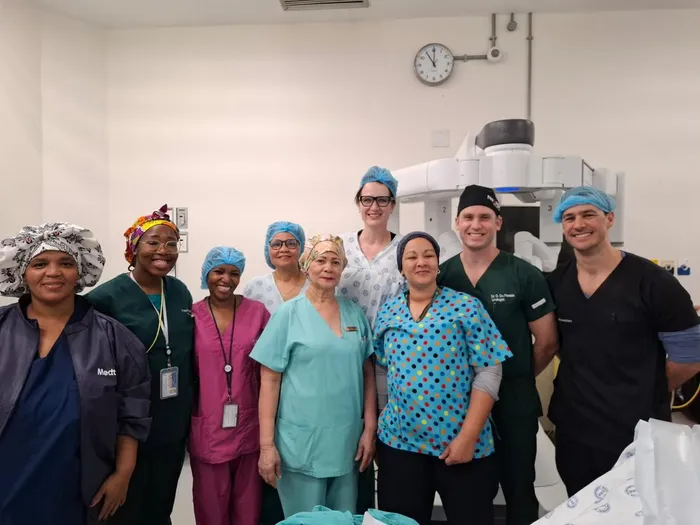
Surgical team that performed the robotic surgery, donor nephrectomy at Tygerberg hospital
Image: Supplied
Imagine the anxiety of a parent watching their child’s life hang in the balance, knowing their own body holds the key to saving them.
Now imagine the relief of waking up the day after donating a kidney, free from major pain, and able to embrace recovery with minimal disruption.
This is no longer a distant dream for South Africans, thanks to groundbreaking medical advances in robotic surgery.
In a first for South Africa, a team of surgeons at Tygerberg Hospital in Cape Town, in collaboration with Stellenbosch University (SU), successfully performed a robotic-assisted donor nephrectomy, a procedure where a kidney is removed from a healthy donor for transplantation.
Dr Danelo du Plessis' historic surgery ushers in a new era of safer, less invasive organ donation in the country, offering hope to thousands awaiting transplants.
A leap forward in medical technology
The procedure was conducted using the da Vinci Xi Robotic Surgery System, a cutting-edge platform that allows surgeons to operate with unparalleled precision.
Controlled remotely through a 3D console, the system’s four robotic arms enable minimally invasive procedures that reduce pain, minimise scarring, and speed up recovery times.
Du Plessis, a senior lecturer and medical specialist in SU’s Division of Urology, highlighted the success of the operation.
“The surgery exceeded our expectations, completed in under 90 minutes. This technology allows us to prioritise the donor’s wellbeing, ensuring a safer, less invasive experience for them.”
The donor in this groundbreaking procedure was a 45-year-old mother who gave a kidney to her 24-year-old daughter.
Thanks to the robotic system’s precision, the team used a retroperitoneal approach, a less invasive technique that avoids cutting through abdominal muscles. The mother was discharged the very next day, while her daughter’s new kidney began functioning immediately.
Organ donation is often seen as a heroic but physically taxing process, especially for living donors. Traditional methods can involve significant post-operative pain, long recovery periods, and visible scarring.
These factors deter potential donors, creating a bottleneck in a country where organ donation rates are critically low.
“Living donors make this extraordinary sacrifice purely from altruism. They deserve a procedure that is as safe and minimally invasive as possible. This technology delivers on that promise.”
While robotic surgery has been used in South Africa for other procedures, such as removing diseased kidneys or treating prostate cancer, a donor nephrectomy is far more intricate.
The surgery demands the complete removal of a healthy kidney while meticulously preserving the organ’s blood vessels, ureter, and structural integrity to ensure successful transplantation.
Professor Elmi Muller, dean of Stellenbosch University’s Faculty of Medicine and Health Sciences and an internationally recognised transplant surgeon, praised the achievement.
“Robotic surgery has proven effective globally for procedures like nephrectomies and prostatectomies. It’s exciting to see South Africa adopting this innovation. This milestone represents a significant step forward for the country’s medical field.”
The successful nephrectomy is the latest achievement in a broader robotic surgery program developed by Tygerberg Hospital and Stellenbosch University.
Since 2022, the institutions have trained surgeons and senior trainees in advanced robotic techniques. Du Plessis has performed over 200 robotic procedures, including prostatectomies and partial nephrectomies, cementing his expertise in the field.
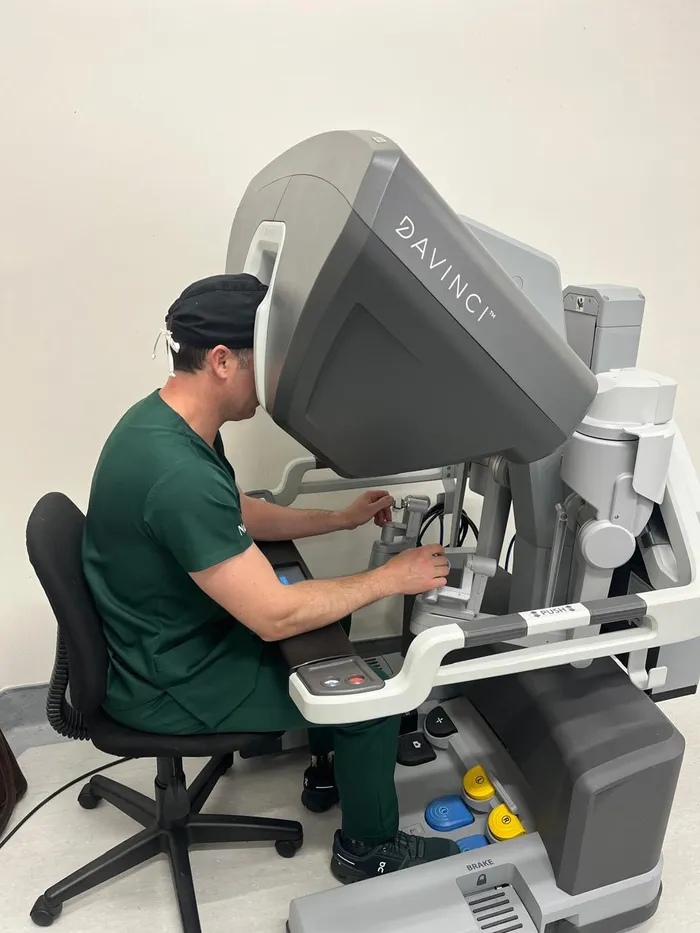
Dr Danelo Du Plessis performing surgery from the 3D console
Image: Supplied
Globally, robotic surgery is fast becoming the gold standard in many fields, offering results that rival or even surpass traditional laparoscopic techniques.
A 2024 consensus study on robotic surgery in transplantation confirmed that outcomes are comparable to standard methods, with added benefits like reduced recovery times.
In South Africa, where access to cutting-edge medical technology is often limited, this milestone represents a beacon of hope. It demonstrates the potential for public hospitals to provide world-class care, bridging the gap between innovation and accessibility.
Dr Matodzi Mukosi, CEO of Tygerberg Hospital, expressed pride in the hospital’s achievement,
“This milestone reflects our commitment to innovation and excellence in patient care. It’s a proud moment for Tygerberg Hospital and a testament to the extraordinary skill of our surgical teams.”
For the 4 300 South Africans currently on the kidney transplant waiting list, this breakthrough could be life-changing. By making organ donation less daunting for living donors, robotic surgery could increase the pool of available organs, giving more patients a second chance at life.
But the ripple effect extends beyond organ transplants. This achievement signals a brighter future for medical care in South Africa, where cutting-edge technology and skilled professionals are coming together to rewrite the possibilities of healthcare.
As we celebrate this milestone, it’s worth reflecting on the power of innovation to transform lives not just for the patients whose futures are rewritten by these procedures, but for the families, friends and communities who share in their journey.