Swept under ‘no-campaigning’ carpet
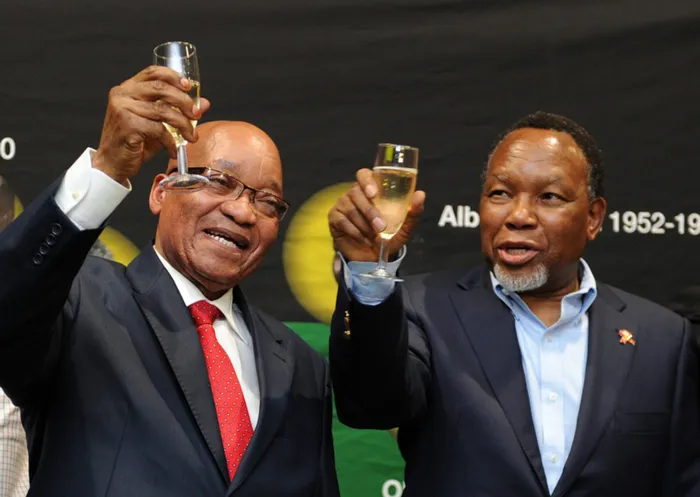
President Jacob Zuma and his deputy, Kgalema Motlanthe, share a toast. The ANC shows a friendly facade to the public " but behind the scenes campaigning is taking place. President Jacob Zuma and his deputy, Kgalema Motlanthe, share a toast. The ANC shows a friendly facade to the public " but behind the scenes campaigning is taking place.
SA and all but the activist-delegate-leader corps of the ANC are mesmerised onlookers on to a “no-campaigning campaign” for election into top ANC and national positions. A farcical cloak of “no campaigning please, we are disciplined cadres” veils the lining up of potential presidents and deputy-presidents that could take SA up to 2019.
The official ANC contention that “campaigning starts in October” is an obvious fallacy. The pervasive actually existing campaigning is disguised through denials, attempted “underground” statuses of factions, and proxy mobilisation such as that around the ANC Youth League.
But campaigning is there, for all except the self-blindfolded to see. It is misleading to contend that October is the month of nominations and hence the time for campaigns to commence. This is when regions and provinces start finalising their candidates, not when they start considering them. In effect, “campaigning in October” equates with “effectively no campaigning”.
Both in action and in occasional proclamation ANC activists are calling the no-campaigning bluff, albeit often with trepidation… the threat of “ill-disciplined cadres” being called to book is omnipresent, except for incumbents who campaign in the guise of movement and state duty.
Many of the ANC regions and some provinces are making their preferences known in these unfolding stakes. Cosatu is pushed to show its (divided) hand. The SACP is basking in the opportunity to stand by its man, Jacob Zuma, and map the ascendancy of candidate Blade Nzimande. The remaining youth league is campaigning on the ground for a Kgalema Motlanthe presidency.
The MK Veterans Association has repeatedly declared its bread to be buttered on the Zuma side. Nationalist sentiment is stirred up to recreate the 2005-07 under-siege-of-the-enemy sympathy around Zuma. Close Zuma associates try to root out criticism of their man. The women’s league appears publicly speechless in its endorsement of Zuma.
ANC branches are fighting tooth and nail to get the “right” delegates in place; those who will help construct the winning slate come Mangaung. Rival branches are springing up as precursors to Midrand’s policy conference and Mangaung. They are on both sides of the contest. It is the ANC’s Luthuli House (firmly under Zuma’s control), however, that will wield the final accreditation axe.
This is the actually existing campaign. It is of such a scale that some incumbents – Zuma and Gwede Mantashe, with the support of Nzimande – have possibly outmanoeuvred the challengers… under the mantra of “no campaigning, we are disciplined ANC cadres” and “now we focus on policy”. Turnarounds are possible, but the odds are stacked and daunting.
Hence, the ANC and SA’s future rulers are being elected in terms of underground, cloak-and-dagger campaigning. It cannot substitute for full and open campaigning because by definition it disallows systematic assessment. The implication is that the ANC and SA will get a leadership that is elected courtesy of mastery of strategy and tactics in internal politics. The new leaders would hardly have been interrogated – even just by the ANC – on how determined, committed and wise they are or will be in taking forward the collectively determined ANC public policy positions.
Even more than just determining the immediate next set of leaders, the current, inconsistent process directs the rolling out of future sets of presidents as well. Three assumptions inform this argument. The first premise, historically proven since at least the early 1990s, is that the ANC is a hierarchical organisation when it comes to the ascendance of deputy presidents into the party presidency. The second is that the ANC will continue to advance its president into the presidency of the country, and the third is that the ANC will remain in power at least until 2029.
Thus, with immediate effect, the ANC is electing the next president of SA – for 2014. Jacob Zuma may very well retain his position in Mangaung. He has by all current indications outmanoeuvred those who are obediently waiting for the starting gun. Zuma is the only one of the likely contestants with a declared candidacy.
That was first put in place before the ban on campaigning was instituted. His declaration was in the vintage ANC style of “if the people want me…” Subsequently, and in the context of the youth league’s thus far ill-fated rebellion, the ANC mantra of being disciplined cadres gained the force of imposition on to the leadership contest.
It was a case of “all hands off deck; the president is campaigning”.
With even longer term implications, the ANC is in all likelihood set to elect, under these no-campaigning-no-interrogation conditions, the subsequent president for SA – a now-deputy to take over from Zuma as ANC president in 2017 and 2019 as SA president. Should this yet-unknown person run for a second term, the 2012 ANC events could determine the president of the country for all of the period 2019-2029.
The hitherto strong supposition that ANC deputy presidents rise into ANC presidencies is moderated by growing insistence on generational mix, which is also a euphemism to replace Mantashe with Fikile Mbalula. In addition, Motlanthe, roughly the same generation as Zuma and consoled by already earning a presidential pension, may not be availing himself for a presidential term that would commence after the Zuma aeon had finally run out by 2017/2019 (obviously, should Zuma indeed make the grade in Mangaung).
Of matching importance is the question whether Motlanthe, should he not run for president this year, keep the hot seat of ANC deputy presidency occupied? If he exits, the space will be wide open for the anointment of the next, post-Zuma president of SA, 2019-2024-2029.
This unfolding process is of ANC and national importance, yet is swept under the no-campaign carpet. Tokyo Sexwale is on an undefined mission. Is he aiming for the top, now, or is he bartering the deputy presidency in exchange for not opposing Zuma? Cyril Ramaphosa’s name refuses to go away – presidency, deputy presidency? Some insist that Nkosazana Dlamini Zuma is Mangaung presidential mettle… Hence the frantic moves to try to deploy her to the AU.
There is some merit in the argument that the ANC needs to focus on policy, for now, and only campaign “when the time comes”. However, the argument falters. There needs to be a pairing of policy and leadership. Top-leader candidates need to tell the ANC (and in effect, even if indirectly, SA) how they would go about addressing pernicious policy problems – how they would lead, flesh out the collectively determined ANC directions, manage the state and make executive appointments.
Subject to this scrutiny, the ANC’s election processes will be more transparent and accountable. It would be better known why some leaders are capturing constituencies as we read this column.
There would be lessened chances for dubious patrons to advance candidates that will protect and deploy them to powerful positions. Timely, open campaigning would help do justice to the fact that ANC presidential and top-leader elections are in fact the first phase of SA elections.
l Susan Booysen is a professor at Wits University and author of The African National Congress and the Regeneration of Political Power.