

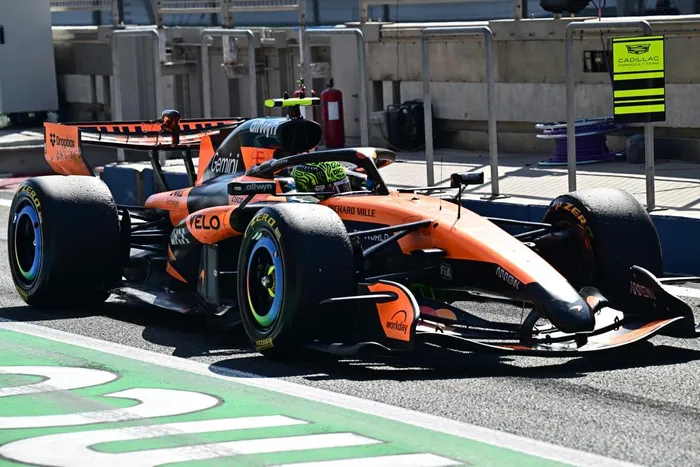
Lando Norris and McLaren will be gunning to retain their Formula 1 titles in 2026.
Image: AFP
For the first time since its inception, 22 drivers will take to the Formula 1 grid for a full season of racing.
The 2026 season promises to be a landmark year, not just for the sheer size of the driver roster, but for the sweeping changes in regulations, engines, and aerodynamics that are set to redefine the sport.
You can expect a season full of teething issues though, and fine-tuning, punctuated with flashes of brilliance, an upper echelon of blistering speed, and, inevitably, a fair share of drama.
The driver line-up for 2026 blends seasoned champions with young talent, ensuring a mix of experience, ambition, and hunger for victory across all 11 teams. Alpine fields Pierre Gasly and Franco Colapinto under the guidance of Flavio Briatore and Steve Nielsen, who share leadership responsibilities. Gasly brings consistency and precision, while Colapinto represents the next generation of rising stars.
Aston Martin keep Fernando Alonso and Lance Stroll behind the wheel, with Adrian Newey at the helm as team principal. Alonso’s wealth of experience will be invaluable in navigating the new regulations, while Stroll brings speed and determination.
Audi F1 Team, led by Jonathan Wheatley, features Nico Hülkenberg and Gabriel Bortoleto. Hülkenberg’s technical understanding will complement Bortoleto’s youthful enthusiasm, creating a team capable of quick adaptation.
Cadillac F1 Team debuts this season with Valtteri Bottas and Sergio Pérez driving, guided by Graeme Lowdon. This is a bold entrance for Cadillac, and both drivers are expected to deliver valuable feedback on the brand-new machinery.
Ferrari fields Lewis Hamilton alongside Charles Leclerc, with Fred Vasseur overseeing operations. Leclerc’s pace in testing has already set tongues wagging, while Hamilton brings unmatched experience and racecraft to the team.
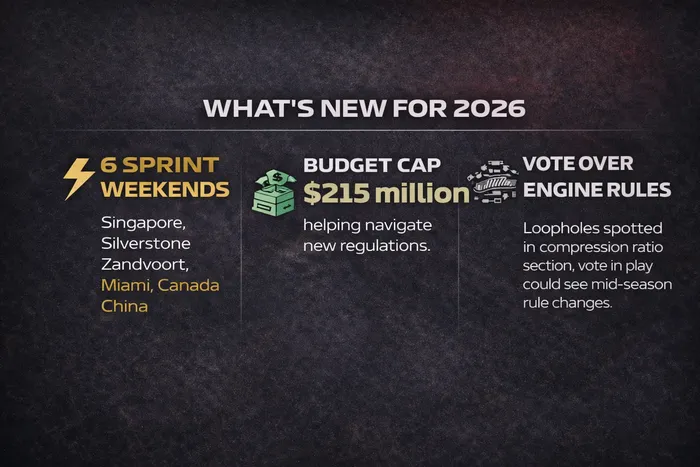
Some of the new changes in addition to the regulation changes for the 2026 F1 season. Some of the new changes in addition to the regulation changes for the 2026 F1 season.
Image: Supplied
Haas F1 Team runs Oliver Bearman and Esteban Ocon, under Ayao Komatsu. Haas remains a team that can surprise when the car clicks, and the blend of youth and experience provides flexibility in strategy.
McLaren continues with Lando Norris and Oscar Piastri, led by Andrea Stella. Both drivers have demonstrated race-winning potential, and McLaren will be looking to translate that into consistent podium finishes.
Mercedes pairs George Russell with rookie Kimi Antonelli, managed by Toto Wolff. Mercedes’ development prowess could give them a strong early advantage, though the new regulations present an unpredictable challenge.
Red Bull Racing, under Laurent Mekies, fields Max Verstappen and Isack Hadjar. Verstappen is an established powerhouse, while Hadjar’s promotion from the sister team brings youthful energy and fresh perspective.
Racing Bulls, Red Bull’s sister team, features Liam Lawson and Arvid Lindblad, guided by Alan Permane. Both are young drivers with potential to shine, particularly in chaotic races. Williams has Alex Albon and Carlos Sainz, managed by James Vowles. The team continues its push for consistency and competitiveness, with drivers capable of taking advantage of mid-field battles.
Sprint races will make a first-time appearance at Singapore, Silverstone, Zandvoort, Miami, Canada, and China, creating more opportunities for drivers to score points and for teams to influence the championship early. The 2026 season is defined by new regulations and bold engineering changes, but there are several other elements that make this season distinct:
* Active Aerodynamics – Teams can adjust front and rear wings dynamically, adding a new layer of strategy to overtaking and cornering.
* Boost and Overtake Modes – Strategic use of power delivery can allow drivers to gain advantages mid-race.
* Budget Cap Adjustments – The budget cap has been raised to $215 million, providing teams more resources to adapt to the extensive regulatory changes.
* Engine Development Loopholes – A vote is currently underway regarding a loophole in the engine compression ratio rules. Mid-season adjustments may occur, potentially reshuffling competitiveness unexpectedly.
* New Team Entry – Cadillac’s debut adds an eleventh constructor, broadening competition and challenging existing hierarchies.
* Driver Mix – Four former World Champions, combined with a deep pool of young talent, ensures races will be unpredictable and exciting.
* Sustainability Focus – Cars will run on advanced sustainable fuels, part of F1’s long-term environmental strategy.
Early testing highlights Pre-season testing in Bahrain has already offered a glimpse of what might be possible.
Charles Leclerc emerged as the fastest driver on the circuit, posting times that suggest Ferrari could finally mount a serious challenge for the championship. While testing results are never a guarantee, the combination of speed, reliability, and new aerodynamics hints at a potential resurgence for the Scuderia.
The introduction of sprint races at additional venues means more points up for grabs, adding intensity to Saturday qualifying sessions and influencing overall championship standings. Teams will need to manage tyre wear, engine reliability, and aerodynamic efficiency with even greater precision.
The raised budget cap allows for more development, but efficient use of resources will remain critical, particularly for mid-field teams aiming to close the gap on the front-runners. The potential mid-season regulatory adjustments, particularly concerning engine compression, could shake up the grid, rewarding teams that can adapt quickly.
Expect some dramatic moments as teams interpret, challenge, and optimise within these evolving rules. All of these factors converge to make 2026 one of the most strategically complex and technically innovative seasons in F1 history. Between the expanded sprint calendar, updated aerodynamics, new engine regulations, and the mix of veterans and rising stars, every race has the potential to produce memorable battles, unexpected podiums, and late-season twists.
Ferrari’s early testing pace suggests they may finally reclaim the speed they were lacking in previous seasons. However, Red Bull, Mercedes, and McLaren can never be underestimated, making this a truly open and unpredictable championship. So far, Charles Leclerc is the fastest around the Bahrain circuit during testing, signalling the possibility of a long-awaited Ferrari resurgence. Could 2026 finally be their season to dominate again? Personally, I hope so. It’s about damn time.
The 2026 season stretches from March to December, encompassing 24 races across six continents. Each track presents unique challenges, from high-speed straights to twisty street circuits, testing both driver skill and team engineering.
March 15: Australian GP, Melbourne – Albert Park Circuit
March 29: Chinese GP, Shanghai – Shanghai International Circuit
April 12: Japanese GP, Suzuka – Suzuka Circuit
April 26: Bahrain GP, Sakhir – Bahrain International Circuit\
May 10: Saudi Arabian GP, Jeddah – Jeddah Corniche Circuit
May 24: Miami GP, Miami – Miami International Autodrome
June 7: Canadian GP, Montreal – Circuit Gilles Villeneuve
June 28: Spanish GP, Barcelona – Circuit de Barcelona-Catalunya
July 5: Austrian GP, Spielberg – Red Bull Ring
July 19: British GP, Silverstone – Silverstone Circuit
August 2: Belgian GP, Spa-Francorchamps – Circuit de Spa-Francorchamps
August 16: Hungarian GP, Budapest – Hungaroring
August 30: Dutch GP, Zandvoort – Circuit Zandvoort
September 27: Azerbaijan GP, Baku – Baku City Circuit
October 4: Singapore GP, Marina Bay – Marina Bay Street Circuit
October 18: United States GP, Austin – Circuit of the Americas
October 25: Mexican GP, Mexico City – Autódromo Hermanos Rodríguez
November 8: Brazilian GP, São Paulo – Autódromo José Carlos Pace
November 21: Las Vegas GP, Las Vegas – Las Vegas Strip Circuit
December 6: Qatar GP, Lusail – Lusail International Circuit
December 13: Abu Dhabi GP, Yas Marina – Yas Marina Circuit
* Jehran Naidoo is sports reporter with focus on motorsport for Independent Media and editor of the social media channel The Clutch