

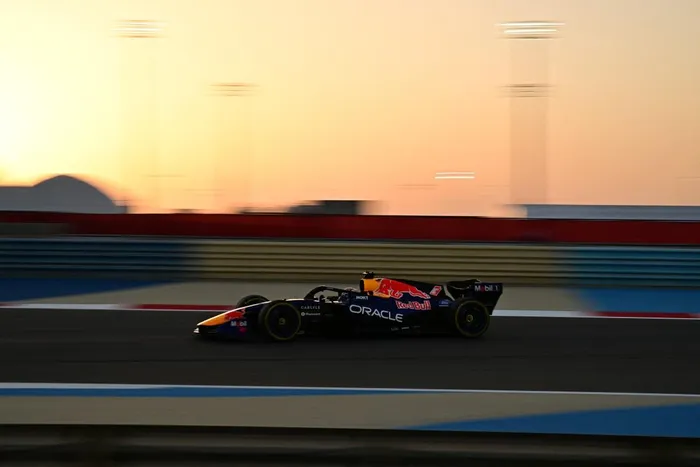
Despite 2026 regulation shake-ups, Laurent Mekies confirms there’s "zero concern" over Max Verstappen’s future. Photo: AFP
Image: AFP
Red Bull and Max Verstappen looked locked in for another season of racing under the new 2026 Formula 1 regulations, with no retirement concerns around the paddock’s best driver, according to team boss Laurent Mekies.
Mekies was unequivocal in his post-testing assessment, saying there was “zero concern” that Verstappen might lose interest in F1 despite some vocal criticism of the new cars, a clear vote of confidence in both Verstappen’s motivation and the team’s direction.
The 2026 Bahrain pre-season tests provided the first real benchmark for the radically redesigned Red Bull RB22 under its new technical and power unit regulations.
After two weeks of running, Verstappen’s best lap of 1 m 33.109 s placed him third overall on the final day of testing, about 1.117 s off the pace set by Charles Leclerc in the Ferrari (1 m 31.992 s) and behind Lando Norris as well.
Top Five drivers for the final day of Bahrain testing:
Charles Leclerc (Ferrari) – 1:31.992
Lando Norris (McLaren) – 1:32.871
Max Verstappen (Red Bull) – 1:33.109
George Russell (Mercedes) – 1:33.197
Pierre Gasly (Alpine) – 1:33.421
While still competitive, the times highlighted that Red Bull’s outright pace in testing hasn’t yet matched Ferrari or McLaren’s best. A gap of nearly two seconds in F1 feels like a lightyear away.
“I think it is quite obvious, of course, that there is still quite a bit of work to do for us to be faster… This week has been a good start… Let’s see what we get in Melbourne," Verstappen said.
Across the full test program, which included Barcelona shakedown runs and two three-day Bahrain sessions, Red Bull focused heavily on data gathering and reliability rather than outright times, completing hundreds of laps to validate the new RB22 and break-in the first Red Bull Powertrains-Ford engine.
A new gamble?
A major storyline for Red Bull’s 2026 campaign is the new driving partnership. Isack Hadjar has been elevated from the sister Racing Bulls team to join Verstappen at the front, a bold step given his relative lack of experience.
The Frenchman impressed during his rookie stave, earning his seat after a strong rookie campaign and podiums in F2 and free practice sessions. While pairing a seasoned world champion with an up-and-comer like Hadjar undoubtedly injects fresh energy into the team. How fruitful that combination will be towards Red Bull’s constructors’ title ambitions remains unproven. The second has been a nightmare for the Bulls since Sergio Perez was replaced was Liam Lawson.
It was, in many ways, a strategic gamble by the squad, one that could pay dividends if Hadjar develops quickly alongside Verstappen, but one that also carries the usual risks of a young pairing in a championship fight.
Off the track, Red Bull’s partnership with Ford and the transition to its own Red Bull Powertrains project has been one of the biggest off-season narratives. Ford’s return as a technical partner marked a strategic reinvestment in the team’s engine program, with the DM01 engine split across 12 key components developed in conjunction with Ford engineers.
Early feedback suggests this collaboration already looks solid, with both Verstappen and Hadjar contributing valuable insights to fine-tune the power unit and chassis integration. While still in its infancy, this alliance could be the cornerstone of Red Bull’s competitive future if development remains strong and sustainable.
Verstappen optimism
Adding an external vote of confidence, Jos Verstappen, Max’s father and former F1 driver, expressed optimism about the team’s winter work.
He described the RB22’s early signs as “promising” given the scale of the regulation changes and praised the team’s craftsmanship and reliability, especially regarding the engine. Jos conceded that “you never know what’s behind the tests,” but said he was “satisfied with what’s happening,” particularly the power unit’s performance and the team atmosphere.
So, where are Max Verstappen and Red Bull after the biggest regulation overhaul in years? They are competitive, ambitious, and clearly in the title mix, but not yet unequivocally dominant. To be fair, they haven't been for the past two seasons.
Bahrain’s benchmark times and Verstappen’s honest assessment underscore that there is more development work ahead. How quickly Red Bull can close the gap and harness its new team-mate dynamic, all while integrating a fresh engine collaboration with Ford, will define their 2026 season.
Jehran Naidoo is sports reporter with focus on motorsport for Independent Media and editor of the social media channel The Clutch