

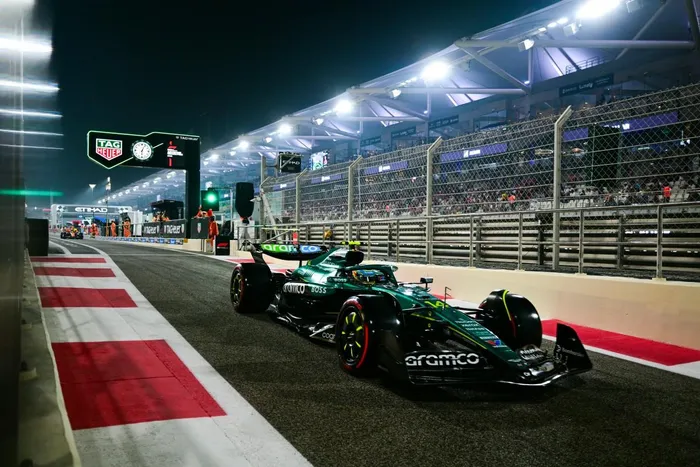
Honda’s return to a sweeping regulatory overhaul has sparked memories of the 2015 McLaren nightmare. With testing woes mounting, can Adrian Newey and Aston Martin find a way out of the midfield? Photo: AFP
Image: AFP
The last time Formula One underwent a sweeping regulatory overhaul, Honda Racing found themselves painfully exposed. Their reunion with McLaren in 2015 was meant to rekindle one of the sport’s most iconic partnerships. Instead, it became a cautionary tale.
For three seasons between 2015 and 2017, McLaren wrestled with an underpowered, unreliable engine that left the once-dominant team stranded at the back of the grid. The relationship fractured under the strain, and McLaren cut ties before Honda, armed with hard-earned lessons, went on to forge a championship-winning dynasty alongside Red Bull Racing.
A decade later, history threatens to repeat itself. This time, it is Aston Martin that finds themselves tethered to Honda at the dawn of another transformative era. The 2026 regulations represent the most significant technical reset since the hybrid revolution of 2014.
And early signs suggest Honda may once again be scrambling to catch up. Honda Racing Corporation president Koji Watanabe did little to hide the company’s concerns following pre-season testing.
“I think it's clear that we're not satisfied with how we're doing now,” Watanabe said, a blunt assessment that echoed the unease surrounding Honda’s readiness. Testing, the critical window in which manufacturers gather essential performance and reliability data, did not go according to plan.
“We identified a lot of areas to work hard on by the first race. Ideally, we would have liked to run more during the tests and collect more data, but unfortunately we ran into some unexpected problems that we are working on.”
Those lost miles could prove costly. With engine homologation looming, Honda faces a narrow window to resolve its deficiencies before hardware development is frozen.
“We must approve the engine at the end of the month,” Watanabe explained. “Based on this, we will optimise how we can make the power unit work.”
While pragmatic, this hints at a familiar scenario. When manufacturers speak of “optimisation” so early, it often signals fundamental limitations baked into the design. Once frozen, the opportunity for meaningful hardware improvements vanishes, leaving teams to extract incremental gains through software and operational refinement.
Aston Martin’s troubled Bahrain test was defined by fundamental reliability and integration failures, largely centered on the new Honda power unit. Battery faults, hybrid energy recovery weaknesses, and cooling inefficiencies severely limited running, robbing the team of vital data.
Gearbox and engine integration problems further compromised drivability, with poor synchronization affecting stability and power delivery. These setbacks forced extended garage time and emergency cooling modifications, highlighting deeper packaging and thermal management concerns.
Most alarming was the lack of mileage, which prevented meaningful setup work and performance optimization. On the final day of testing, Aston Martin complete 146 laps among both drivers. The result was a car lacking both reliability and pace, exposing serious deficiencies that could leave Aston Martin struggling to escape F1’s midfield early in the season.
For Lawrence Stroll, the stakes could not be higher. Over the past several years, Stroll has invested hundreds of millions into transforming Aston Martin into a title-contending force he thinks it can be. He has recruited elite engineering talent, secured the services of legendary designer Adrian Newey, and built one of the most advanced facilities in F1.
Yet, even the best chassis cannot compensate for a deficient power unit. Watanabe remains publicly optimistic, outlining Honda’s long-term strategy and emphasizing collaboration across its motorsport divisions.
“We are proceeding decisively to establish a collaboration between the F1 programs and MotoGP,” he said. “We are considering how we can link the two realities to transfer and share skills between projects and thrive in their respective championships.”
It is a forward-thinking approach, but optimism is also a corporate necessity. Public confidence buys time — time Honda may urgently need. History suggests patience will be required.
Honda’s hybrid program eventually flourished, but not before years of struggle. Ironically, Honda had already begun solving many of their early shortcomings while still partnered with McLaren, yet the results never materialized on track until its switch to Red Bull.
That raises an uncomfortable question for Aston Martin: do they have three seasons to wait?
F1’s competitive cycles are unforgiving. Momentum, once lost, can take years to recover. While there remains time for Honda to stabilize its platform, the most realistic outlook for the immediate future is modest progress rather than instant success.
Caught between ambition, limitation and bad timing, Aston Martin may find itself stuck in Formula 1’s crowded midfield, again, this season. All the while history doesn't take so long to repeat itself.
Jehran Naidoo is sports reporter with focus on motorsport for Independent Media and editor of the social media channel The Clutch