

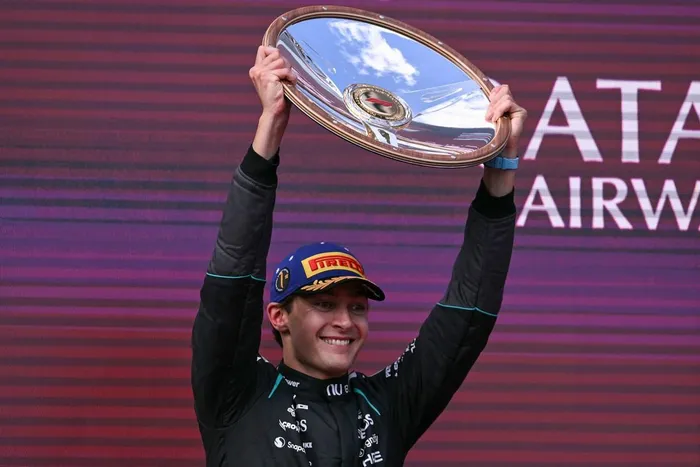
George Russell won the season-opening Australian GP on Sunday for Mercedes. Photo: AFP
Image: AFP
The opening race of the Formula One season has clearly shown which teams are in favour of the new regulations and which teams will likely spend this season catching up. The curtain-raiser at the Australian Grand Prix on Sunday morning did more than hand out the opening points of the year, it exposed a sharp divide in how the grid has adapted to F1’s sweeping 2026 regulation overhaul.
At the front of the field, Mercedes looked right at home in the new era. From the first practice laps to Sunday’s chequered flag, the Silver Arrows dictated the tempo with commanding pace in both qualifying and race trim.
Their aerodynamic platform looked stable, their energy deployment clean, and their tyre management composed, all hallmarks of a team that has quickly decoded the new rulebook.
Close behind, Ferrari proved they are no mere supporting act. While Mercedes held the outright edge, Ferrari’s race pace and aggressive starts kept the pressure on throughout the weekend.
The Scuderia showed they have a car capable of fighting at the sharp end, even if they still lack the final tenths that separate contenders from favourites. Mercedes team principal Toto Wolff acknowledged exactly that after the race, admitting his team will not have things their own way this season.
“We have a fight on our hands with Ferrari,” he conceded, pointing to how closely matched the two outfits looked once the lights went out.
It was a telling remark, less celebration, more recognition that the title battle is already taking shape. But while Mercedes and Ferrari appear aligned with the direction of the new regulations, frustration is brewing elsewhere.
Both McLaren and Red Bull left Melbourne with more questions than answers.
In the paddock and in front of the microphones, the sentiment was blunt: the 2026 cars are not delivering the driving experience many hoped for. Reigning world champion Lando Norris was among the most vocal critics, lamenting the feel of the new machinery and suggesting the sport had taken a step backwards in drivability.
His comments echoed a wider unease among drivers adjusting to heavier cars, complex energy systems, and a racing style shaped as much by battery management as outright speed. Wolff, however, appeared surprised by what he viewed as a nostalgic tone in Norris’ assessment.
He noted that drivers rarely praised previous generations of cars at the time and suggested comparisons to the past can blur objective judgment. While he stressed that driver feedback matters, Wolff also underlined a broader priority: whether the racing remains compelling for fans.
If improvements are needed, he indicated the sport has room to evolve. Amid the regulation debate and emerging team hierarchy, one storyline stands out — Mercedes is back on top. For George Russell, this may finally be the long-awaited breakthrough. The Brit has spent years proving his pedigree, often carrying teams through rebuilding phases and near-misses.
Now armed with the grid’s most complete package, Russell finds himself in prime position to mount a serious championship assault. A first world title would be richly deserved, but consistency will be everything.
If Mercedes maintain their edge and Russell sustains this level across the remaining 23 races, the regulation reset may well be remembered as the moment his career shifted into championship gear.
Jehran Naidoo is sports reporter with focus on motorsport for Independent Media and social media coordinator of the our YouTube channel The Clutch