Model T of the electric era? Ford announces affordable EV family with 'revolutionary' assembly process
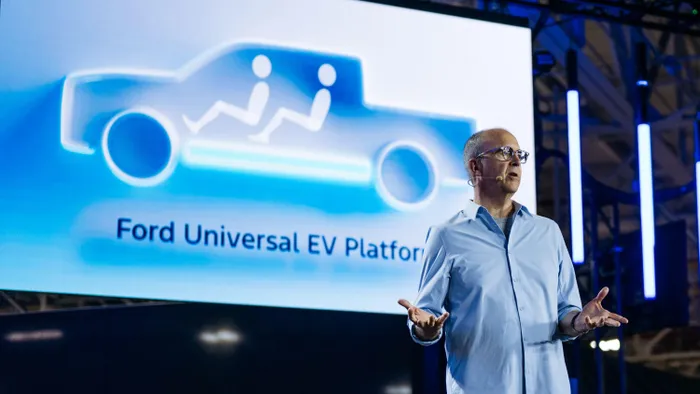
Ford's chief EV officer Doug Field has shared the company's plans to design and assemble breakthrough electric vehicles.
Image: Supplied
Big, heavy and expensive electric vehicles (EVs) have limited profit potential for Ford, its global CEO Jim Farley has previously stated. For that reason, the company is now shifting its focus towards smaller and more affordable EVs that better align with customer needs and cost structures.
This new strategy will be underpinned by Ford’s brand-new ‘Universal EV Platform’, designed to enable a family of affordable EVs that can be produced at scale.
Instrumental in this plan is what it calls a more efficient assembly process.
“More than a century after the invention of the moving assembly line, Ford combines its industrial know-how with a start-up mentality to create the new Ford Universal EV Production System, radically simplifying vehicle assembly for safety, quality and speed,” Ford said at an event held at its Louisville plant in Kentucky on Tuesday.
To achieve this, Ford transformed the traditional assembly line, which is essentially one long conveyor, into three sub-assemblies which run down their own lines simultaneously before joining together near the end.
Large single-piece aluminium unicasings replace dozens of smaller parts, allowing the front and rear of the vehicle to be assembled separately. The battery forms the basis of the third sub-assembly, to which the seats, consoles and carpeting are assembled.
Parts are moved down the assembly tree in a kit, which includes all the fasteners, scanners and power tools required by the operator, and in the correct orientation for use.
Ford says the new platform reduces parts by 20%, with 25% fewer fasteners and 40% fewer workstations. Assembly time is also said to improve by 15%.
See how it works in the video below:
To further reduce costs and enhance durability, the vehicles will use lithium iron phosphate (LFP) batteries, which also enable space and weight savings.
“We put our employees at the center and re-created the factory from scratch,” said Bryce Currie, Ford’s regional manufacturing VP.
“We live and breathe continuous improvement, but sometimes you need a dramatic leap forward. We expect ergonomic breakthroughs and complexity reduction - through elimination of parts, connectors and wire - will flow through to significant quality and cost wins.”
Fast and affordable compact bakkie
As mentioned, this platform will spawn an entire family of vehicles, but the only one that Ford is mentioning for now is a compact double cab pick-up (bakkie).
This vehicle, it says, will have more passenger space than the Toyota Rav4, and it will also have a ‘frunk’ and spacious cargo bed, which will make it possible for owners to lock on their surfboards and other gear, without the need for a roof rack or trailer.
It should be fun to drive, thanks to the lower centre of gravity, and Ford claims it will accelerate to 100km/h quicker than a Mustang EcoBoost.
It will be relatively affordable too, with Ford mentioning a starting price of around $30,000 (R534,000) in the US.
“We took inspiration from the Model T - the universal car that changed the world,” said Doug Field, Ford’s chief EV, digital and design officer.
“We assembled a really brilliant collection of minds across Ford and unleashed them to find new solutions to old problems. We applied first‑principles engineering, pushing to the limits of physics to make it fun to drive and compete on affordability.
“Our new zonal electric architecture unlocks capabilities the industry has never seen. This isn’t a stripped‑down, old‑school vehicle.”
IOL Motoring