
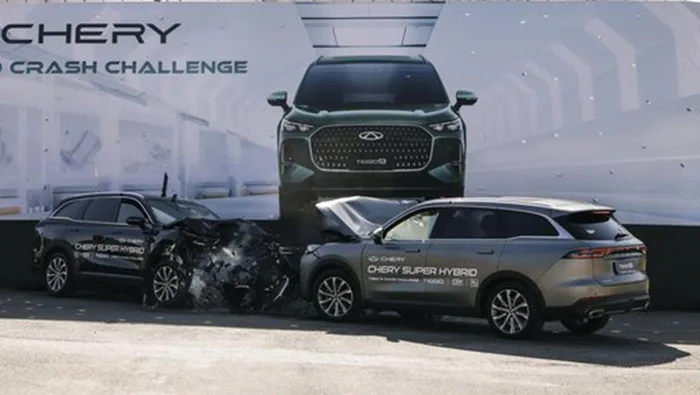
The Chery Tiggo 9 crash test simulated a common and dangerous type of accident.
Image: Supplied
Judging by the evidence seen so far, you can rest assured that the recently launched Chery Tiggo 9 is an extremely safe vehicle.
To prove this, Chery South Africa recently conducted Africa’s first real-world dual-vehicle crash test by colliding two Tiggo 9s in a controlled 50% offset head-on crash at 50km/h. This, said the Chinese carmaker, replicated one of the most common and dangerous types of accident.
Thankfully for Chery, all went according to plan. The cabins of both vehicles remained completely intact, with zero deformation of the A-, B- or C-pillars, according to the carmaker, while all the doors could still be opened normally.
Featuring 85% high-strength steel and no fewer than 10 airbags, the Tiggo 9 was designed to meet global five-star safety standards.
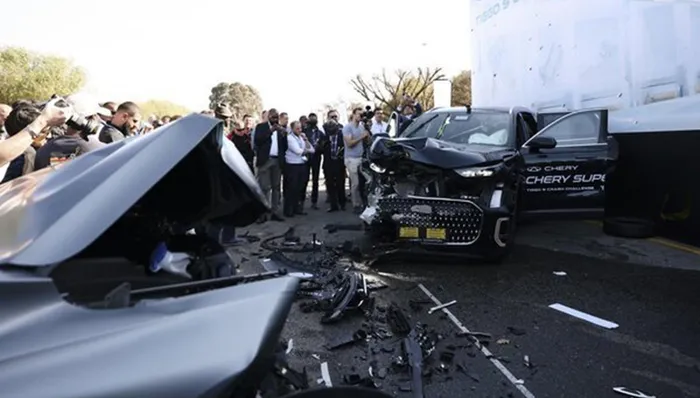
Chery's dual-vehicle crash test was a smashing success.
Image: Supplied
However, Chery South Africa describes this dual-vehicle crash as a “milestone in automotive safety” carried out in a country where road safety is an “urgent priority”.
I’m not for one moment going to imply that Chery shouldn’t produce the safest cars that it possibly can, nor that this shouldn't be celebrated. However, I vehemently disagree that this particular crash test should be seen as a win for road safety in Africa.
Let’s look at the basic physics here. With its large dimensions, luxurious interior, and heavy batteries for its plug-in hybrid system, the Tiggo 9 weighs over 2.3 tonnes. A smaller and lighter vehicle crashing into it would surely come off second best if it crashed into the Tiggo 9, or a similarly sized vehicle. A compact vehicle would surely be obliterated.
News flash: most vehicles on the road are lighter than the Tiggo 9, which - though very well priced for what it is - is also out of grasp for most local car buyers, starting at R839,900.
The difference that mass and stature can make was most famously illustrated in a German ADAC crash test some years back when a four-star safety-rated Audi Q7 practically obliterated a five-star-rated Fiat 500 hatchback.
That’s not to say there is an easy solution to this problem. It’s almost impossible to avoid weight differences between cars on the road, short of a taxation system that penalises vehicles that are too heavy or too light. That would surely seem excessive and draconian.
But this is something that South Africans need to think about before purchasing their next vehicle, assuming safety is a priority. And perhaps all carmakers could work towards making their larger vehicles lighter, as well as more forgiving towards smaller vehicles in a crash.
But if we're going to talk about victories for road safety in Africa, dare I suggest they crash a Chery Tiggo 4 into a Tiggo 9 for the next round?
IOL Motoring