
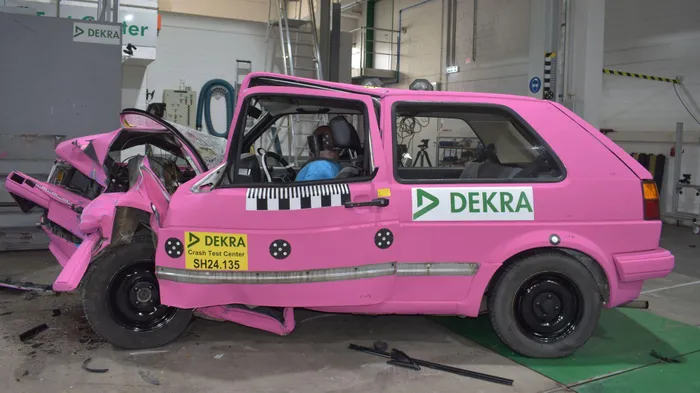
Occupants would not have survived the 64km/h crash, according to experts.
Image: Supplied
“They don’t make them like they used to” is a saying often repeated in conversations about old cars. Newer vehicles are “soft” and will crumple up like paper in a crash, or so they say. Yet all the evidence we’ve seen so far suggests that modern cars are much safer in an accident.
Since the formation of independent crash testing authorities such as Euro NCAP in the late 1990s, we’ve seen a dramatic improvement in vehicle safety.
To drive that point home in startling fashion, Dekra recently crash tested a Volkswagen Golf 2 at its facility in Neumünster, Germany, and the result was sobering to say the least.
Its occupants would have had little chance of surviving this collision due to the collapse of the passenger compartment and the deep penetration of vehicle components into the passenger compartment, Dekra expert Markus Egelhaaf explained. The lack of an airbag also meant the driver was not shielded from the steering wheel.
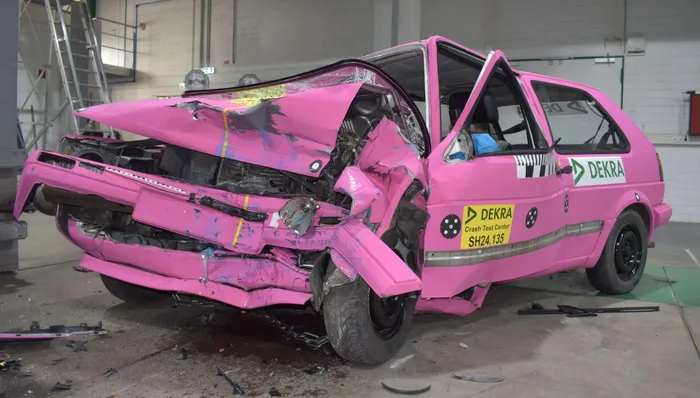
Severe structural deformation took place on the older-generation car.
Image: Supplied
The vehicle, said to be in mint condition, was collided with a barrier at a speed of 64km/h with a 40% overlap, mimicking the test that Euro NCAP performed until 2020. It also corresponds to a head-on collision between two identical vehicles travelling between 50km/h and 55km/h.
Dekra compared its results to the latest Euro NCAP crash test of a Golf 8, in which the newer model’s passenger compartment remained completely intact, with its occupants protected by multiple airbags as well as more modern seatbelts with tensioners and force limiters.
As a result, the occupants of the eighth-generation Golf would have likely escaped with just minor injuries, Egelhaaf said.
The organisation also directly compared the Golf 2 and 8 models in a series of tests that included braking, handling and nighttime illumination.
The road holding differences were not massive, with the newer car being able to handle an emergency double lane change at 75km/h versus 65km/h for the older car. However, the braking distance of the new vehicle was a significant 30% shorter, and the testers also found the Golf 8’s LED headlights to provide vastly superior illumination.
“Overall, the tests have shown the progress that has been made in vehicle safety over the past 35 years”, Egalhaaf concluded.
ALSO READ: Zero-star crash test shows why airbags are so important
That’s not to say we shouldn’t love and appreciate classics such as the Golf I and II, and many others from the 1980s and prior. However, it helps to understand their limitations and also appreciate the strides that have been made in modern car safety technology.
It also doesn’t mean the Golf 2 is unsafe for its era. In fact, it is likely one of the safest, given the safety engineering that Volkswagen spoke of at the time. Many other independent crash tests have shown older models to be significantly less safe than their modern counterparts, with two famous examples being the Nissan Tsuru versus Almera, and the Chevrolet Malibu versus its 1950s counterpart, the Bel Air.
IOL Motoring