

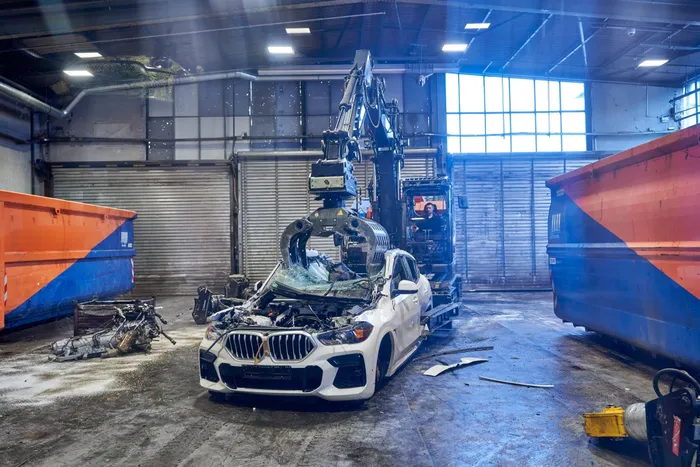
Vehicles are methodically deconstructed. Airbags are removed, fluids drained and wiring harnesses extracted. What remains is pressed into a dense cube. The cube is sent to external facilities, where metals and plastics are shredded, separated, melted down.
Image: Supplied
The end of a vehicle’s life isn’t a pretty sight. Metal groans, glass shatters, and an excavator tears into what was once the beating heart of a BMW. In a few minutes, the car is reduced to a pile of parts, stripped of its valuable materials.
But this violent-sounding process marks the beginning of the rebirth of resources.
At BMW’s Recycling and Dismantling Centre (RDC) in Unterschleissheim, near Munich, sustainability takes on a new form. Since 1994, the complex has been the centre of innovation, dedicated to rethinking what happens when a car reaches the end of its life.
What began as a modest facility to dismantle pre-series and test vehicles has evolved into a global centre of excellence for circularity, the idea that nothing should go to waste.
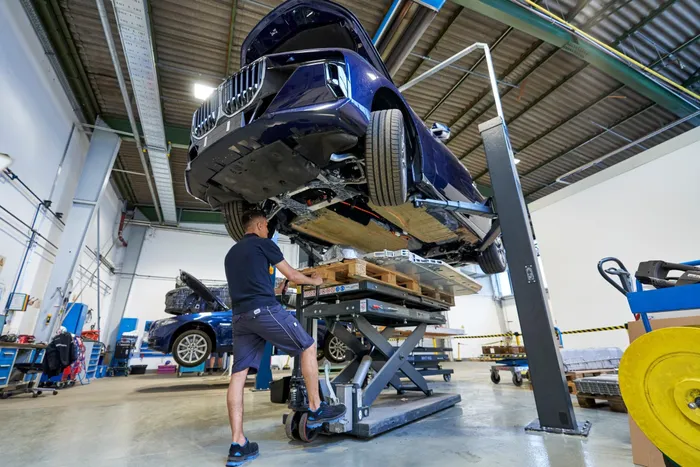
As global regulations tighten and customers demand greater environmental responsibility, BMW’s Recycling and Dismantling Centre is more relevant than ever.
Image: Supplied
Full-circle approach
Daniel Koschade, BMW’s Head of Circular Economy Network and Requirements, describes the RDC as “a vital link between early-stage development and real customer needs.” He explains that the team’s mission isn’t just to recycle vehicles, but to close the loop - ensuring materials find their way back into new cars.
“We recycle around 6,000 cars a year here, with capacity for up to 10,000,” says Koschade. “We know our customers, and we know our vehicles. We follow the entire life cycle — from when we sell a car to when it comes back - and then we feed what we learn back into development.”
This philosophy is captured in three simple words: Relax, we care. It’s a promise that extends beyond customer service to environmental responsibility. “Sustainability is no longer a trend,” Koschade emphasises. “It’s a responsibility - one we live day by day.”
What is circularity?
For BMW, circularity isn’t about ticking a regulatory box. “In the past, we treated end-of-life components as waste,” Koschade says. “Now we view them as valuable resources.”
Modern vehicles must be 85% recyclable and 95% recoverable by law. That includes not only metals and plastics but also high-voltage batteries - one of the most complex elements to recycle. BMW’s goal is to keep materials circulating in the economy as efficiently as possible, minimising the need for virgin resources.
The RDC’s circular strategy operates on two levels:
The inner loop: This focuses on repair and reuse. Defective components are refurbished and reused in warranty cases or offered as affordable replacement parts. “That’s the best kind of recycling, you reuse what already exists.”
The outer loop: This deals with components that can’t be repaired. These are dismantled and sent for material recovery, extracting valuable metals such as copper, aluminium, and elements from catalytic converters.
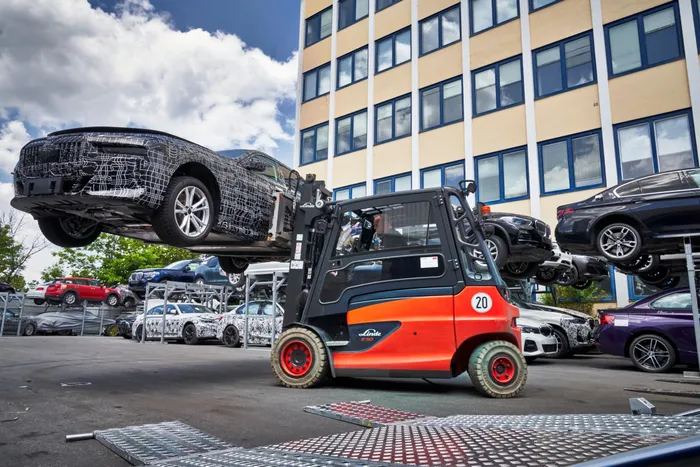
What began as a modest facility to dismantle pre-series and test vehicles has evolved into a global centre of excellence.
Image: Supplied
Designing for disassembly
Circularity begins at the design stage. BMW’s engineers collaborate closely with recycling experts to make future vehicles easier to dismantle.
“We’re designing vehicles to be easier to take apart and recycle,” says Koschade. “For instance, high-voltage batteries are now screwed, not glued. It sounds simple, but it makes a huge difference when you have to repair or recycle them.”
“It’s a completely new way of thinking,” Koschade adds. “We discuss material choices, connections, and assembly techniques at the very earliest stages of design.”
New life for batteries
Electric vehicles bring new challenges and opportunities. When an EV battery reaches the end of its life, it’s not discarded. At the RDC, used batteries are dismantled and sent to BMW’s partner, SK TES, a specialist in battery recycling technology.
Through mechanical shredding and a process called hydrometallurgy, key elements such as nickel, cobalt and lithium are recovered from what’s known as the black mass. These materials are then fed back into BMW’s supply chain for use in new batteries.
“This is a perfect example of a closed loop,” says Koschade. “We buy cells from suppliers, use them in our cars, then recycle and return the recovered materials to make new cells for future models.”
BMW’s battery recycling operations are in the process of expanding. After establishing loops in Europe and China, the company plans to extend the system to the USMCA (United States, Mexico, Canada) region by 2026, creating a global approach to resource recovery.
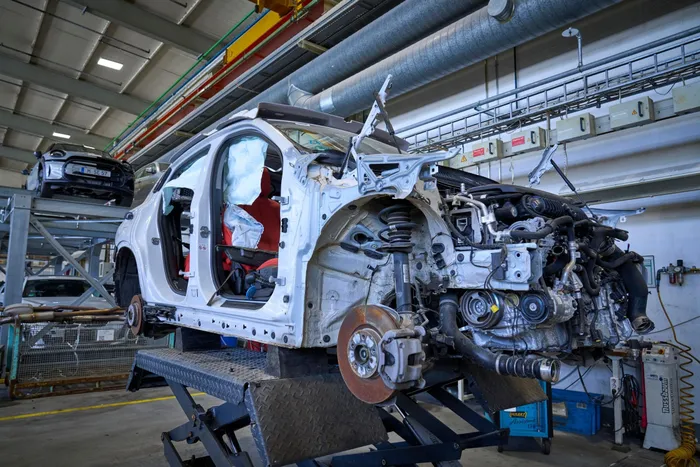
Over the past 30 years, more than 120 000 vehicles have been processed at the RDC.
Image: Supplied
The beating heart of circularity
The RDC isn’t just a recycling plant; it’s also a laboratory. Every process is meticulously logged and analysed, generating insights that flow back into BMW’s product development teams.
“We’ve transformed the RDC from a recycling facility into a centre of competence,” Koschade explains. “Engineers come here to learn. The data and findings help shape the design of future BMWs.”
Over the past 30 years, more than 120,000 vehicles have been processed at the RDC. That’s equivalent to a mountain of metal 20 times higher than Mount Everest.
Nearly one million litres of fluids have been drained - enough to fill 19 tanker trucks - and a staggering 200,000 kilometres of wiring harnesses have been extracted, enough to wrap around the earth five times.
“It’s tough work,” Koschade admits. “But it’s worth it. Every bit of material recovered makes a difference.”
Sharing knowledge
The RDC’s influence extends beyond Munich. BMW coordinates a global network of around 3,000 partner recyclers across 41 countries. Each of these dismantlers has free access to a cross-manufacturer database, detailing how to recycle and recover materials from BMW vehicles safely and efficiently.
“The circular economy won’t work if we act alone,” we need to enable the whole dismantling industry to recycle our vehicles in the best possible way,” says Koschade.
This collaborative approach has created a feedback loop not only for materials but also for knowledge, ensuring that lessons learned in the RDC inform the entire automotive ecosystem.
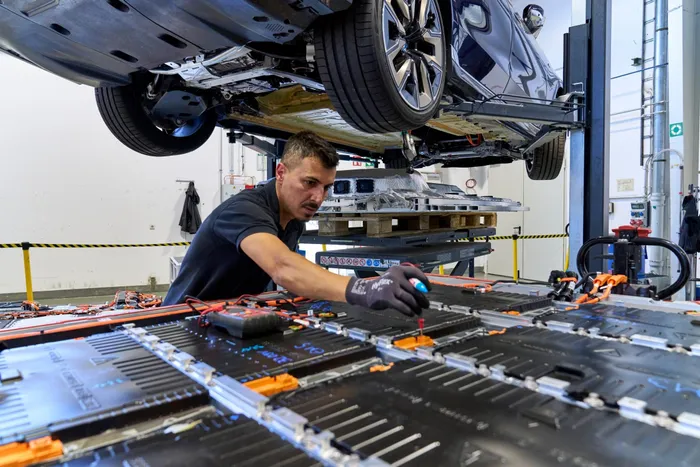
Through mechanical shredding and a process called hydrometallurgy, key elements such as nickel, cobalt and lithium are recovered from what’s known as the black mass from recycled batteries.
Image: Supplied
Scrap to strategy
In the workshops of the RDC, vehicles are methodically deconstructed. Airbags are removed, fluids drained, and wiring harnesses extracted. What remains is pressed into a dense cube. The cube is sent to external facilities, where metals and plastics are shredded, separated, melted down, and returned to the cycle as secondary raw materials.
With this, BMW meets its legal recycling obligations. But for Koschade and his team, compliance is just the start. “We don’t just want to meet regulations,” he says. “We want to create potential - for our business, for our customers, and for the planet.”
Moving forward
As global regulations tighten and customers demand greater environmental responsibility, BMW’s Recycling and Dismantling Centre is more relevant than ever. “Circularity is becoming increasingly important for the automotive industry’s future,” Koschade says. “And the RDC will play a key role in that journey.”
At Unterschleissheim, the past is literally being torn apart to make way for the future, proving that when a car’s life ends, its story doesn’t.