

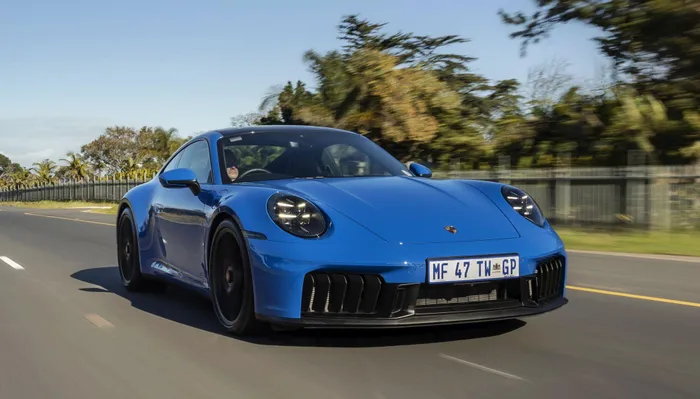
The new Porsche 911 GTS now produces a shade under 400kW.
Image: Supplied
Very few performance cars, if any, can match the feeling of balance inherent in a Porsche 911. Whether you’re blasting around a track, sweeping your way through a mountain pass, or simply trundling through traffic to the next board meeting, it is the sports car for all reasons.
The 911 GTS, first introduced in 2010 as part of the '997.2' generation, has always epitomised this blend of performance, driving thrills and comfort. But whereas the previous versions felt very much like spicier Carreras, the new 2025 GTS feels more akin to a tamer 911 Turbo. It genuinely begs the question of whether you even need to stretch your way to Porsche’s performance flagship, which was also recently revised.
Ushering in several visual and cabin enhancements to the 911 range, the new GTS is also the first model to feature Porsche’s new T-Hybrid “super-lightweight performance hybrid” system.
It pairs a new 3.6-litre flat-six (boxer) turbopetrol engine with an electric motor that’s integrated into the new eight-speed PDK dual-clutch gearbox. With system outputs of 398kW and 610Nm, it is 45kW brawnier than before, and it also swaps its predecessor’s twin turbochargers for a single blower that features an integrated electric motor, to all but eliminate lag.
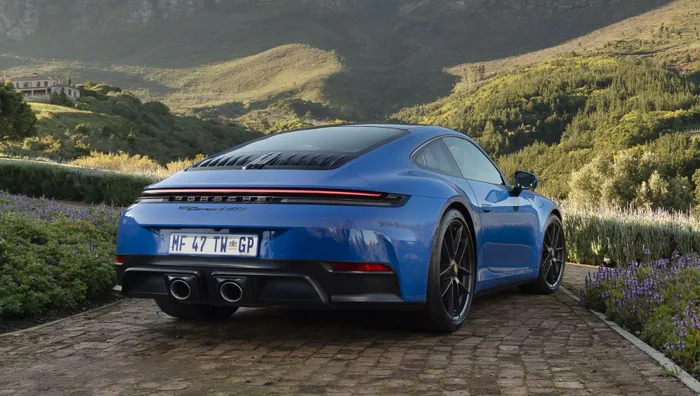
The latest 911 features visual changes inside and out.
Image: Supplied
The petrol engine alone delivers 357kW and 570Nm, while the e-motor adds 40kW and 150Nm to the equation. It pairs with a 1.9 kWh battery, which also helps power the vehicle’s ancillaries. This hybrid system is far more about performance than economy. According to the official figures, it consumes 0.3 litres per 100km less petrol than its predecessor, which still qualifies as a small win considering that the new model is 50kg heavier.
But enough of that - let’s speak about the speed. According to Porsche, the new GTS can accelerate from 0-100km/h in three seconds flat in the case of the Carrera 4 PDK version. The GTS is also available as a Carrera 2, with rear-wheel drive, and customers can further choose between Coupe, Cabriolet, and Targa body styles, with the latter only available in ‘4’ guise.
Porsche has completely reworked the suspension of the GTS, and most importantly, rear-axle steering is now standard on this mid-tier 911 model.
Porsche South Africa let us loose in both the Carrera 2 GTS and Carrera 4 GTS models over two days in the Western Cape. The route would take us over seven mountain passes, including Helshoogte and Franschhoek Pass. It also allowed us to get acquainted with the Porsche Roads app, which is loaded with cool driving routes that owners can access via their Apple CarPlay or Android Auto.
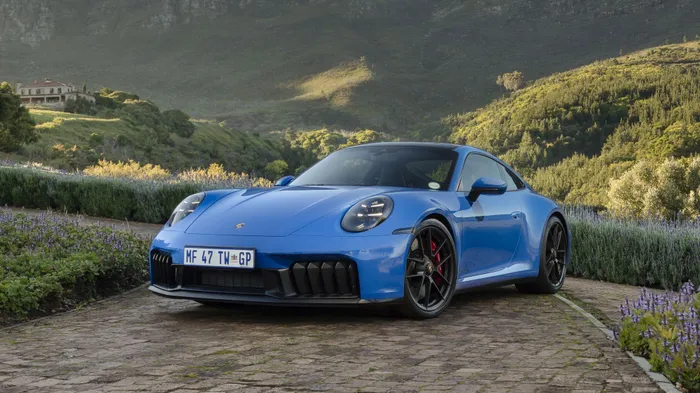
The GTS rolls on 20-inch (front) and 21-inch (rear) wheels.
Image: Supplied
What immediately struck me about the new 911 GTS was just how responsive it has become, thanks to that electrically assisted turbocharger and the instant torque provided by the e-motor. Power delivery is instantaneous, yet that sonorous flat-six howl is also present from the word go as both motors combine to launch you off the line like a super typhoon.
Being all-wheel drive, the Carrera 4 was much easier to launch off the line than its rear-wheel drive counterpart, the latter producing more wheelspin and tail swaying, but at higher speeds, the differences between the two were less apparent. Although extra caution is prudent in the rear-driven model, it never failed to surprise with its level of grip and stability. That I would say is true in the case of both cars.
Communicative steering and agile handling have always been hallmarks of modern 911s, and the latest GTS is no exception. It’s all about balance, as I said earlier, and you can really ‘dance’ it through a corner.
The suspension is firm, of course, but on the relatively smooth Western Cape tarmac we encountered on the launch, it never felt uncomfortable or jarring. This really is a sports car for all occasions.
As mentioned earlier, the 911 range has been handed a series of upgrades.
In typical Porsche fashion the evolution is subtle. Most notable are the five vertical active cooling air flaps on either side of the front bumper. Buyers can also opt for new HD matrix LED headlights with over 32,000 light points.
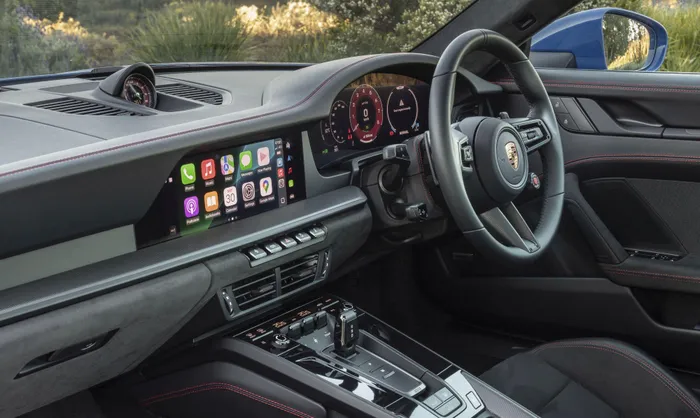
The cockpit is more digitised, but still has a traditional feel.
Image: Supplied
The revised cabin features a fully digital curved instrument cluster and a start button has finally been added to the dashboard.
The 10.9-inch central infotainment screen remains as before, but its operation and connectivity have been significantly improved, Porsche says, particularly when it comes to customising the driving modes and driver assistance systems.
Porsche 911 GTS Pricing (September 2025)
IOL Motoring