

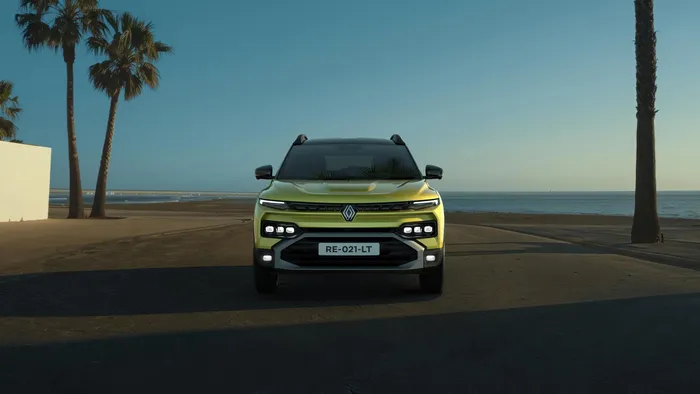
The Renault Kiger Turbo has received significant upgrades, including a turbocharged engine, advanced technology features, and a fresh exterior design.
Image: Supplied
A 1.0-litre three-cylinder normally aspirated engine with 53kW and 96Nm of torque struggles to pull the skin off the proverbial custard, and it’s made even worse in the rarefied Gauteng air.
It was one of the major drawbacks of the Renault Kiger, which has now been upgraded by mounting a turbocharger to the unit, which increases outputs to 74kW and 160Nm, making it a much-improved drivetrain.
Still, it remains a popular option in the B-SUV segment with 28,000 Indian made Kigers having found homes locally since its introduction in 2021.
And while they were at it, they also gave the exterior a fresh look, a better-equipped cabin and improved convenience features.
The Kiger Turbo comes out in three trim levels: 1.0L Turbo Techno, 1.0L Turbo Iconic, both with a five-speed manual transmission and 1.0L Turbo Iconic CVT, which, as the name suggests, is paired with a continuously variable transmission.
From the outside, the Kiger Turbo keeps the same compact SUV formula, but the updated range brings Tri-Octa LED headlamps on the Techno derivative, while the flagship Iconic model adds 16-inch Evasion diamond-cut alloy wheels.
It has a raised stance with 205mm of ground clearance and practical roof rails rated to carry up to 50kg.
There are six colours, including a new autumn yellow, alongside grey, red, blue, white and silver.
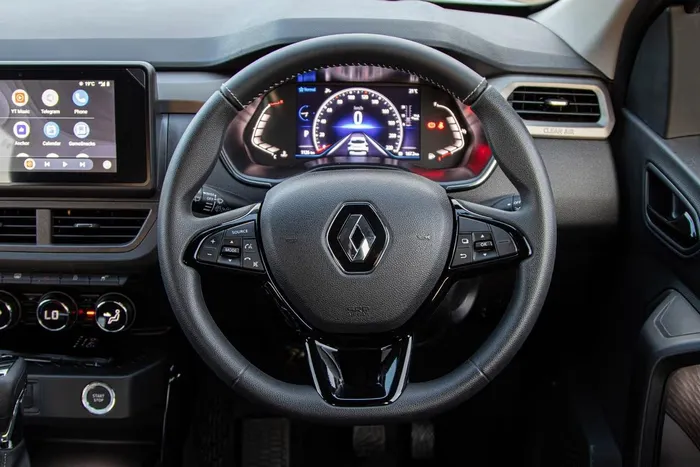
The Renault Kiger Turbo has an 8-inch touchscreen infotainment system with wireless Apple CarPlay and Android Auto and a 7-inch digital instrument cluster.
Image: Supplied
Inside, the updates are more noticeable. It has an 8-inch touchscreen infotainment system with wireless Apple CarPlay and Android Auto, while a 7-inch digital instrument cluster adds a more modern feel ahead of the driver.
Rear air vents and a reverse camera are standard across the range, while boot space is 405 litres, expanding to 879 litres with the rear backrests down.
The Techno model adds a dual-tone interior and wireless smartphone mirroring. The Iconic derivative gets ventilated leatherette front seats, automatic climate control, a multiview camera, automatic lights and wipers, wireless charging and additional driver convenience features such as remote engine start.
It also gains multi-sense drive modes, allowing the driver to switch between Eco, Normal and Sport settings.
We drove the top spec Iconic CVT, and it’s a cheerful interior that is well put together, but the plastics are hard and hollow, which is expected at this price point.
Rear space is ample, and I sat comfortably behind the driver during our route in and around Durbanville in the Western Cape.
Power comes from Renault’s familiar 1.0-litre three-cylinder turbocharged petrol engine, which produces 74kW and 160Nm. Buyers can choose between a five-speed manual gearbox and an X-Tronic CVT, depending on the derivative.
On paper, those outputs are modest, but the extra 64Nm makes a considerable difference to the car.
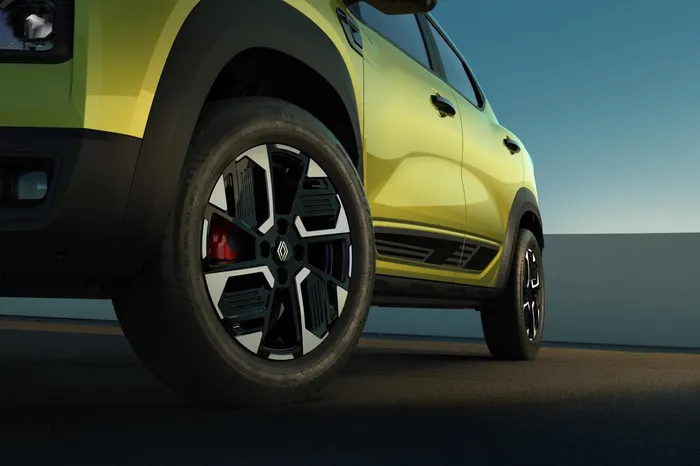
The flagship Iconic model has 16-inch Evasion diamond-cut alloy wheels.
Image: Supplied
Look, you’re not going to break any records with the Kiger Turbo, but it’s a considerable improvement over the normally aspirated version.
There’s a brief pause as the turbo spools up before the power comes through. It doesn’t lunge forward when the accelerator is pushed hard, but rather it’s more of a gentle pull away as the engine and transmission get their communication sorted.
Toggling between Eco, Normal and Sport didn’t make a significant difference, and I suspect most owners will just keep it in Normal.
As CVTs go, though, it’s not bad.
Suspension is on the firm side, making it ideal for town and highway driving, but on a short gravel stretch, it felt jittery and unsure of its footing.
Through bends and corners, the Kiger behaves as you would expect from a B SUV. There’s slight body roll, but not alarmingly so, and it doesn’t feel uncomfortable.
It’s fit for purpose because it was never designed to go barreling down Van Reenens Pass.
Renault says they have improved the noise, vibration and harshness levels of the Kiger, and it’s perfectly acceptable. Pressed hard, there’s some engine whine in the cockpit, but once it settles down, there’s only slight wind and road noise.
Consumption is rated at 5.0l/100km for the manual and 6.0l/100km for the CVT, and that alone makes it a strong contender.
Safety features across the range include ABS with EBD, brake assist, tyre pressure monitoring, ISOFIX child-seat anchors and rear parking sensors. Iconic versions add electronic stability control, traction control and up to six airbags.
It comes with a five-year/150,000km mechanical warranty and a two-year/30,000km service plan. Renault also offers customers the option of extending these plans through its dealer network.