

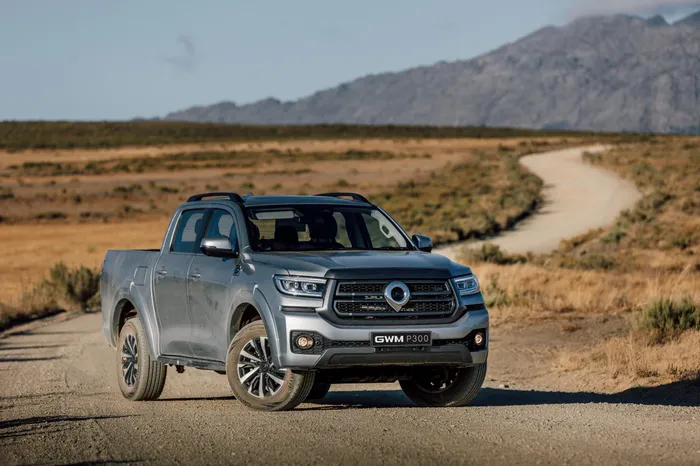
The GWM P300 ships standard with leather (leatherette in the LS spec), 18" alloys, body-coloured bumpers and mirrors, LED daytime running lights, automatic headlights, rain-sensing wipers, keyless entry, push-button start, and all the creature comforts you could need, far outweighing similar priced Hilux and Ranger models.
Image: Supplied
Has the GWM P300 got what it takes to topple Toyota's Hilux and Ford's Ranger?
The Chinese contender's P Series has always had a very attractive design, and with the subtle updates to the front and rear bumpers, rear tailgate, and updated alloy wheels resulting in the rebranding as the P300, I think it definitely looks the business, but some of the refinement needs work before it can challenge the top two.
The P300 is big – I don't normally need to step on running boards to get into a double-cab, but for some reason, I needed to in order to climb into the cabin of GWM's "small" bakkie (there's the bigger, P500 on sale too).
It's also incredibly well-equipped for the price.
The P300 ships with full leather from the LT spec upwards (leatherette in the LS spec), along with a charging pad, multiple USB ports dotted all over, 360° panoramic camera system that's better than I've seen in most cars, touchscreen infotainment system with wireless CarPlay and Android Auto, 18" alloys, heated seats, and something you won't find in a Hilux – a sunroof.
Plenty of Chinese double cabs have sunroofs either as standard fare or an optional extra, and I can't for the life of me understand why bakkies didn't come with sunroofs before. Maybe it's got something to do with torsional rigidity, especially when you're needing some extreme articulation when you're off-roading?
But I've not heard of any glass panels exploding while doing some serious rock crawling to date.
The cabin is a very pleasant place to be – it feels rough and ready, with some beautiful finishes like the back-lit passenger side dash that features some pretty iconography. Some of the surfaces are a little hard to the touch, but it's understandable in the context of its rough-and-ready overall vibe.
The P300 is motivated along spiritedly by a 2.4l turbo-diesel powering the driven wheels through a 9-speed auto-box, and apart from the setup struggling a bit to decide between 2nd and 3rd on the steep, narrow, spiral ramp up to my office parking, I had no other challenges.
The engine is more than willing, and the bakkie is, dare I say, quick?
It pushes out 135kW and 480Nm, which is more than you'll get in its competitors.
And you can tell. It's not going to win any robot-to-robot races, but in its price range, you'd be hard pressed to find a faster, more powerful bakkie.
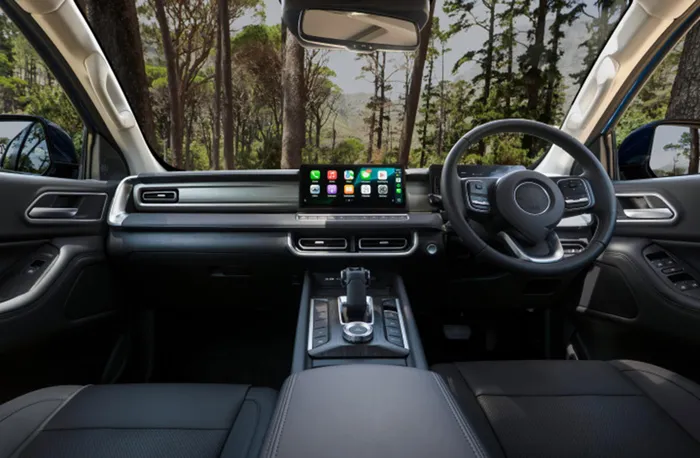
The interior of the GWM P300 makes the Hilux look awfully dated.
Image: Supplied
The Ford Ranger double cab XL starts at R574,000 but for that price, you're getting a pretty stark, drab interior, and none of the fancy things like LED daytime running lights you'll find in the higher-specced models. Remember, the Ranger's range is extensive too, and extends all the way above the million rand mark. Ranger also gives you, for your R574k, a 2l single turbo diesel engine available with a six-speed manual or automatic, producing 125kW and 405Nm.
The Toyota Hilux starts with the S and SR derivatives, which cost R572,000 for the GD-6 2.4l turbodiesel six-speed manual, and R528,800 for the 2.7l petrol six-speed manual. The GD-6 produces 110kW and 400Nm in this spec, while the 2.7l petrol generates 122kW and 245Nm.
And at this price point, in the Hilux, you'll have to do without alloy wheels and body-coloured bumpers and mirrors. It's dead, stock basic, inside and out. If you want any of those nice things, you'll need to spring for the Raider spec model, which starts at R716,300 – a good R140k premium over the Ranger.
The P300 starts at R529,900, but that comes standard with basically everything, bar the sunroof, 360° panoramic view camera system, and heated front seats.
It really should be a no-brainer.
So, we've established the engine and gearbox are more than willing, but the suspension – with its leaf springs at the back – can feel a little floaty and vague sometimes. The steering is light and direct enough most of the time, but some of the time, the steering feels a little off. In tight spaces, it performs well; I had little trouble parking this behemoth in our narrow, short parking bays at the office. But over bumpy roads, it just felt a little too bouncy for my liking. Perhaps with a fully-laden load bay it'd feel more secure, but no one is deliberately weighing down their bakkies just to make the drive feel more planted.
I find the Ranger far more sure-footed and refined in this respect, but get a similar bouncy, vague experience from the lower-specced Hilux models.
If you're looking for a commanding driving position, with a willing engine, and all the creature comforts you could ever need while spending almost half of what you would need to put down for an equivalently-specced Ranger or Hilux, the P300 is a hands-down champion.
It's more than masculine-looking enough, and plenty rugged, without coming across as trying too hard.
Will you have to constantly defend your choice to your mates around the braai? Probably.
IOL Motoring