

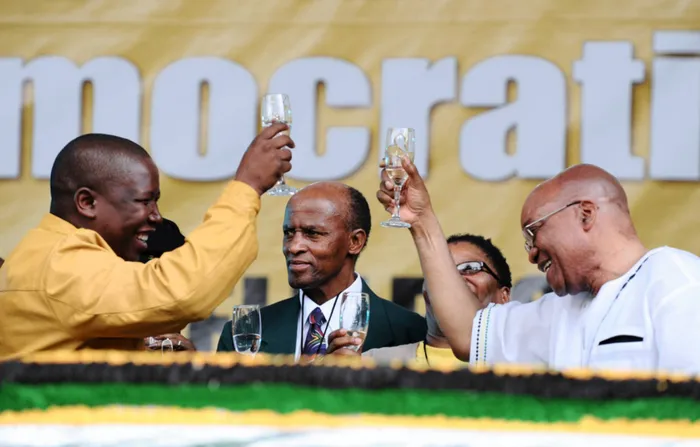
ANCYL President Julius Malema with President Jacob Zuma at the African National Congress (ANC) 99th Anniversary Celebration held at Peter Mokaba Stadium in Polokwane, Limpopo Province. Photo: Dumisani Sibeko ANCYL President Julius Malema with President Jacob Zuma at the African National Congress (ANC) 99th Anniversary Celebration held at Peter Mokaba Stadium in Polokwane, Limpopo Province. Photo: Dumisani Sibeko
The ANC’s annual January 8 statement is a significant marker in the political calendar because it outlines the governing party’s priorities and programme of action for the year ahead.
Inevitably, the media focused on the glitz and glamour, the luxury cars, the entertainment, the abundance of alcohol, the gourmet menu – and then the political promises.
Our job is to go behind the facade, and analyse the content of President Jacob Zuma’s keynote speech.
Taken at face value, it says much that the DA can agree with.
l We agree that South Africa should be guided by the “vision of a non-racial society built on the values of equality and respect for a common humanity”.
l We agree that “job creation must be the central focus of our economic policies” because jobs are the only sustainable way to beat poverty.
l We agree that our public health-care system must be “revitalised and improved” which includes “appointing qualified personnel and improving infrastructure”.
l We agree that there must be a sustained improvement in public education and that “teachers must be in school, in class, on time, teaching for at least seven hours a day”.
l We agree that “government must provide textbooks and (learning) materials and provide the necessary support”.
l We agree that loans should be converted to bursaries for deserving tertiary students.
l We agree that the country needs a strong, diverse and independent media.
l We agree that “alcohol and drug abuse are twin scourges that impact negatively on all aspects of SA society” and that there should be a campaign against this abuse.
l We agree with the notion of “steadfast opposition to corruption”.
l We agree that senior municipal officials must not hold executive leadership positions in political parties.
l We agree with the promotion of democracy, peace and stability.
Most South Africans would agree with all of the above.
The problem is that the ANC cannot achieve these goals because of its own internal contradictions.
Zuma’s speech reveals the reason: the ANC’s tripartite alliance is still caught in a toxic trap of racial nationalism and Marxist-Leninism (including discredited ideas such as “democratic centralism”, a Communist “vanguard” party, cadre deployment, the conflation of party and state, and the predominance of the ruling party over Parliament.)
The ANC needs this ideological underpinning, because without it, the “tripartite alliance” would fall apart. Keeping this coalition together is Zuma’s “unwavering commitment” and his top priority in an election year. But, ironically, this is also the key reason why the ANC will be unable to adopt or implement the policies that can achieve its stated goals. This will become increasingly apparent, in the form of unfulfilled promises, and paralysing internal conflict, which will eventually lead to the party’s downfall.
A clear example of the contradiction between ends and means is the ANC’s Africa policy. All sensible South Africans would agree with Zuma’s stated goal of promoting “democracy, peace and stability in Africa”. But the next few sentences of Zuma’s speech reveal why the ANC’s actual policy programme will lead to the precise opposite.
Said Zuma: “The ANC has strong party-to-party relations with former liberation movements in the SADC region and other parts of the continent. We will continue to enhance these relations in order to contribute towards deepening progressive political thought in the continent and globally.”
In other words, the ANC will continue to unconditionally support Zanu-PF in Zimbabwe and other former liberation movements in the sub-continent. The ANC will ensure that SADC continues to protect former “freedom fighters” who have morphed into despots.
Unless democracy is restored in Zimbabwe (and it will not come without a tough confrontation with Mugabe and Zanu-PF), Zuma’s noble goal is a pipedream.
Another clear contradiction between ends and means is Zuma’s stated commitment to a “strong, diverse and independent” media.
But he immediately went on to say that the ANC places “a high premium on the involvement of our cadres in all centres of power. ANC cadres have a responsibility to promote progressive traditions within the intellectual community which includes our universities and media.”
If Zuma succeeds in extending ANC “cadre deployment” in universities and the media, these institutions will forfeit their independence and become extensions of the ANC. His refusal to be interviewed by e.tv’s Nikiwe Bikitsha was a neat illustration of Zuma’s position on a “strong, independent media”. Bikitsha asks sharp, difficult questions. She is no cadre.
Perhaps the biggest flaw is Zuma’s continued delusion that the state can play a leading role in planning and managing sustainable economic growth and job creation.
In endorsing the New Growth Path, Zuma also effectively confirmed the side-lining of Trevor Manuel in economic planning.
In placing such reliance on the state to drive job creation, Zuma remains in denial about the extent to which cadre deployment and corruption have undermined the state at all levels. Many departments and institutions of state cannot fulfil their basic functions, let alone lead “economic transformation”. Zuma stressed that the ANC would continue to “place a high premium on the involvement of our cadres in all centres of power… We need their presence and involvement in key strategic positions in the state as well as the private sector”.
In other words, the ANC’s need for patronage and control (the “closed, crony society for comrades”) trumps the need for “open, opportunity-driven” policies to promote economic growth and job creation. That is the key reason the New Growth Path cannot deliver the promised results.
The speech contains countless other examples of the inherent contradictions in the ANC today. There was the usual rhetoric about reducing South Africa’s high rate of alcohol abuse, even as the subsidised high-end range of whiskies flowed freely. The repeated reference to “selfless sacrifice” contrasted sharply with the bling, the entertainment and the fleets of luxury cars. There was the usual ironic reference to fighting corruption, even as the arms deal cover-up continues in order to protect ANC heavyweights. And there was the usual avoidance of the inconvenient truth that concurrent sexual relationships are the primary driver of our HIV-Aids pandemic.
None of these things can be confronted under a Zuma presidency.
The president may have brought his party under control and papered over the cracks, but only for now.
The internal contradictions within the ANC alliance will eventually tear it apart. Our job is to build a coherent, internally consistent, inclusive alternative that can really deliver the better life for all in South Africa.
That is our task for this year, and the years ahead. We will keep on going until our mission is completed.
l Zille is leader of the DA and Premier of the Western Cape.