

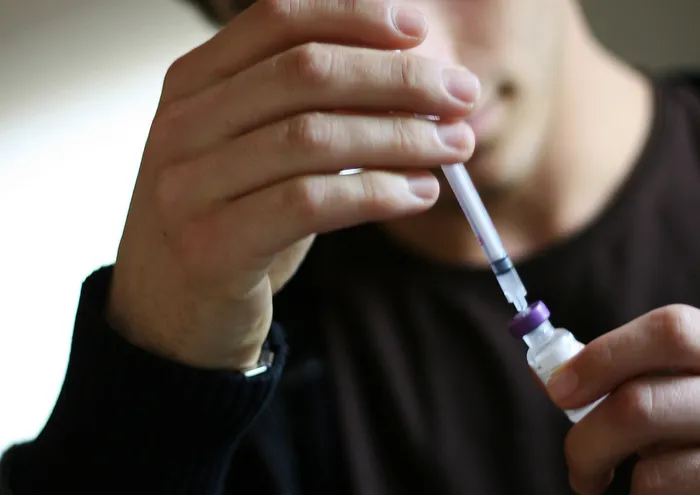
File photo: Just one dose of the cells relieved pain in mice with nerve damage for more than a month. File photo: Just one dose of the cells relieved pain in mice with nerve damage for more than a month.
London - Most people look away when they know something is going to hurt.
But watching during a painful procedure such as an injection can actually make it hurt less.
Scientists claim focusing on the part of the body that is suffering can change the way the brain processes the experience.
Researchers who pressed a hot probe on to the hands of volunteers found they could put up with more pain if they looked at their hand.
The team let the volunteers watch their hands using mirrors, which meant they could not see the probe. Simply viewing their hands reduced the pain so much that the volunteers could stand an extra 3C.
Professor Patrick Haggard, professor of cognitive neuroscience at University College London, said “You always advise children not to look when they are having an injection or a blood sample taken. But we found that just looking at the body reduces pain levels. So my advice would be to look at your arm, but try to avoid seeing the needle, if that’s possible.”
He said the discovery may lead to new treatments for pain.
“Many psychological therapies for pain focus on the painful stimulus, for example, by changing expectations or by teaching distraction techniques,” he added. “Thinking beyond the stimulus that causes pain, to the body itself, may have novel therapeutic implications.”
Making the hand look bigger also cut pain levels, according to the scientists from UCL and the University of Milan-Biococca in Italy.
But when the hand looked smaller, pain levels increased, says their report in the journal Psychological Science. The “visual trick” may influence the brain’s spatial maps of the skin and, as a result, the way the brain processes sensations coming from the sore area.
It is already known that amputees feel pain in their missing limbs when this map goes wrong. Confused by the mismatch between its internal map of a whole body and the reality of a missing limb, the brain triggers the sensation of pain.
The scientists behind the new study believe it shows the brain’s internal “map” of the body can be reset, a process that seems to play a key role in the perception of pain.
During the experiments 18 volunteers had a heat probe placed on their left hand.
The temperature was increased until the volunteers felt pain, at which point they used a foot pedal to stop the heat.
Prof Haggard said “We’ve shown there is an interesting interaction between the brain’s visual networks and the brain’s pain networks.” - Daily Mail