New shapes bound to emerge
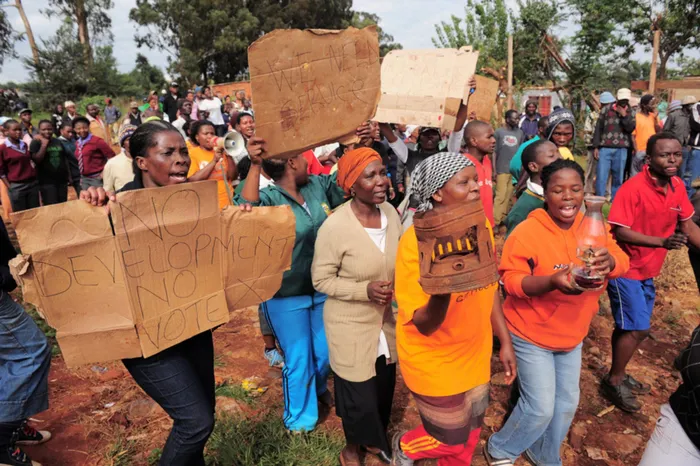
NOT TAKING IT: Residents from Kapok informal settlement near Ennerdale, south of Joburg, protest against poor service delivery and vow not to vote in the coming local elections if their needs are not met. Picture: Boxer Ngwenya NOT TAKING IT: Residents from Kapok informal settlement near Ennerdale, south of Joburg, protest against poor service delivery and vow not to vote in the coming local elections if their needs are not met. Picture: Boxer Ngwenya
The 2011 local government elections will test like never before a hitherto strange but secure relationship. Up to now, protesters have followed through with a vote for the ANC. This may no longer be the case.
In the past, South African voters have seamlessly combined protest against ANC municipalities – and in effect against their provincial and national counterparts – with voting for the ANC and returning it to power. With the “ballot and the brick”, voters have consistently engaged their ANC government to deliver services and bring the better life. Protest supplemented voting. Elections have only minimally been used to punish the ANC.
The permanence of the ballot and brick relationship, however, is not assured.
Will the dual repertoire of brick-and-ballot protest followed by electoral support persist in the 2011 elections? Or will voters find new ways to punish the ANC for lapses and deficits? From Ficksburg to Wesselton, Zandspruit to Gugulethu, the question is whether this year’s elections will be the “moment” that confirms the ANC’s tentative Elections 2009 support decline.
At this moment of truth, ironically at a point where the ruling party needs peak organisational power, the ANC is spread out across three battle fronts, fighting for citizen and voter allegiance.
There is the “enemy” of opposition parties against whom to mobilise. The DA hopes that its modest by-election breakthroughs in ANC wards can be confirmed as a signal that the “tide has turned” and that it has conquered the racial ceiling.
The DA is desperately searching for evidence that the South African voter has become willing to match disappointment with the ANC with a switch to an opposition vote.
The second front is the ANC’s battle against independents.
They revolted against being sidelined in the internal processes of candidate determination, a process that originated in noble Polokwane intentions.
ANC provincial offices now match municipal buildings as protest targets. The independents phenomenon is evidence of rejection of organisational authority that follows from the ANC’s doctrine of democratic centralism. The independents are a “mixed bag” of authentic community-preferred representatives, of careerists and small-brother tenderpreneurs that cannot pass through the eye of any needle, and renegades that fell on the wrong side of regional and provincial party principals’ strategising for Mangaung 2012.
The third ANC front is in the ANC’s electoral battle “against” alliance partners, and especially against Cosatu. The SACP and Cosatu have been unsuccessful in halting their supporters altogether from contesting against ANC candidates, or getting their memberships to guarantee campaigning for all ANC candidates.
The SACP even spawned an offspring, the Lebaleng Communist Party. Cosatu has been severe in its criticisms of ANC failures, even if those are echoed in the ANC’s select “we have failed you” statements. Cosatu’s internal opposition, however, could very well also work in favour of the ANC. It articulates with the prevailing political culture of critiquing plus voting for, or using brick and ballot.
The approach is to air the worst possible critiques of the ANC, within the safety of alliance ranks, and then tell voters to close ranks, vote ANC, with the aid of the scare of “president Godzille”.
Even just the existence of these fronts speaks to a changed, weakened ANC, as it argues for continuation of the liberation dividend.
Ficksburg in the last week added to the ANC’s multifront burden. It will also fight the local government elections against renegade, apartheid-style local police forces – under its command yet far removed from the ANC’s values. The graphic reality of Ficksburg, however, was only one step up from the increasing use of police force in recent years to dispel community protest.
A recent Diepsloot protest poster reminded the police that protesters were fighting bad services, not the police.
Recent protests, however, complicated matters when some in the police sided with factions in the ANC-independent battles.
If the ANC succeeds in the next month in persuading voters to continue the dual ballot and brick repertoire, it will be more because of continuous reverie for its fight for political freedom than because of completion of the post-liberation tasks of governance.
A recent Idasa survey found that the majority of citizens in four provinces are dissatisfied with services. (We also know, however, that it is not necessarily the most aggrieved of communities in the worst-performing municipalities that protest.)
My research in the past five years highlighted how community protest evolved through phases.
At first, there were straightforward service delivery protests against the non-performing, malfunctioning local governments. Later protesters also punished local government for non-delivery by provincial and national government. Then came the 2008 phase in which xenophobia (Afrophobia, in effect) combined with socio-economic deprivation, service delivery grievances and general lawlessness in government-less local communities to produce particularly violent outbursts.
By 2011 it’s clear that protests combined all of the previous types of protests, accumulating layers. This year ANC candidate-revolt protests have thus reflected components of organisational disintegration (lawlessness, all but the disciplined movement of the Left), criminality and xenophobia (especially in looting foreigners’ shops), and intraparty rivalry (an instigation of protests and mayhem). Angry and unemployed young people, with loads of time, often ran the protests.
They were part of the 1 million “new voters”, including the born-frees, who had already won the iconic status of holding party political futures in their hands.
In many a setting such disarray would have delivered fertile ground for opposition party growth. In South Africa at this time, however, most voters will still almost do anything except vote for an opposition party, especially if that party is the DA.
South Africa’s D-class of voters – disappointed, disillusioned, disaffected – has four options at their disposal, apart from voting DA or voting ANC despite grievances: split their ballots to register grievances (without helping too much to lift their ANC from power); spoiling ballots (not a big culture locally); form small opposition parties that could still forge governing alliances with the ANC after the elections (a multitude registered, especially in the Western Cape); or abstain.
Abstention and lower voter turn-outs than the 48.1 and 48.4 percent of the 2000 and 2006 local elections, respectively, might still be the story of this year’s elections.
Election times, up to now, have been the times of the ANC and its supporters uniting ranks against opposition party enemies.
If this time around the ANC continues these feats, the parables of the ANC ruling “until Jesus comes”, ANC members going to heaven and God being with the ANC, might live on.
Without, South Africa will be entering a strange period in which the ANC will be irretrievably weak, yet far too strong to be lifted from the throne in more than a sprinkling of municipalities.
l Susan Booysen is contributing editor to The Star and professor in the Graduate School of Public & Development Management, Wits University.