

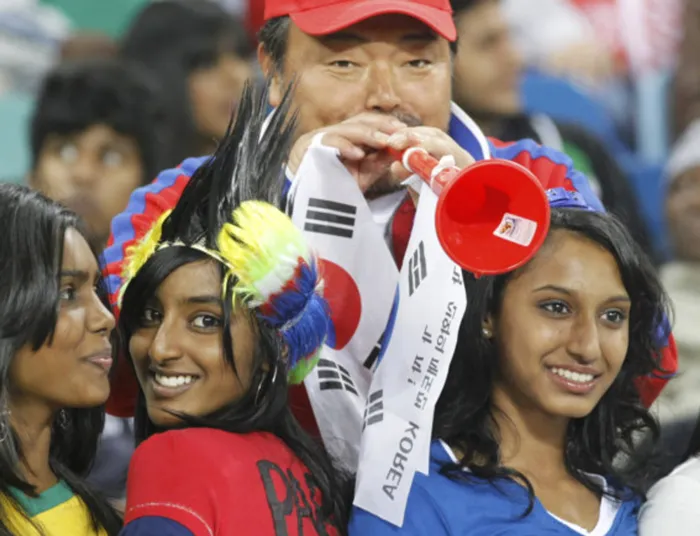
FEEL-GOOD FACTOR: Fans enjoyed the country's warm hospitality during the World Cup, although Fifa was bent on extracting much of the financial benefit of hosting the tournament, says the writer. Picture: Lee Jae-Won / Reuters FEEL-GOOD FACTOR: Fans enjoyed the country's warm hospitality during the World Cup, although Fifa was bent on extracting much of the financial benefit of hosting the tournament, says the writer. Picture: Lee Jae-Won / Reuters
Hosting the World Cup promised not just the excitement of the event, media exposure, influx of tourists, economic bonanza and infrastructure projects, but also the expectation of a positive return on the investment associated with razzmatazz of hosting the event.
Exactly a year after the 32 participating nations slugged it out for the world’s prestigious trophy and the winner, Spain, packed their bags and left our shores, is South Africa better or worse off?
South Africa is better off than at any other time since the dawn of democracy in 1994. But how? The World Cup was never a panacea to cure our social and economic ills. The event served as a foundation we could build on to solve these ills. The tournament succeeded in doing just that.
We need to understand that hosting a football extravaganza was a right our country had to purchase from Fifa after a competitive bidding process that included four other nations, Morocco, Tunisia, Libya and Nigeria.
To maximise revenue, Fifa was and has always been a monopolistic oligarchy bent on extracting much of the financial benefit of hosting the tournament. The tournament is a financial proposition, and the host country, whether Germany in 2006 or Korea and Japan in 2002, had to guarantee billions in revenue for Fifa.
Fifa sells the rights to the best bidder and like any good monopolist, it is never prepared to give their property away cheaply. That is why Fifa and our government signed 17 guarantees that regulated the flow of benefits associated with the tournament.
For example, some of the guarantees concerned advertising, which, within a 1km radius of the stadium and along all major access roads, was restricted to Fifa-endorsed enterprises, with all profits channelled to Fifa.
Other requirements included the provision of dedicated lanes on highways for Fifa officials and teams, hotel accommodation, offices with unlimited phone and internet access, catering, and so on.
For us, there were five benefits: infrastructure development, job creation, tourism growth, continental branding and social cohesion.
The infrastructural legacy was massive. Six brand new stadiums – in Joburg, Mbombela, Durban, Polokwane, Cape Town and Nelson Mandela Bay – now grace our cities’ skies, giving domestic football a huge boost and providing facilities for other sports, concerts and mass meetings.
A lot of money was pumped into transport infrastructure, plus hotel and conference facilities. The event created 150 000 new jobs – some temporary – many in the tourism, hospitality, building and road construction sector.
At the end of the tournament, the government said annual economic growth had risen to 3.1 percent, as the manufacturing sector proved more resilient than expected to the impact of a doggedly strong rand. Of course we know that a higher growth, in the region of 4 percent to 5 percent, is required if we are to tackle the unemployment rate. But such growth is better than nothing.
On the tourism front, the tournament brought more than 350 000 football fans who are now our ambassadors. The sporting event generated massive global media coverage, promoting South Africa as a holiday destination to millions of non-Africans who had not previously considered the country for a visit.
Our international guests had a ball. Some came to watch the matches either live in the stadiums or to enjoy them at the many public viewing places. Many shopped until they dropped.They felt good and our warm hospitality boosted the tournament as an amazing event. The atmosphere was so fantastic that tourists who were here this time last year would not hesitate to recommend South Africa as a travel destination.
Indeed, the potential benefits of hosting the tournament were multidimensional, including direct pecuniary benefits associated with activities at the time of the tournament and expenditure by tourists, teams, the media, and long-term benefits from the capacity built for the tournament and the benefit from accommodating, transporting and entertaining future visitors.
The feel-good factor is a benefit beyond the purely economic.
There was much more at stake than a sporting event. The World Cup was seen by billions of viewers, and the build-up to it focused attention on Africa, particularly on our country, in a way never before possible.
The World Cup fit into the larger scheme of things to improve the image of Africa as a whole, which had for years been based on stereotypes as a hopeless continent, lacerated by war, tribalism, famine and disease.
The tournament showcased South Africa as an engine for recovery and foreign direct investment for the whole continent and improved our country’s image overseas. Anything that can be done to promote the country as a vibrant go-getting economy cannot help but do a lot of good.
We all know that sport in South Africa has traditionally been divided along racial lines, with our white compatriots generally favouring rugby and cricket, while most black South Africans are passionate about soccer.
Despite this, sport is one of the few things that bring people together in South Africa, and soccer is far more representative of the sporting passions of our country than any other sport.
The tournament was not just football, but the image and economic future of South Africa.
We are and have been a diverse and historically brutalised nation. We needed a sporting event like the World Cup to contribute and give us a push to nation-building. As a sporting-mad country, soccer has gone a long way in bringing our nation together.
True, there have always been debates about the representativeness of different sporting sides, but for the first time, many white South Africans acknowledged that they truly felt a sense of patriotism and the need to stand behind Bafana Bafana, other participating nations and our country as the host.
Who could forget the 200 000-strong multiracial crowds that converged on the streets of Sandton three days before kick-off to rally behind Bafana Bafana?
In understanding and building social solidarity and cohesion, the World Cup played an important role in building an understanding of public good across races and classes.
The 2010 World Cup was the greatest World Cup ever and has provided massive scope for nation-building and social cohesion.
As a nation and as a continent, we now need to work hard in consolidating the gains brought by the tournament, and extend our common understanding across all races for the common good.
l Rich Mkhondo was the chief communications officer for the 2010 Fifa World Cup Organising Committee South Africa. He is now the executive for corporate affairs at MTN Group. He writes in his personal capacity.