

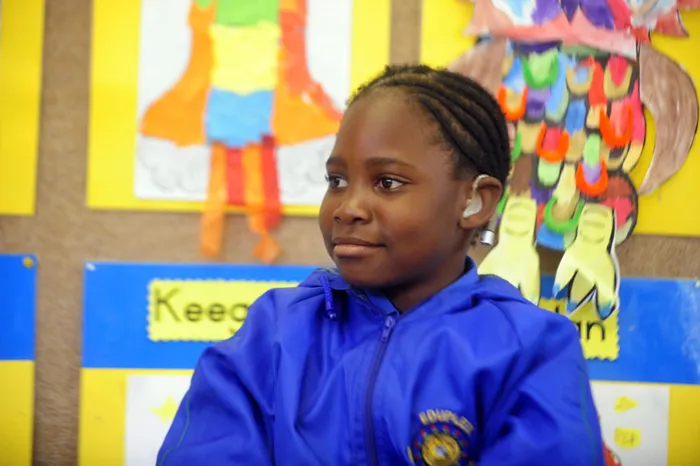
0222 Profoundly deaf Bianca Ntuli (7) in her classroom at Educentre in Pretoria East. Ntuli is an ideal candidate for a cochlia implant but doesn't have the R300 000 required for the procedure. Pretoria East. 260711 - Picture: Jennifer Bruce 0222 Profoundly deaf Bianca Ntuli (7) in her classroom at Educentre in Pretoria East. Ntuli is an ideal candidate for a cochlia implant but doesn't have the R300 000 required for the procedure. Pretoria East. 260711 - Picture: Jennifer Bruce
THANDI SKADE
By the age of five, Bianca Ntuli, 7, hadn’t uttered a single coherent sentence.
She spoke a language no one could understand. Her speech was a series of disjointed babblings.
While her mother Josie, 53, had noticed that something was amiss with her youngest child of six, she thought her daughter was just developing more slowly than her other children.
“Bianca was a good child, but I noticed she would get angry when she tried to speak because I couldn’t understand her,” Ntuli said.
In 2009 Ntuli enrolled Bianca at a play school, where teachers suspected she had a hearing problem.
Following a battery of tests, Bianca was diagnosed profoundly deaf, and fitted with hearing aids two-and-a-half years ago.
Audiologist Karen Bester had to start from scratch developing Bianca’s listening and communication skills.
“When Bianca first came to me she wasn’t communicating at all. She would babble and gesture. Now she can ask questions, her spoken language has developed tremendously and she’s curious. She can now use her language to express how she feels,” Bester said, adding that Bianca had taught herself to lip-read.
Since learning that Bianca was deaf, Ntuli said, life had changed drastically. Traditionally a Setswana-speaking family, all family members have had to change to speaking English around the house so that Bianca can understand and communicate with her family.
“It’s difficult for us in the house, but it’s worth it because now we can understand each other. Before she’d feel frustrated and angry because she couldn’t speak or hear, but now she has become a very confident little girl,” Ntuli said. The pair no longer rely on hand gestures to communicate with one another.
Now, five years after Bianca lost her hearing following a high fever and stint in hospital, she has the chance to hear, but her mom can’t afford it.
Bianca recently became a confirmed candidate for a cochlear implant, but at a cost of around R300 000 – R220 000 for the device itself and between R70 000 – R90 000 for hospitalisation – her dream of hearing her mother’s voice again hangs in the balance.
A cochlear implant is an electronic device that’s surgically implanted under the skin behind the ear. The implant works to compensate for damaged or non-working parts of the inner ear, which converts sound waves into electrical impulses that are sent to the brain.
Studies have shown that cochlear implant recipients have an average of 80 percent sentence understanding compared to a 10 percent sentence understanding among people with hearing aids.
Ntuli’s employer, Beatrice Archer, with whom Bianca stays during the week, said getting the implant would mean Bianca would have a better chance in life.
“If she got the implant it would mean she’d receive a better education, she would be self-sufficient and not have to rely on her elder siblings and mother,” she said.
Bianca is in Grade 1 at The Eduplex in Pretoria, a private Christian mainstream school established by the Foundation for Children with a Hearing Loss in Southern Africa that includes profoundly deaf or hard-of-hearing pupils in its mainstream classes.
Each class has two teachers to provide extra support for children with hearing loss with individual conversations before school starts and tutorials after class.