Zim is at a crossroads… again
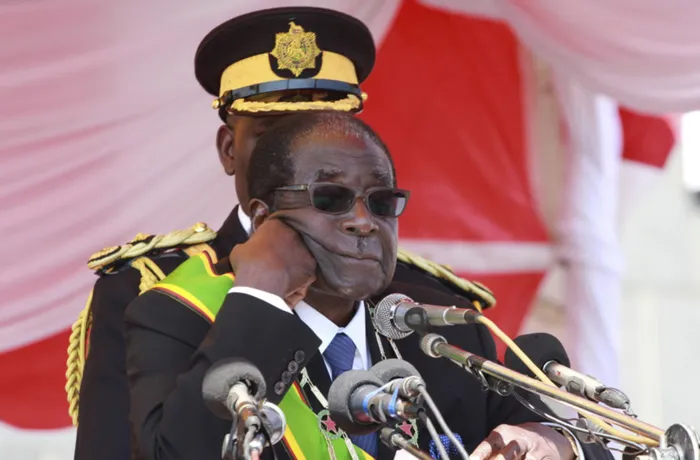
TURNCOAT: Robert Mugabe pretended to be a democrat until the vote threatened his power. Then he switched from the ballot back to the bullet, says the writer. Picture: Philimon Bulawayo / Reuters TURNCOAT: Robert Mugabe pretended to be a democrat until the vote threatened his power. Then he switched from the ballot back to the bullet, says the writer. Picture: Philimon Bulawayo / Reuters
Robert Mugabe won the battle for Zimbabwe some time ago. Despite losing a couple of elections, he triumphed by calling on the state security sector – with whom he, in his civilian suits, runs government affairs – to stifle the will of the people.
It was easy. He just pretended to be a democrat until the vote threatened his power. Then he switched from the ballot back to the bullet – having promised to do just that way back in 1976.
As leader of the Zimbabwe African National Liberation Army (Zanla), Mugabe warned that “our votes must go together with our guns. After all, any vote we shall have shall have been the product of the gun. The gun which produces the vote should remain its security officer – its guarantor. The people’s votes and the people’s guns are always inseparable twins.”
I remember Winston Churchill’s daughter, Lady Mary Soames, wife of Rhodesia’s last British governor, describing how her husband had had to plead with “old Robert”, as she called Mugabe, not to put a prominent image of a gun on the new nation’s flag. “You won through voting, not violence,” Christopher Soames had insisted in the days immediately before Mugabe was installed as head of state in 1980.
Over the past decade, however, it has become obvious that Zimbabwe’s blood-stained generals, the Dirty Half-Dozen, have been calling the shots alongside Mugabe.
Army commander Constantine Chiwenga, police commissioner Augustine Chihuri, head of prisons Paradzai Zimondi and air force chief Perence Shiri are household names in Harare. Even their wives are well-known social figures. (How many South Africans know the names of their military honchos, let alone the wives? Virtually none, because our generals are not politicians but civil authorities.)
In Zimbabwe, the securocrats are celebrities, despite their troops being responsible for the bloodiest of massacres – when pregnant women have been hacked open, for example, and their unborn babies thrown down wells.
These ghastly men aren’t allowed to travel to some countries due to the targeted sanctions brought against them by much of the international community. But most are younger than Mugabe and so, even when he dies, they will remain to rule Zanu-PF through the barrels of guns.
This is one of the reasons that some form of transitional justice needs to begin before the conflict in Zimbabwe ends. The evil generals have to be persuaded to leave the scene, even if cast-iron indemnities and, heaven forbid, golden handshakes are required to restore democratic order.
The violence in that god-forsaken country has gone on way too long. Zimbabwe achieved its independence more than 30 years ago after a brutal war during which widespread human rights atrocities were committed.
The new prime minister called for reconciliation and forgiveness and no one was prosecuted. Within a few years, Mugabe had committed gross human rights violations in the Gukurahundi campaign, during which 20 000 people are believed to have been killed. Nobody has been held accountable for that outrage either.
With at least a quarter of Zimbabwe’s population living in South Africa and, let’s say, another half being too young to vote, there are equal numbers of enfranchised citizens here as in their homeland.
For that reason alone, a prototype for transitional justice and national healing could begin without further ado in South Africa.
Would the truth-seeking be headed by a religious institution? Which time period would be investigated? Could it be fairly monitored from within Zimbabwe, or would an international body need to arbitrate?
These are some of the questions that would have to be resolved if a test site were to hear the painful memories of Zimbabweans living in South Africa.
As to whether story-telling is fundamental to healing and can create a change in a nation’s emotions, we are led by western psychology to believe that speaking of emotional as well as physical pain helps to heal psychic wounds.
The magnanimity involved in victims forgiving perpetrators is also said to be empowering, which is why judicial accountability is essential in response to the revealed truth of such a process. Of course, the fact that domestic prosecutions would not be possible in a South African-based process presents the biggest challenge to the idea of an external investigation.
When you consider the sad state of Zimbabwe’s politicised judiciary, the ideological bias of some of its senior churchmen, the urgent need to free the country’s civil society from opposition politics, and the vast numbers of its citizens residing in the diaspora, it is hard to envisage either Arab Spring-like collective action or transitional justice and reform taking root amid such rampant corruption and impunity.
Indeed, the co-minister for the Organ of National Healing, Reconciliation and Integration – an institution set up by the SADC-sponsored Global Political Agreement that created the current inclusive government – was recently jailed in Zimbabwe for his outspoken comments about Gukurahundi.
Overall, one of the greatest impediments to progress in Zimbabwe today is what Eldred Masunungure, writing in Zimbabwe at the Crossroads – an excellent publication from the Open Society Initiative of Southern Africa – calls an overdeveloped sense of “organisational sovereignty” among civil society initiatives.
In simple language, he is saying that the country’s NGOs can’t work together.
Shame on them. The most successful political formation ever in southern Africa was our own United Democratic Front, a coalition of civic, church, student, women’s and workers’ groups.
If civil society in Zimbabwe were able to get over individual ambition and vanity to form a united body, such an organisation could really talk truth to power, perhaps beginning with transitional justice hearings in South Africa. Even if a prototype truth commission achieved no more than a record of power at its most abusive and the enormity of personal loss, it might reinvigorate the moribund debate on how to achieve democracy in Zimbabwe.
l Heidi Holland is the author of the internationally acclaimed Dinner With Mugabe