

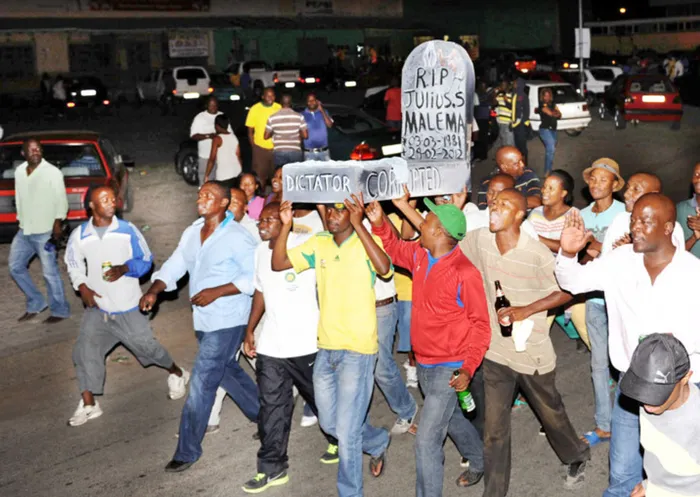
290212. In Seshego, Polokwane. Anti-ANCYL President Julius Malema carrying a replica of a tombstone celebrating following Malema expulsion. Picture: Dumisani Sibeko 290212. In Seshego, Polokwane. Anti-ANCYL President Julius Malema carrying a replica of a tombstone celebrating following Malema expulsion. Picture: Dumisani Sibeko
ANC Youth League president Julius Malema’s expulsion has had many rushing to write his political obituary. While popular opinion appears to be that this is the end of Malema’s political career, in which he rose to the helm of the youth league and dominated news headlines, there’s some way to go before it can be said he has reached political Siberia.
The fight for Malema’s political life – and the preservation of the youth league’s autonomy – will see two parallel and, at times, overlapping processes unfold.
These include the ANC’s internal disciplinary process and the youth league’s political strategy. Much will be played out behind the scenes, with fierce lobbying expected in ANC branches – where the real power lies – to drum up support before the elective conference in Mangaung in December.
The conference has the final say on any decision by a structure of the party. Public shows of support may also be staged.
Malema and Company have 14 days to appeal to the national disciplinary committee of appeals against the judgment and sentence.
Once they have notified the committee of their intention to appeal – they are on record as saying they will – the appeals committee, chaired by senior ANC national executive committee (NEC) member Cyril Ramaphosa, will, at its discretion, set a date for the defence and prosecution to submit their heads of argument.
This will take some time.
Then, given that many committee members are full-time cabinet members with conflicting schedules, a date will have to be found to hear the verbal arguments from Malema’s defence and the ANC’s prosecution.
The hearing itself may take a few days or weeks. The appeals committee then sits to deliberate.
Realistically, it will take about a month for the appeals committee ruling, which is “final and binding”, to be handed down to Malema and his fellow accused. They are league secretary-general Sindiso Magaqa, who was handed a three-year suspended sentence and ordered to apologise to former league president Malusi Gigaba for derogatory comments he made about him, and spokesman Floyd Shivambu, suspended from the ANC and the league for three years.
While the ANC wants to wrap up the processes as soon as possible, the appeals committee will not want to appear to be too hasty and desperate to get rid of Malema.
Malema’s defence has succeeded in prolonging the disciplinary action and will probably continue to try to buy time.
If the appeals committee upholds the judgment by the disciplinary committee, Malema’s expulsion will take immediate effect.
He will then, according to the ANC’s constitution, cease to be president of the youth league.
Even if the appeals committee softens the sentence of expulsion, Malema’s suspended two-year suspension, handed to him in 2010 for sowing division in the party, will kick in. The appeals committee has already confirmed the guilty finding on the charge of sowing division.
Youth branches resolved at the league’s lekgotla last month that Malema would remain president, regardless.
This was on the basis that a clause in the league’s constitution – amended by the congress that re-elected Malema in June – stipulated that, in the event the ANC suspended or expelled a youth league member, “such penalties shall be subjected to internal inquiry by the corresponding disciplinary structure of the ANCYL”.
This is likely to be discussed when the league’s national executive committee meets on Sunday.
As the league has also argued that its leadership was elected by the more than 5 000 delegates at the congress and that only they have the power to remove the leaders, more drama can be expected in the weeks leading up to the ANC’s national policy conference in June.
When the internal appeal pro-cess is exhausted, the ANC NEC may be petitioned to review the ruling.
This is not automatic, however.
The youth league would have to persuade an NEC member to take up the matter for review.
This will be the first sure-fire test of Malema’s support in the NEC. But, given the political climate, it appears few ANC bigwigs are prepared to come out in support of Malema for fear of being associated with the ANC’s enfant terrible.
The ANC’s history suggests no comrade who is expelled from the party flourishes politically.
However, Malema has stated: “You can arrest me, but you can’t arrest my ideas.”
The ANC, political analysts say, must heed this, because crushing an opponent, as President Jacob Zuma can attest to, does not mean the opponent is finished.
Professor Somadoda Fikeni, a visiting fellow at Unisa, said the action against Malema and his colleagues would see the youth league battling to lobby branches and mobilise members behind its policy positions and preferred leadership.
Malema’s expulsion had “obviously diminished his role in the mainstream ANC”, he said.
However, Malema’s visit to the Impala Platinum mine, where he addressed workers this week, indicated that “we have not seen the last of Malema”.
He had carved out for himself the role of an economic freedom fighter with the youth, many of whom were unemployed. Dissatisfied citizens also found in him a “fearless, undisciplined, raw leader who is seen to speak the language people use when they retreated to the comfort places”.
So where did Malema go wrong?
“Two things are more serious than being badly advised. He has deep personality challenges,” said Fikeni.
“Raised to rebel against authority… combined with power he got later on and the role model of (former league president) Peter Mokaba… produced the person he is.
“In his mind he removed a sitting president, Thabo Mbeki. You can imagine the impact on his ego.”
Perhaps more important, Fikeni said, was, “instead of asking where he went wrong, we must ask why the ANC went so wrong in giving him so much space”. - Political Bureau