Migrants are a bridge to outside world
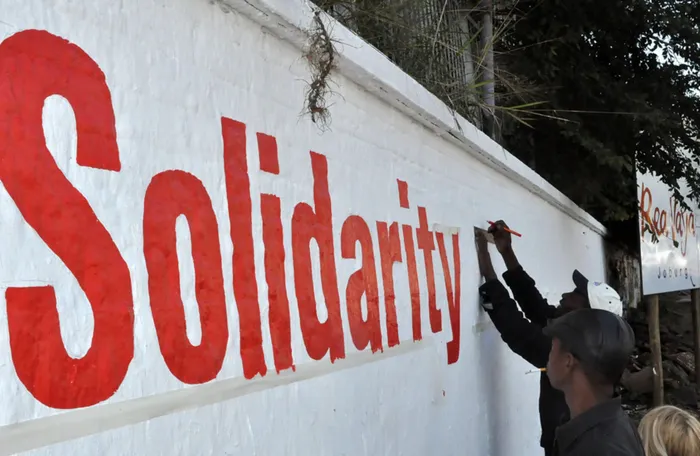
BRUSH WITH HARMONY: Graffiti artist Mark Salimu paints the word "Solidarity" on the corner of Empire Road and Jan Smuts Avenue, expressing the need for all cultures in SA to live together in peace. Picture: Timothy Bernard BRUSH WITH HARMONY: Graffiti artist Mark Salimu paints the word "Solidarity" on the corner of Empire Road and Jan Smuts Avenue, expressing the need for all cultures in SA to live together in peace. Picture: Timothy Bernard
Over the past weeks, we have been subjected to outrageous claims from DA leader Helen Zille that South Africans sensibly seeking economic opportunities are “refugees”, and even more outlandish arguments from the ANC’s Jackson Mthembu that Zille’s statements are “racist” and revanchist.
Behind the bluster of this tragicomic spat are two parties who share more than either would like to admit.
For one, it is fairly clear that neither party knows what a refugee is.
Beyond that, it is fairly evident that neither party is comfortable with people moving into the cities they control.
If you speak to officials or read their policy documents, it is not only refugees, but almost all foreigners and pretty much any outsider who is considered a drain: an obstacle to transformation and a threat to social cohesion.
At one level, of course, Zille is right in defending herself.
Assuming that the title “refugee” is an insult and degradation reveals much about what we think of them.
Beyond the offence, though, is she wrong?
In popular usage the term is just a way of describing people forced to leave home by circumstances beyond their control.
Given the economic conditions in many parts of SA, to say nothing of criminality, gender-based violence, or political exclusion, the shoe seems to fit.
However, wanting to disassociate oneself from the term is not uniquely South African; after Hurricane Katrina, Americans fleeing the rising waters actively protested against the label, preferring instead a more neutral-sounding “displaced people”.
The ANC has also got a point: all South Africans, and indeed all legal residents, should be allowed to live wherever they please.
But while the ANC demands that Eastern Capers be welcomed to Cape Town, its own politicians have not always proved so hospitable.
In her recent State of the Province address, Gauteng’s Premier Nomvula Mokonyane explained that her province was experiencing “a massive influx of so-called health migrants from other parts of the country and other African countries”, creating a “spiralling demand” that puts the province’s health system under “huge pressure”.
While Mokonyane’s comments have caused no controversy at all, imagine how hot under the collar Mthembu would have been if Zille had made such a speech.
No one can deny that politicians’ angst is real, but any migration crisis is one they have helped create.
Joburg mayor Parks Tau is right that the arrival of large numbers of domestic migrants and a much smaller group of international migrants comes with its “own set of challenges, including the need to expand the provision of services”. He is also on point in noting that migration is what makes SA cities – and cities the world over – “vibrant”, and the growth engines they need to become.
If cities are to achieve these ends, they need to plan for population change – something they have largely failed to do.
In research conducted by the African Centre for Migration & Society across SA (including Cape Town), our colleagues reveal just how little municipal authorities know about the populations they are ostensibly meant to serve.
In almost no cases have they tried to determine and plan for population growth and ongoing mobility.
In a country such as SA, that’s akin to hiding your head in the sand.
With the country’s rapid rates of migration and fertility, cities are growing.
Incidentally, they are growing far more due to births and people living longer than migration, which accounts for less than 30 percent of Gauteng’s population growth, and international migration only a small percentage of that.
Ignoring these dynamics won’t keep people away, but it does mean that municipalities are always behind the curve.
Unless municipal authorities get a handle on SA’s complex population dynamics, they will continue to feel overwhelmed by the strangers in their midst.
Whether we call them refugees, job seekers, investors, or simply residents, we need to be paying attention.
Rather than promoting a vision of how cities should look and then expecting the population to comply, we – ward councillors, civic activists, the National Treasury, and political parties – need to help cities plan for, protect and promote whoever lives in our towns and urban areas.
Tau speaks of the need for unity and solidarity, others of the need for social cohesion. By all means, let us work towards that goal. But we must not pretend that solidarity will arise only through building stable, sedentary communities.
Rather, we must align ourselves with the aspirations of our neighbours, wherever they come from, wherever they’re going, and no matter how long they wish to stay.
Cities’ successes are built on their connections to the world beyond their boundaries and migrants are a bridge.
Yes, they come to the cities to compete in the job market or access services.
Such moves are one of the swiftest and most successful strategies for improving their welfare and the well-being of families who travel with them or remain behind.
In their efforts they bring with them energy, ideas and the power to transform.
This may be uncomfortable for some, but rather than decrying their arrival, let us instead ask how we can support them.
This means ditching our juvenile name calling and accepting that at one point almost all of us were migrants or refugees.