

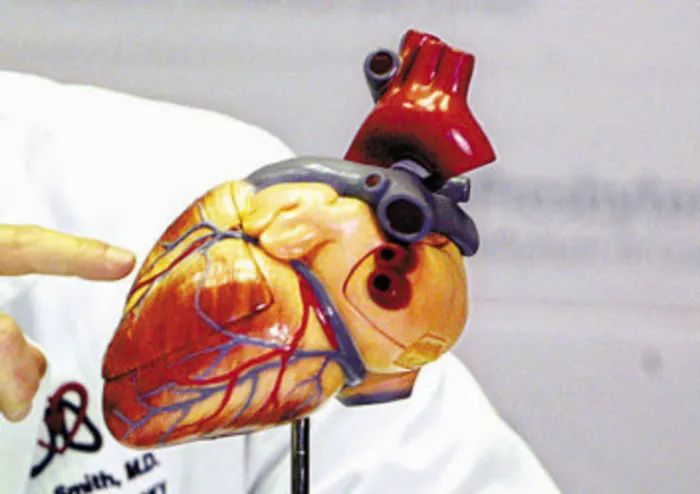
Dr. Craig R. Smith, chief of the Division of Cardiothoracic surgery at the New York-Presbyterian/Columbia University Medical Center uses a model of a human heart to explain to reporters the heart bypass surgery he performed on former President Bill Clinton, Monday, Sept. 6, 2004, in New York. Clinton was at high risk of a heart attack before his quadruple bypass surgery Monday, with several arteries well over 90 percent blocked, doctors said after the four-hour operation. (AP Photo/Mary Altaffer) Dr. Craig R. Smith, chief of the Division of Cardiothoracic surgery at the New York-Presbyterian/Columbia University Medical Center uses a model of a human heart to explain to reporters the heart bypass surgery he performed on former President Bill Clinton, Monday, Sept. 6, 2004, in New York. Clinton was at high risk of a heart attack before his quadruple bypass surgery Monday, with several arteries well over 90 percent blocked, doctors said after the four-hour operation. (AP Photo/Mary Altaffer)
London - Scientists claim they can rejuvenate “broken” hearts using skin cells that have been turned into cardiac muscle ones.
It is the first time such cells have been taken from the skin of elderly and diseased patients – who are most likely to need treatment – and transformed into heart ones.
The research is the latest advance in stem cell therapy, where the so-called “repair” cells are put directly into scarred heart muscle.
Stem cells have the ability to become virtually any type of cell within the body, but are in short supply in adult organs.
They can be harvested from mature cells in bone marrow or elsewhere, and then transplanted back into a patient without fear of rejection.
Doctors hope they will then improve the heart’s pumping action. Several thousand patients worldwide have received stem cells from bone marrow but a study in the European Heart Journal shows the potential of using skin cells.
Researcher Lior Gepstein, professor of medicine and physiology at the Sohnis Research Laboratory for Cardiac Electrophysiology and Regenerative Medicine, in Haifa, Israel, said: “We have shown it’s possible to take skin cells from an elderly patient with advanced heart failure and end up with his own beating cells in a lab dish that are healthy and young – the equivalent to his heart cells when he was just born.” - Daily Mail