Found, key to blocking spread of cancer
|Published
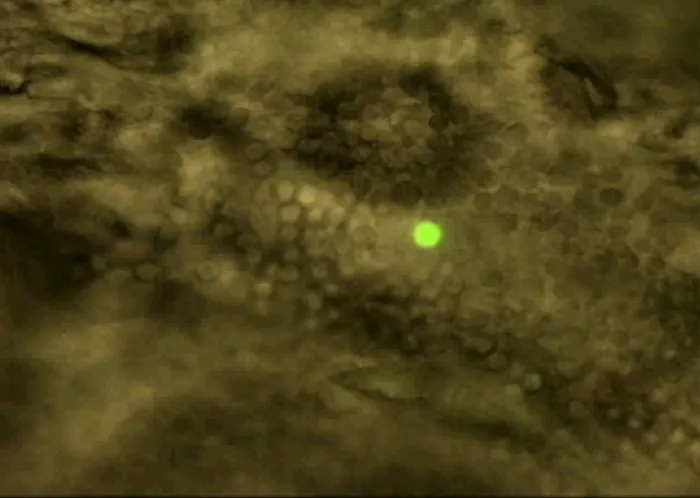
Undated handout image shows a single glowing hematopoietic stem cell in its natural environment at the edge of bone marrow in a section of mouse scapula. Stem cells, the master cells that make bone marrow transplants such useful therapy for cancer and other conditions, hide out at the edges of bone marrow, U.S. and Japanese scientists reported on January 30, 2006. FOR EDITORIAL USE ONLY REUTERS/University of Michigan Medical School/Douglas Engel, Ph.D,./Handout Undated handout image shows a single glowing hematopoietic stem cell in its natural environment at the edge of bone marrow in a section of mouse scapula. Stem cells, the master cells that make bone marrow transplants such useful therapy for cancer and other conditions, hide out at the edges of bone marrow, U.S. and Japanese scientists reported on January 30, 2006. FOR EDITORIAL USE ONLY REUTERS/University of Michigan Medical School/Douglas Engel, Ph.D,./Handout
London - A breakthrough in cell research may pave the way for treatments that stop cancer spreading through the body.
Scientists at British universities have worked out how cells are able to migrate from organ to organ – and how they could be blocked. It means aggressive cancers, which spread quickly, might in the future be isolated as soon as they are detected.
Most cancer deaths are not caused by initial tumours, but by secondary tumours that are created by cancerous cells invading other parts of the body.
Professor Roberto Mayor, of University College London, whose paper was published in the Journal of Cell Biology, said: “This is an important breakthrough in the understanding of how cells move, which we strongly believe provides an insight into the way cancer spreads. There is a long way to go from here to a cancer treatment, but it provides a theory as to how a tumour may be isolated and the cells stopped from spreading.”
His team, along with researchers at Kings College London, Cambridge University and Akika City University in Japan, found that a molecule called lysophosphatidic acid, or LPA, allowed cells to change state.
It weakened the links between each cell, transforming them into a liquid-like state and allowing them to move along the narrow passages in the body.
Vitally, the scientists discovered the chemical signal that prompts the change. By switching off the signal with a simple injection, they were able to solidify the cells, effectively blocking any further movement.
The research has so far been shown to work only in non-cancerous embryonic cells, but Professor Mayor is confident it could be replicated for the way cells spread from a tumour.
“The tumour will become solid and will not move,” he said. “It means you stop it spreading.” - Daily Mail