Poll concerns not addressed, says Kenyan opposition
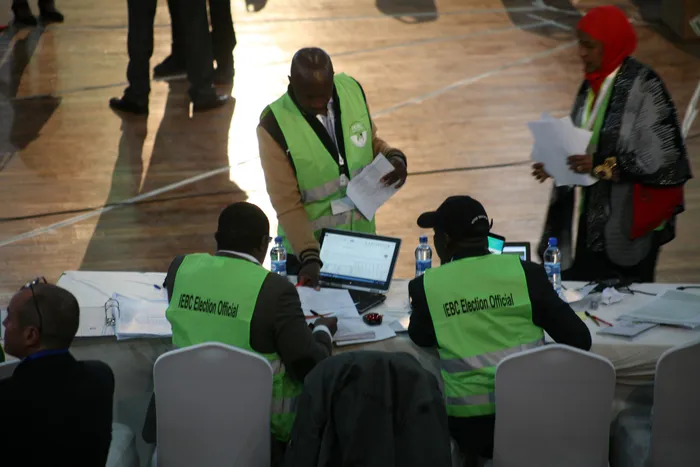
Officials of the Independent Electoral and Boundaries Commission (IEBC) work at the tallying center in Nairobi, Kenya, before the formal announcement of the winner. Picture: Xinhua/Charles Onyango Officials of the Independent Electoral and Boundaries Commission (IEBC) work at the tallying center in Nairobi, Kenya, before the formal announcement of the winner. Picture: Xinhua/Charles Onyango
Nairobi/Kisumu, Kenya - Kenya's opposition
said on Friday it would "not be a party" to the election
commission's imminent announcement of the result of the
presidential vote because its concerns had not been addressed.
Provisional results from polling stations show President
Uhuru Kenyatta with a lead of 1.4 million votes as he vies for a
second and final five-year term.
Opposition candidate Raila Odinga's camp has disputed the
count and said it would accept the election result only if
allowed to see raw data on the commission's computer servers.
Odinga has lost the last two elections, claiming fraud in
both cases.
Many Kenyans fear a repeat of the violence that followed the
2007 contested election, when about 1,200 people were killed and
hundreds of thousands displaced as political protests lead to
ethnic killings.
"We raised some very serious concerns, they have not
responded to them. As NASA (opposition coalition) we shall not
be party to the process they are about to make," senior
opposition official Musalia Mudavadi said.
James Orengo, chief election agent for the opposition
coalition, said: "This has been an entire charade," adding: "The
Kenyan people have never disappointed ... every time an election
has been stolen, the Kenyan people have stood up to make sure
changes are made to make Kenya a better place.
"Going to court, for us, is not an alternative. We have been
there before."
Earlier, Orengo had called for the candidates and observers
to be given access to the election commission's servers so there
could be a transparent audit of data from 41,000 polling
stations across the country.
Yakub Guliye, election commissioner in charge of information
technology, said the opposition had not made a formal request
and it would not act on a verbal request.
Normal procedure calls for the commission to release final
results after cross checking its electronic tally with paper
forms.
Odinga's camp has said figures released by the commission
since Tuesday's vote were "fictitious" and that "confidential
sources" within the commission had provided figures showing
Odinga had a large lead in the race.
The election commission rejected the claims, pointing out
they contained basic mathematical errors.
SECURITY
Police had beefed up security across much of Kenya -
particularly in opposition strongholds in the west and parts of
Nairobi - in anticipation of the announcing of the election
result on Friday.
At an international conference centre, ruling party
supporters sang "Today is our day, God is good" as the president
arrived to address them.
Kenya is the leading economy in East Africa and any
instability would be likely to ripple through the region.
Odinga is a member of the Luo, an ethnic group from the west
of the country that has long said it is excluded from power.
Kenyatta is from the Kikuyu group, which has supplied three of
four presidents since Kenya gained independence from Britain in
1963.
International observers have given the thumbs-up to the vote
and U.S. Ambassador Robert Godec issued a statement on behalf of
the diplomatic community calling for any complaints to be
channelled through the courts, not street protests.
"If there are disputes or disagreements, the Kenyan
constitution is very clear on how they are to be addressed.
Violence must never be an option," he said on Friday.
But the opposition criticised foreign observers.
"The observers largely served the interests of the
government," Orengo said.
As well as a new president, Kenyans also elected new
lawmakers and local representatives. Some of those races have
also been disputed, leading to violence in Garissa and Tana
River counties.