

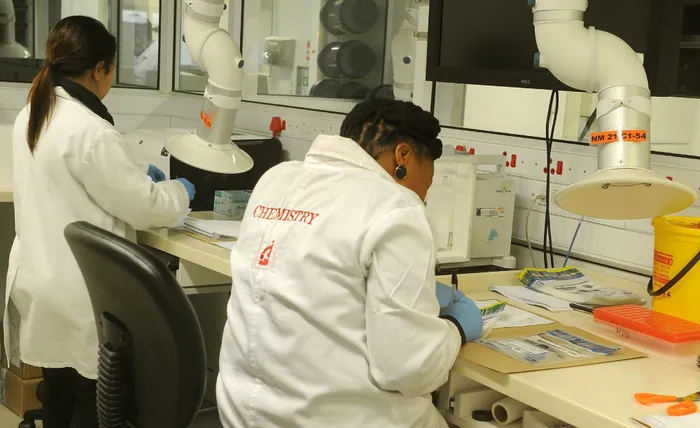
Cape Town-160610 - Reporter-Lance Witten toured the Forensic Science Laboratory in Platterkloof which deals with a variety of forensic disciplines, and evidence for crime and court cases. In pic is the Prep/ Extraction Lab-Photographer-Tracey Adams
Johannesburg - The Public Service Commission (PSC) said a well-functioning Criminal Justice System (CJS) is vital to ensuring that citizens are and feel safe.
A total backlog in forensic cases is standing at 300 722 in 2020/21. The data for 2021/22 that shows a backlog of 308 186 reflects a (2.4%) increase in backlogs from the previous financial year.
The commission said the functioning of the CJS is dependent on the effective service delivery of all role-players to ensure that there is an overall decrease in crime and renewed trust by citizens in the CJS.
The Forensic Science Laboratories (FSLs) of the South African Police Service (SAPS) are a key player within the CJS, with the mandate to support the investigation of crime through the processing of crime scenes, the analysis of forensic evidence, and the maintenance of criminal records.
The commission, which released its recent report, said the key function of the FSLs is to process and analyse case exhibits and draft forensic reports, which form the basis of the court testimony during criminal proceedings.
“It is imperative that the FSLs are well-resourced with state-of-the-art instruments, appropriately designed, and adequately staffed, especially given the high rate of violent crime in the country. However, the principal challenge facing all FSLs is the reduction and/or eradication of backlogs,” said the commission.
It further said: “With backlogs, the laboratories cannot fulfil their critical role effectively and are therefore contributing to delays in the CJS, and as a result, justice is not served, especially to the most vulnerable.”
Recent data obtained from the SAPS FSLs has indicated that the case backlogs have been significantly reduced; however, this data only pertained to the Section: Biology (DNA), with a finalisation rate in the first quarter of the 2023/2024 financial year of 90.68%.
“The PSC is currently monitoring the management of the overall backlog within the FSLs across all the sections with full cooperation from SAPS,” said the report.
The commission said challenges in the processing and analysis of case exhibits lead to delays in the dispensation of justice and result in various negative impacts, such as delays in cases going to trial (remand cases), possible repeat offences by perpetrators, and/or innocent people being unduly detained for lengthy periods.
“With the current scourge of Gender-Based Violence (GBV)-related crimes in the country, especially since COVID-19, delays in the processing and analysis of case exhibits allowing possible repeat offences leading to a failure in the fight against these crimes cannot be tolerated.
“Bottlenecks in the CJS as a result of backlogs also adversely affect the families of victims of crime awaiting the identification of the remains of their loved ones. Over the past few years, the backlog numbers have been increasing,” said the report.
The PSC plans to conduct follow-up inspections at the Forensic Science Laboratories to monitor the progress made with the implementation of the recommendations.
“Given the extent of the forensic science backlogs during 2021/22, the impact of these backlogs on the CJS and society at large, and the prominence in media reports of this soaring number of backlogs during 2021, the PSC decided to conduct inspections at all the FSLs across the country,” said the commission.
Aligned with the PSC Protocol on Inspections, the objectives of these inspections were to assess the effectiveness and efficiency of forensic laboratories, observe the state of facilities and the conditions at the laboratories to facilitate service delivery, determine the reasons for the backlog of cases at the FSLs, and establish the measures put in place to eradicate such backlogs.
The commission said all the SAPS FSLs were included in the PSC inspections, namely, those based in the Eastern Cape (Gqeberha), KwaZulu-Natal (Amanzimtoti), Gauteng (Arcadia and Silverton), and the Western Cape (Plattekloof).
The Star