

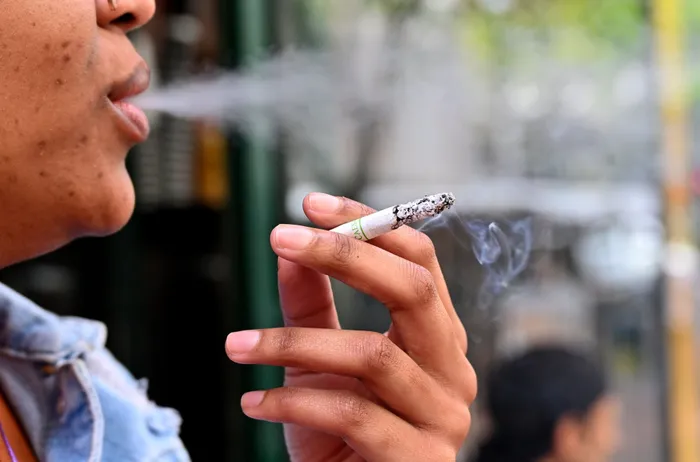
South Africa Cape Town 05- October- 2022 - Lady smoking in Adderley street Cape Town. The Tobacco Products and Electronic Delivery Systems Control Bill seeks to change where people can smoke and how cigarettes are packaged. Photographer Ayanda Ndamane African News Agency (ANA)
Johannesburg - The chairperson of the National Informal Traders Alliance of South Africa (Nitasa), Rosheda Muller, said she was worried that the Portfolio Committee on Health would simply follow the directives of its political leaders and ignore the many constructive comments, inputs, and suggestions it had received.
This is despite the issues raised by informal traders and other affected parties about the Tobacco Bill.
Nitasa is a coalition of informal microbusinesses that represents thousands of the estimated 2.2 million hard-working tabletop traders, hawkers, spaza shop owners, and home-based operators in the country.
“It’s for this reason that we continue to raise our concerns in the media, to whom we are very grateful for providing a platform for Nitasa and many other affected parties.
“South Africans have a right to know what the bill will actually mean in practice and the negative impact many of its provisions will have on the informal trade in particular,” said Muller.
She said Nitasa had legitimate issues with the bill as cigarettes were one of the most highly traded products in the informal sector of the retail market.
“We are opposed to the bill’s ban on the sale of single cigarettes and on the display of all tobacco-related products, including cigarettes, and we are shocked by the inappropriately extreme prison sentences in the bill,” said Muller.
The coalition said cigarettes formed a large percentage of many traders’ incomes and played a vital role in attracting customers, who stop for cigarettes and then purchase a range of other products.
“The majority of these cigarettes are sold as single cigarettes, known as ‘draws’ or ‘sticks’, and are not sold in a pack. This is because customers cannot afford to buy a full box of 20 cigarettes, nor do they want to; many simply want one or two cigarettes for the day,” Nitasa said.
“You don’t need to be a lawyer to understand that this obviously means that single cigarettes are banned because you have to open a cigarette packet to access a single cigarette for sale,” added Muller.
According to Muller, the bill puts every hawker or trader on the wrong side of the law. This is alarming because informal traders, most of whom are women, are already some of the most marginalised in our society.
“For many, their little table on the pavement is all that they have to live off, as these women struggle daily to feed their families. Does our government not have more important things to do than criminalise millions of honest, hard-working informal traders?” she said.
Muller said that there was nothing wrong with the current tobacco control laws; they just needed to be enforced. The informal trade was the lifeblood of the economy, and the government should be doing everything it could to support it, not cut off access to one of its most important sources of income.
The Star