
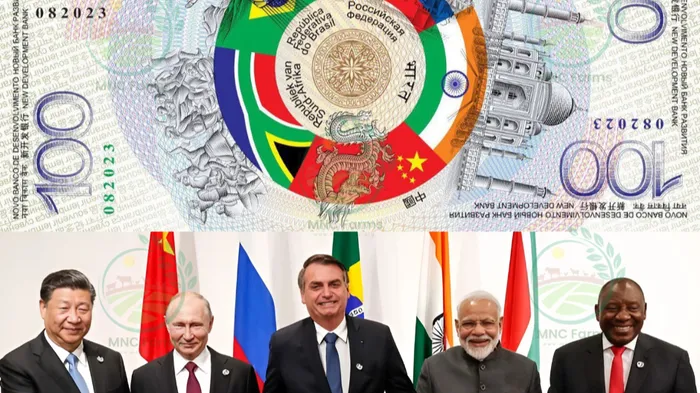
According to economists and political analysts, one of the main reasons for Trump's economic rhetoric has to do with US fears that BRICS countries are embarking on a strategic plan to dethrone the dollar, or de-dollarise the world, as some observers put it.
Image: LinkedIN
Some people may wonder why the US President has been acting out in recent months, threatening to impose tariffs at times in a seemingly excessive manner.
Economists and political analysts suggest that one of the main reasons for Trump's economic rhetoric is the United States' concern that BRICS countries are initiating a strategic plan to undermine the dollar, a process some observers refer to as "de-dollarisation''.
The BRICS grouping comprises Brazil, Russia, India, China, and South Africa, as well as a few other countries that have joined in the past couple of years.
It all started in Kazan, Russia, during the 16th BRICS summit last year when these countries unveiled a symbolic BRICS banknote, unleashing hot debate regarding the US dollar's dominance. At the time, Russian President Vladimir Putin emphasised that the dollar is being used as a ''weapon.''
A year before, meanwhile, Brazilian President Luiz Inácio Lula da Silva proposed creating a new, common currency in South America to reduce its reliance on the dollar in international trade. India has also been advocating for local currency settlements among BRICS nations.
The unveiling of the BRICS currency bill, featuring the Taj Mahal, added controversy, as the bloc explores challenging the US dollar's global financial power.
Despite research showing that the US dollar remains the primary reserve currency, Trump would take none of that as he continued his criticism of BRICS.
"We are going to require a commitment from these seemingly hostile countries that they will neither create a new BRICS currency, nor back any other currency to replace the mighty US dollar or, they will face 100% Tariffs,'' he wrote in his Social Truth platform in January.
The statement was similar to the one he posted last November.
According to Bloomberg, Brazil and South Africa have criticised Trump separately for his anti-BRICS comments, while India has refrained from responding publicly, signalling that it is walking a fine line in maintaining its relationship with Washington.
Would a BRICS currency threaten the dollar?
Political analyst Anda Mbikwana offers his insights on the issue.
'The unveiling of a symbolic BRICS banknote at the St. Petersburg International Economic Forum represents far more than ceremonial posturing — it signals a deliberate escalation in the bloc's strategy to construct alternative financial architectures that could fundamentally reshape global monetary dynamics.
''While critics may dismiss this $200 denomination note as mere symbolism, the careful design choices reveal sophisticated strategic thinking. The front's display of founding member flags alongside the reverse featuring partner nations creates a visual narrative of expanding multipolarity that directly challenges the hierarchical nature of the dollar-dominated system.
''This imagery reinforces BRICS' positioning as what President Putin has characterised as 'non-western' rather than 'anti-western' — a crucial distinction that broadens its appeal across the Global South.''
''The symbolic banknote masks more substantive developments in BRICS' financial infrastructure. Russia's emphasis on blockchain-based payment systems and central bank digital currencies represents a technologically sophisticated approach to circumventing traditional dollar-denominated channels.
''These systems offer practical alternatives to SWIFT and correspondent banking relationships that have become increasingly weaponised through sanctions regimes.''
And how does this directly affect South Africa, one might ask.
Said Mbikwana: ''For South Africa, this development presents both opportunities and challenges. Greater financial integration within BRICS could reduce transaction costs and currency exposure risks in trade with major partners.
''However, it also requires careful navigation of relationships with Western economies that remain crucial for South African exports and investment. The Reserve Bank's approach to central bank digital currency development will become increasingly strategic as these alternative payment systems mature.''
According to Mbikwana, despite BRICS' banknote symbolic significance, fundamental economic realities limit BRICS' ability to displace dollar dominance quickly.
''The United States retains unparalleled capital market depth, institutional credibility, and network effects that have historically proven resilient to challengers. Moreover, internal coordination challenges within BRICS — particularly between China and India — limit the bloc's ability to present a unified monetary alternative.''
The BRICS symbolic banknote, as Mbikwana noted, should be understood not as an immediate threat to dollar hegemony but as a manifestation of longer-term structural shifts in global economic governance. ''Its significance lies not in its current form, but in its representation of institutional momentum toward financial multipolarity.
''American opposition to these developments may paradoxically accelerate their adoption by reinforcing perceptions of dollar weaponisation among emerging economies.
''The ultimate question is not whether BRICS can immediately supplant the dollar, but whether it can create sufficient institutional alternatives to reduce the international community's dependence on dollar-denominated systems. In this context, symbolic gestures serve as important markers of political will and institutional capacity — prerequisites for any serious challenge to existing monetary hierarchies.''
The purpose of the banknote will serve as a payment system designed to facilitate transactions within the BRICS bloc using local currencies and potentially central bank digital currencies.
While a BRICS currency could potentially challenge the US dollar's dominance, it's unlikely to replace it entirely in the near future.
There is ongoing development and testing, with a pilot programme potentially appearing before the end of 2026.
Some economists are criticising Trump for threatening the BRICS, according to a CBS News report, saying it makes the US look weak.
"It isn't a good look, as it indirectly elevates the stature of a non-threat and suggests a lack of confidence in the dollar," Brad Setser, a senior fellow at the Council on Foreign Relations and former Treasury Department economist, wrote on X.