
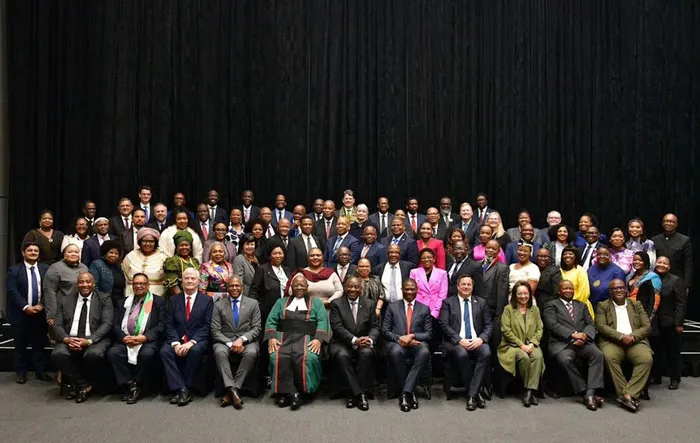
A new study has revealed a dramatic return to pre-election pessimism about the country's direction and the GNU.
Image: Supplied
A new Ipsos study, "What Worries the World," has revealed a dramatic return to pre-election pessimism about the country's direction, marking a sharp decline from the initial surge of optimism that followed the Government of National Unity's (GNU) formation in mid-2024.
With a staggering 80% of South Africans believing the nation is on the "wrong track," opposition parties have seized upon the "chilling revelations" to voice their outrage and condemn the GNU, highlighting its perceived failures and the ongoing infighting between its main partners, the ANC and the DA.
The data, which tracks online South African sentiment over 20 months, shows how public mood, initially lifted by the prospect of a united government, has now plummeted to levels mirroring the uncertainty before the May 2024 national elections.
Service Line Manager at Ipsos South Africa, Robyn Williams said the ‘What Worries the World’ study offered an exceptional snapshot of world opinion on pressing global issues.
"The findings of this measurement show that it reacts to the reality on the ground in the country and tells the story of South Africa's political journey over the past two years.
“We can clearly see how major political events, from election uncertainty to GNU formation and subsequent challenges, directly impact public confidence about the country's trajectory,” he said.
The tracking data shows a clear pattern, initial GNU optimism in July-September 2024, when 36% to 40% were positive about the country's direction, gradually declined through various political challenges, including budget disagreements between GNU partners that culminated in the narrow parliamentary budget acceptance vote in April 2025.
The formation of the GNU itself was a direct consequence of the May 2024 elections, where the ANC lost its outright majority for the first time in South Africa's democratic history.
This compelled President Cyril Ramaphosa to form an inclusive government with ten opposition parties, most notably the DA, alongside the Inkatha Freedom Party (IFP) and the Patriotic Alliance (PA).
This unprecedented political arrangement was hailed by some as a new era of cooperation, but deeply distrusted by others.
Opposition parties, particularly those not part of the GNU, have wasted no time in capitalising on the Ipsos findings.
The uMkhonto weSizwe Party (MKP), led by former president Jacob Zuma, has been an outspoken critic of the GNU, condemning it as a "white-led unholy alliance".
The MKP has consistently refused to join the GNU, arguing it is not a genuine Government of National Unity but rather a "coalition representing colonialism, racism, and apartheid," designed to maintain the status quo.
The party has also pursued legal action, challenging the SABC's use of the term "Government of National Unity," accusing the public broadcaster of misleading the public.
African Transformation Movement (ATM) spokesperson, Zama Ntshona, said they interpreted the study as a valuable indicator of current societal sentiments.
"At ATM, we believe it accurately reflects the lived experiences of our citizens, which, unfortunately, do not suggest an upward trajectory. Instead, they point towards a concerning trend of declining quality of life,” Ntshona stated. He emphasised the urgent need for targeted policies and strategic initiatives to address these challenges and foster sustainable improvements in the well-being of the community.
Ntshona outlined ATM's approach to holding the GNU accountable, focusing on empowering and mobilising the populace.
Adding to the GNU's woes is the highly publicised infighting between its two main parties, the ANC and the DA.
The parties have been at loggerheads over contentious issues such as the National Health Insurance (NHI) Bill, the Basic Education Laws Amendment (BELA) Act, and the signed Expropriation Act. Most recently, the DA reportedly threatened Ramaphosa with a motion of no confidence if he did not dismiss cabinet ministers implicated in wrongdoing, further exposing the cracks in the fragile alliance.
Political analyst Professor Ntsikelelo Breakfast said South Africans were tired and wanted to see change for the better however, he was wary that studies like those of Ipsos were sometimes biased.
“What these results mean is that people want material things to change for the better…This arrangement has not done a total overhaul on everyday life for the people…the inequality has not changed, poverty is still there, unemployment has skyrocketed etc.
“People want to see the synergy between administration and material conditions,” he said
However Breakfast added that studies such as this one needed to avail the whole process as to how the research started and who was interviewed, instead of revealing only the results.
“These studies are sometimes not objective,” he said.